
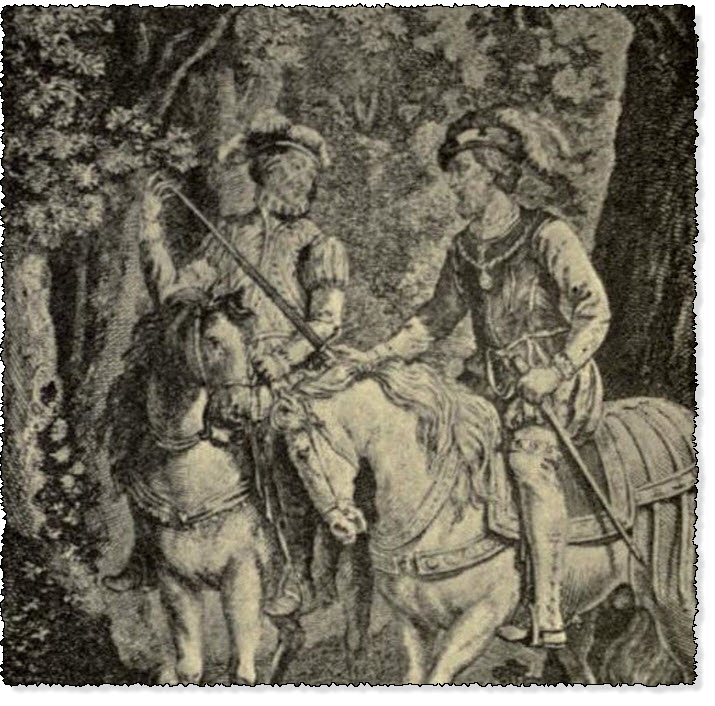
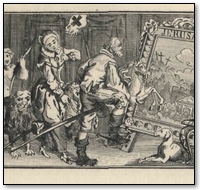
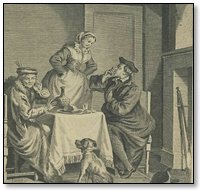
the King Showing his Sword
Day 2 of the Heptameron - Tale 17
Summary of the Seventh Tale Told on the Second Day of the Heptameron
Tale 17 of the Heptameron
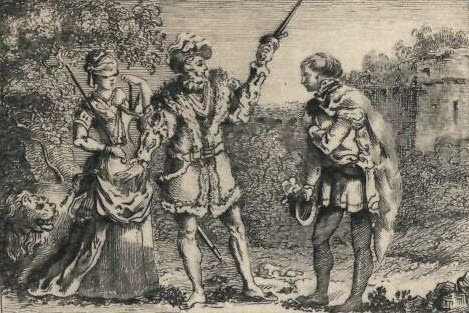
To the town of Dijon, in the Duchy of Burgundy, there came a German Count to take service with King Francis. He was named William, (2) and was of the House of Saxony, which is so closely allied with that of Savoy that formerly they were but one. This Count, who was held for as handsome and valiant a gentleman as Germany ever knew, was right well received by the King, who not only took him into his service, but kept him close to himself as a groom of the chamber.
Now the Lord de la Trémoille, (3) Governor of Burgundy, an old knight and a loyal servant to the King, was ever jealous and anxious for his master's safety, and was wont to have spies at all points to learn what the King's enemies were doing; and so prudently did he contrive matters, that but few things were hidden from him. Among his informations there came to him one day a letter from a friend telling him that Count William had received a sum of money, with promise of more, for putting the King to death in any such manner as he might find possible. (4)
The Lord de la Trémoille failed not to give speedy notice of the affair to the King, and further made it known to the King's mother, Louise of Savoy, who, forgetting that she and this German were akin, begged the King to banish him forthwith. But the King bade her speak no more of it, saying that it was impossible so upright and honourable a gentleman would undertake so vile a deed.
Some time afterwards a second warning arrived in confirmation of the first, and the Governor, burning with love for his master, sought permission either to banish the Count or else take him in hand in some other fashion; but the King charged him expressly to keep the affair secret, being persuaded that he might discover the truth by some other means.
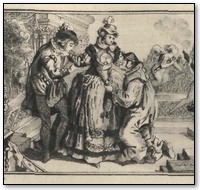
One day when going a-hunting, the King, as his sole weapon, buckled on the finest sword it were possible to see, and took Count William along with him, desiring that he would follow him close. After hunting the stag for some time, seeing that all his people save the Count were far off, he turned out of all the roads and tracks, till he found himself alone with the Count in the deepest part of the forest, (5) when, drawing his sword, he said:—
"Think you that this sword be handsome and trusty?"
Heptameron Story 17
The Count took it by the point, and answered that he had never seen one that he liked better.
"You are right," said the King; "and I think that, if a gentleman had resolved to slay me, he would think twice before he attacked me if he knew the strength of my arm, the stoutness-of my heart, and the excellence of this sword. Yet, for all that, I should count him but a craven scoundrel if, when we were face to face and alone, he durst not execute what he had dared to undertake."
"Sire," replied Count William, with astonished countenance, "the wickedness of the undertaking would be very great, but the folly of seeking to execute it would be no less."
The King laughed, sheathed his sword again, and hearing the hunt hard by, spurred after it with all speed. When he reached his train he spoke to none of what had passed, but he felt convinced that, although Count William was as brave and ready a gentleman as might be, he was not the man to carry out so high an enterprise.
However, Count William, fearing that he had been discovered or was at least suspected, repaired the next morning to Robertet, Secretary for the King's Finances, (6) and told him that he had considered the privileges and pay offered him to continue in the King's service, and that they would not suffice to support him for half the year. Unless therefore it pleased the King to give him double, he would be forced to depart; and he accordingly begged the said Robertet to acquaint him as soon as might be with the will of the King. To this the Secretary replied that he could not better advance the business than by going to the King straightway; and he undertook the mission right willingly, for he had seen the warnings that the Governor had received.
As soon, therefore, as the King was awake he failed not to lay the matter before him in the presence of the Lord de la Trémoille and the Admiral de Bonnivet, who were ignorant of the trick that the King had played the Count the day before.
Then the King laughed, and said to them—"You desired to banish Count William, and you see he is banishing himself. Wherefore, tell him that if he be not content with the establishment which he accepted on entering my service, and which many men of good families have deemed themselves fortunate to have, he must e'en seek a better fortune elsewhere. For my part, I will in no wise hinder him, but shall be well pleased if he can find some condition wherein to live according to his deserts."
Robertet was as prompt to bear this answer to the Count as he had been to prefer his request to the King. The Count replied that with the King's permission he was resolved to depart, and, like one whom fear urges to flight, he did not tarry even four and twenty hours; but, just as the King was sitting down to table, came to take leave of him, feigning much sorrow that his need should force him from the Royal presence.
He also went to take leave of the King's mother, who parted from him no less joyfully than she had formerly received him as a kinsman and friend. And thus he returned to his own country; and the King, seeing his mother and courtiers in amazement at his sudden departure, told them of the fright he had given him, saying that, even if the Count were innocent of that which was laid against him, his fear had been sufficiently great to constrain him to leave a master whose temper he had not yet come to know.
"For my part, ladies, I can see no reason why the King should have been moved to risk himself thus against so famous a captain, except that, forsaking the company and places where Kings find no inferiors ready to give them battle, he desired to place himself on an equal footing with one whom he suspected to be his enemy; and this that he might have the satisfaction of testing the stoutness and valour of his own heart."
"Without a doubt," said Parlamente, "he was in the right; for all the praise of man cannot so well satisfy a noble heart as its own particular knowledge and experience of the virtues that God has placed in it."
"The ancients," said Geburon, "long ago showed us that to reach the Temple of Fame it was necessary to pass through the Temple of Virtue, and I, who am acquainted with the two persons in your tale, know right well that the King is indeed one of the most valiant men in his kingdom."
"By my word," said Hircan, "at the time when Count William came to France, I should have feared his [the King's] sword more than those of the four most accomplished Italian gentlemen at Court."

"We well know," said Ennasuite, "that he is too famous for our praises to equal his merit, and that the day would be spent before we each could say all the good we think of him. And so, madam, I pray you, give your vote to one who will tell us some further good of men, if such there be."
"It seems to me that, as you are so wont to speak ill of women, you will find it easy to tell us some good story in praise of a man. I therefore give you my vote."
"That can I easily do," said Hircan, "for but a little while since I was told a story in praise of a gentleman whose love, constancy and patience are so meritorious that I must not suffer them to be forgotten."
Footnotes:
- The incidents of this story are historical. Francis I. is known to have sojourned at Dijon in June and July 1521.—L.
- This is William, eldest son of Wolfgang von Furstemberg, chamberlain to Maximilian I., and privy counsellor to Philip of Austria.—B. J. Various particulars concerning him are given in the Appendix to this volume, E.
- This is Louis II., Sire de la Trémoille, Viscount of Thouars and Prince of Talmont, born in 1460. The son of Louis I. de la Trémoille and of Margaret d'Amboise, he became one of the most remarkable men of his time. Favoured by Anne de Beaujeu, who arranged his marriage with Gabrielle de Bourbon, he commanded the royal troops at the battle of St. Aubin du Cormier, in Brittany (1488), at which the rebellious Duke of Orleans (afterwards Louis XII.) and the Prince of Orange, with a large number of the nobles, their partisans, were made prisoners. They were all invited to La Trémoille's table after the engagement, and, according to Godefroi's Latin history of Louis XII., at the close of the repast two Franciscan monks entered the hall, whereupon La Trémoille rose and said: "Princes, I refer your judgments to the King, but as for you, Knights, who have broken your faith and falsified your knightly oath, you shall pay for your crime with your heads. If you have any remorse on your consciences, here are monks who will shrive you." The hall resounded with lamentations, but the unhappy nobles were promptly dragged into the courtyard, and there put to death; both Orleans and Orange being too terror-stricken to intercede for them. When the former came to the throne, he forgave La Trémoille for his conduct in this affair, and showed him great favour, appointing him Governor of Burgundy in 1501. La Trémoille also became Admiral of Guienne and Brittany, and figured conspicuously in the various Italian campaigns of the period. He was killed at Pavia in 1525. Jean Bouchet, a contemporary, wrote a curious life of this remarkable man, entitled Panegyric du Chevalier sans reproche. It will be found in Michaud and Poujoulat's Collection de Mitnoires,—L. and Ed.
- It has been suggested that the instigator of this plot was Charles V.'s famous minister, Cardinal Granvelle.—Ed.
- This may be either the forest of Argilly or that of Mondragon, both in the vicinity of Dijon.—ED.
- This is Florimond Robertet, the first of that family of statesmen who served the French crown from Charles VIII. to Henri III. It was Charles VIII. who appointed Florimond Treasurer of France and Secretary of Finances, offices in which he displayed great skill and honesty. Louis XII., who confirmed him in his functions, habitually consulted him on important political affairs. He acquired considerable wealth, and was often called "the great baron," after the barony of Alluye, which he possessed in Le Perche. One of the curiosities of Blois is the Hôtel d'Alluye, a house of semi-Moorish style, erected by Robertet at the close of the fifteenth century. Another of his residences was the château of Bury, near Blois, where he set up Michael Angelo's famous bronze statue of David, presented to him by the city of Florence, and the fate of which has furnished material for so much speculation. Under Francis I. Robertet enjoyed the same credit as during the two previous reigns. Fleuranges declares that no one else was so intimate with the King, and commends him as being the most experienced and competent statesman of the times. According to the Journal d'un Bourgeois de Paris, Robertet died "at the Palais (de Justice) in Paris, of which he was concierge," on November 29, 1527. Francis repeatedly visited him during his illness, and, on his death, ordered that his remains should lie in state, and be interred with great pomp and ceremony. Clement Marot's works contain a poem, four hundred lines in length, celebrating Robertet's virtues and talents.—L., B. J., and Ed.
Online Edition of the Heptameron
This is the Heptameron of Marguerite de Navarre
Other Sites: CruikshankArt.com · Dante's Inferno · Book-Lover.com · Canterbury Tales ·
This site is created by the Heptameron Information Society.