
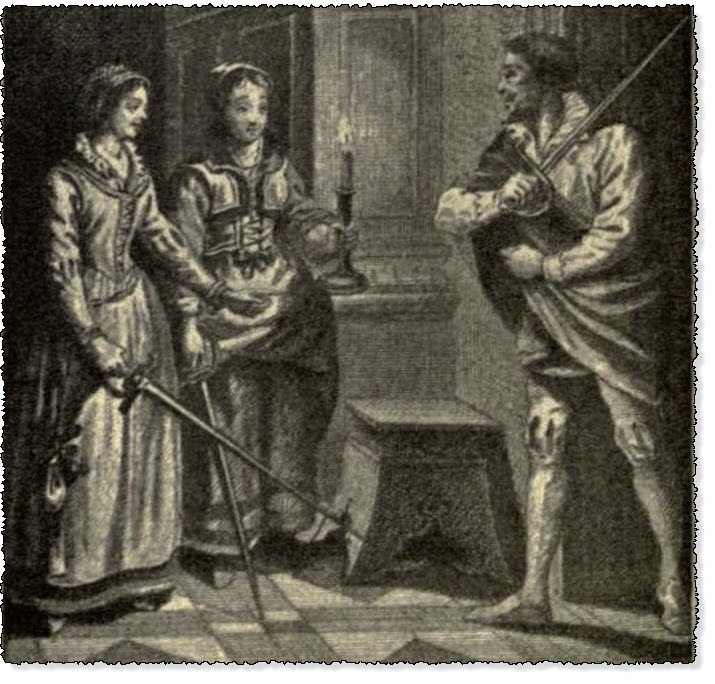
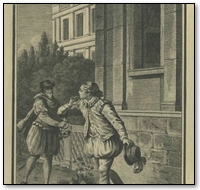
the Gentleman Discovering The Trick
Day 2 of the Heptameron - Tale 16
Summary of the Sixth Tale Told on the Second Day of the Heptameron
Tale 16 of the Heptameron
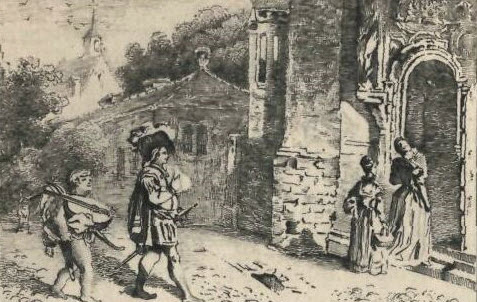
In the days of the Grand Master of Chaumont, (2) there lived a lady who was reckoned one of the most honourable women that there were at that time in the city of Milan. She had married an Italian Count, and being left a widow, lived in the house of her brothers-in-law, refusing to hear speak of another marriage. And so discreetly and piously did she demean herself that there was none in the Duchy, whether French or Italian, but held her in high esteem.
One day when her brothers and sisters-in-law offered an entertainment to the Grand Master of Chaumont, this widow lady was obliged to be present, though she made it her rule not to attend such gatherings when held in other places. And when the Frenchmen saw her, they were all admiration for her beauty and grace, especially one among them whose name I shall not mention; for it will suffice for you to know that there was no Frenchman in Italy more worthy of love than he, for he was endowed with all the beauties and graces that a gentleman could have. And though he saw that the lady wore black crape, and remained with several old women in a corner apart from the young ones, yet, having never known what it was to fear either man or woman, he set himself to converse with her, taking off his mask, and leaving the dance in order to remain in her company.
Throughout the whole of the evening he did not cease talking to her and to the old women, and found more pleasure in doing so than if he had been with the most youthful and bravely attired ladies of the Court. So much, indeed, was this the case, that when the hour came to withdraw he seemed to have not yet had time even to sit down. And although he only spoke to the lady on such common matters as were suited to such company, she knew very well that he desired to win her favour, and this she resolved to guard against by all means in her power, so that he was never afterwards able to see her at any banquet or assembly.
He inquired about the manner of her life, and found that she often went to churches and convents; whereupon he kept such good watch that she could never visit them so secretly but he was there before her. And he would remain in the church as long as he had the happiness to see her, and all the time that she was present would gaze at her so affectionately that she could not remain in ignorance of the love he bore her. In order to avoid him, she resolved to feign illness for a time, and to hear mass in her own house; and at this the gentleman was most sorely grieved, for he had no other means of seeing her than at church.
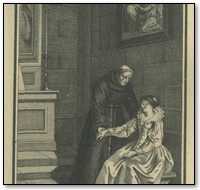
Thinking that she had cured him of his habit, she at last returned to the churches as before, but love quickly brought tidings of this to the French gentleman, who then renewed his habits of devotion. He feared, however, that she might again throw some hindrance in his way, and that he might not have time to tell her what he would; and so one morning, when she thought herself well concealed in a chapel, he placed himself at the end of the altar at which she was hearing mass; and seeing that she was but scantily attended, he turned towards her just as the priest was elevating the host, and in a soft and loving voice said to her—
"May I be sent to perdition, madam, by Him whom the priest has now in his hands, if you are not causing my death. Though you take from me all means of speaking with you, you cannot be ignorant of my desire; my wearied eyes and my deathly face must make the truth apparent to you." (3)
The lady pretended not to understand him, and replied—
"God's name should not thus be taken in vain; but the poets say that the gods laugh at the oaths and lies of lovers, and so women who regard their honour should not show themselves credulous or compassionate."
With these words she rose up and returned home.

Heptameron Story 16
The gentleman's anger at these words may well be imagined by such as have experienced the like fortune. But having no lack of spirit, he held it better to have received this unfavourable reply than to have failed in declaring his love, to which he held fast during three years, losing neither time nor opportunity in wooing her by letters and in other ways.
For three years, however, she vouchsafed him no reply, but shunned him as the wolf shuns the hound that is to take him; and this she did through fear for her honour and fair fame, and not because she hated him. He perceived this so clearly that he pursued her more eagerly than ever; and at last, after many refusals, troubles, tortures and despairs, the lady took pity upon him for the greatness and steadfastness of his love, and so granted him what he had so greatly desired and so long awaited.
When they had agreed concerning the means to be employed, the French gentleman failed not to repair to her house, although in doing so he placed his life in great danger, seeing that she and her relations lived all together.
However, being as skilful as he was handsome, he contrived the matter so prudently that he was able to enter the lady's room at the hour which she had appointed, and found her there all alone, lying in a beautiful bed; but as he was hasting to put off his clothes in order to join her, he heard a great whispering at the door, and a noise of swords scraping against the wall.
Then the widow said to him, with the face of one nigh to death—
"Now is your life and my honour in as great danger as well can be, for I hear my brothers outside seeking you to slay you. I pray you, therefore, hide yourself under this bed, and when they fail to find you I shall have reason to be angry with them for alarming me without just cause."
The gentleman, who had never yet known fear, replied—
"And what, pray, are your brothers that they should frighten a man of mettle? If the whole breed of them were there together, I am sure they would not tarry for the fourth thrust of my sword. Do you, therefore, rest quietly in bed, and leave the guarding of this door to me."
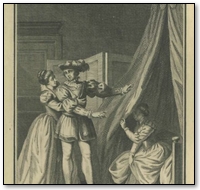
Then he wrapped his cloak about his arm, took his drawn sword in his hand, and opened the door so that he might have a closer view of the swords that he had heard. When the door was opened, he saw two serving-women, who, holding a sword in each hand, had raised this alarm.
"Sir," they said to him, "forgive us. We were commanded by our mistress to act in this manner, but you shall be hindered by us no more."
Seeing that they were women, the gentleman could do no more than bid them go to the devil, and shut the door in their faces. Then he got into bed to the lady with all imaginable speed, his passion for her being in no wise diminished by fear; and forgetting to inquire the reason of this skirmish, he thought only of satisfying his desire.
But when daybreak was drawing nigh, he begged his mistress to tell him why she had treated him so ill, both in making him wait so long, and in having played this last trick upon him.
"My intention," she answered, laughing, "had been never to love again, and I had observed it from the time I became a widow; but, after you had spoken to me at the entertainment, your worth led me to change my resolve, and to love you as much as you loved me. It is true that honour, which had ever guided me, would not suffer me to be led by love to do aught to the disparagement of my reputation. But as the poor hind when wounded unto death thinks by change of place to change the pain it carries with it, so did I go from church to church thinking to flee from him whom I carried in my heart, and the proof of whose perfect devotion has reconciled honour and love. However, that I might be the more certain that I was giving my heart and love to a true man, I desired to make this last proof by means of my serving-women. And I vow to you that had I found you so timorous as to hide beneath my bed, either for fear of your life or for any other reason, I was resolved to rise and go into another room and never see you more. But since I have found that you are possessed of more beauty, and grace, and virtue, and valour than rumour had given you, and that fear has no power over your heart, nor can cool one whit the love you bear me, I am resolved to cleave to you for the remainder of my days. I feel sure that I could not place life and honour in better hands than those of one whom I deem unmatched in every virtue."
And, just as though the human will could be unchangeable, they vowed and promised what was not in their power, namely, perpetual affection. For this is a thing that can neither spring up nor abide in the heart of man, as only those ladies know who have had experience of how long such feelings last. (4)
"So, ladies, if you are wise, you will beware of us even as the stag, had he understanding, would beware of the hunter; for our glory, happiness, and delight is to see you captured in order to rob you of that which is more precious to you than life."
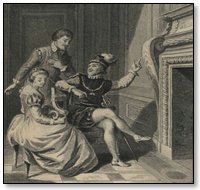
"Why, Geburon," said Hircan, "since when have you turned preacher? I can remember a time when you did not talk after that fashion."
"It is quite true," said Geburon, "that I have just spoken contrary to what I have always said my life long; but since my teeth are no longer able to chew venison, I warn the hapless deer to beware of the hunters, in order that I may atone in my old age for all the mischief which I sought to do in my youth."
"We thank you, Geburon," said Nomerfide, "for warning us to our profit, but for all that we do not feel very greatly beholden to you. You never spoke in that way to one you truly loved, and this is a proof that you have little love for us, and, moreover, would not have us loved. Nevertheless, we hold ourselves as discreet and as virtuous as the ladies whom you so long pursued in your youth. But old folk are commonly vain enough to think that they have been wiser in their time than those who come after them."
"Well, Nomerfide," said Geburon, "will you believe that I have told you the truth when the faithlessness of one of your lovers has made you acquainted with the evil nature of men?"
"It seems to me," said Oisille to Geburon, "that the gentleman whom you praise so highly for his boldness ought rather to be praised for the ardour of his love. So strong is this passion, that it impels the most cowardly to embark on enterprises about which the bravest would think twice."
"If, madam," said Saffredent, "he'had not deemed the Italians to be better at talking than acting, me-thinks he had reason to be afraid."
"Yes," said Oisille, "if he had not had in his heart the fire that consumes fear."
"Since you do not deem the boldness of this gentleman altogether worthy of praise," said Hircan, "you doubtless know of some one else more deserving of commendation."
"Nay," said Oisille, "the gentleman in the story deserves praise, but I do know of one who is more worthy of being admired."
"I pray you, madam," said Geburon, "if that be so, take my place and tell us the tale."
"If," began Oisille, "a man who showed such boldness against the Milanese to save his own life and his mistress's honour is to be esteemed so very brave, what shall be said of one who, without any need for it, and from pure and simple valour, performed the deed of which I will now tell you?"
Footnotes:
- According to M. de Lincy, who points out that Bonnivet must be the hero of the adventure here related, the incidents referred to would have occurred at Milan between 1501 and 1503; but in M. Lacroix's opinion they would be posterior to 1506.—Ed.
- See ante, note 1 to Tale XIV.
- The Queen of Navarre is known to have had a considerable knowledge of the Italian language, and it is therefore quite possible that she was acquainted with the story of Poliphilus and Polia, which, although no French translation of it appeared until 1554, had been issued at Venice as early as 1499. In any case, however, there is a curious similarity between the speech of the French gentleman given above and the discourse which Poliphilus addresses to Polia when he finds her saying her prayers in the temple. A considerable portion of the Italian story is in keeping with the character of the Heptameron tales.—M.
- In Boaistuau's edition of the Heptameron the final part of the above sentence is given as follows: "And those women that have had experience of it know this, and also how long such fancies last." An extract from Brantôme in connection with the story will be found in the Appendix to this volume, D.
Online Edition of the Heptameron
This is the Heptameron of Marguerite de Navarre
Other Sites: CruikshankArt.com · Dante's Inferno · Book-Lover.com · Canterbury Tales ·
This site is created by the Heptameron Information Society.