
The Heptameron - Day 1 - Tale 9
The Heptameron - Day 1 - Tale 9
Summary of the Ninth Tale Told on the First Day of the Heptameron
Tale 9 of the Heptameron
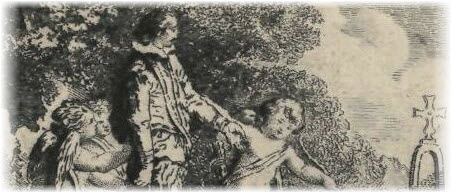
Between Dauphiné and Provence there lived a gentleman who was far richer in virtue, comeliness, and honour than in other possessions, and who was greatly in love with a certain damsel. I will not mention her name, out of consideration for her kinsfolk, who are of good and illustrious descent; but you may rest assured that my story is a true one. As he was not of such noble birth as herself, he durst not reveal his affection, for the love he bore her was so great and perfect that he would rather have died than have desired aught to her dishonour. Seeing that he was so greatly beneath her, he had no hope of marrying her; in his love, therefore, his only purpose was to love her with all his strength and as perfectly as he was able. This he did for so long a time that at last she had some knowledge of it; and, seeing that the love he bore her was so full of virtue and of good intent, she felt honoured by it, and showed him in turn so much favour that he, who sought nothing better than this, was well contented.
But malice, which is the enemy of all peace, could not suffer this honourable and happy life to last, and certain persons spoke to the maiden's mother of their amazement at this gentleman being thought so much of in her house. They said that they suspected him of coming there more on account of her daughter than of aught else, adding that he had often been seen in converse with her. The mother, who doubted the gentleman's honour as little as that of any of her own children, was much distressed on hearing that his presence was taken in bad part, and, dreading lest malicious tongues should cause a scandal, she entreated that he would not for some time frequent her house as he had been wont to do. He found this hard to bear, for he knew that his honourable conversation with her daughter did not deserve such estrangement. Nevertheless, in order to silence evil gossip, he withdrew until the rumours had ceased; then he returned as before, his absence having in no wise lessened his love.
One day, however, whilst he was in the house, he heard some talk of marrying the damsel to a gentleman who did not seem to him to be so very rich that he should be entitled to take his mistress from him. So he began to pluck up courage, and engaged his friends to speak for him, believing that, if the choice were left to the damsel, she would prefer him to his rival. Nevertheless, the mother and kinsfolk chose the other suitor, because he was much richer; whereupon the poor gentleman, knowing his sweetheart to be as little pleased as himself, gave way to such sorrow, that by degrees, and without any other distemper, he became greatly changed, seeming as though he had covered the comeliness of his face with the mask of that death, to which hour by hour he was joyously hastening.
Meanwhile, he could not refrain from going as often as was possible to converse with her whom he so greatly loved. But at last, when strength failed him, he was constrained to keep his bed; yet he would not have his sweetheart know of this, lest he should cast part of his grief on her. And giving himself up to despair and sadness, he was no longer able to eat, drink, sleep, or rest, so that it became impossible to recognise him by reason of his leanness and strangely altered features.
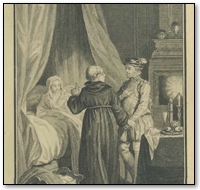
Some one brought the news of this to his sweetheart's mother, who was a lady full of charity, and who had, moreover, such a liking for the gentleman, that if all the kinsfolk had been of the same opinion as herself and her daughter, his merits would have been preferred to the possessions of the other. But the kinsfolk on the father's side would not hear of it. However, the lady went with her daughter to see the unhappy gentleman, and found him more dead than alive. Perceiving that the end of his life was at hand, he had that morning confessed and received the Holy Sacrament, thinking to die without seeing anybody more. But although he was at death's door, when he saw her who for him was the resurrection and the life come in, he felt so strengthened that he started up in bed.
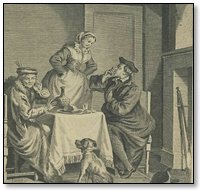
Story 9 of the Heptameron
"What motive," said he to the lady, "has inclined you to come and see one who already has a foot in the grave, and of whose death you are yourself the cause?"
"How is it possible," said the lady, "that the death of one whom we like so well can be brought about by our fault? Tell me, I pray, why you speak in this manner?"
"Madam," he replied, "I concealed my love for your daughter as long as I was able; and my kinsfolk, in speaking of a marriage between myself and her, made known more than I desired, since I have thereby had the misfortune to lose all hope; not, indeed, in regard to my own pleasure, but because I know that she will never have such fair treatment and so much love from any other as she would have had from me. Her loss of the best and most loving friend she has in the world causes me more affliction than the loss of my own life, which I desired to preserve for her sake only. But since it cannot in any wise be of service to her, the loss of it is to me great gain."
Hearing these words, the lady and her daughter sought to comfort him.
"Take courage, my friend," said the mother. "I pledge you my word that, if God gives you back your health, my daughter shall have no other husband but you. See, she is here present, and I charge her to promise you the same."
The daughter, weeping, strove to assure him of what her mother promised. He well knew, however, that even if his health were restored he would still lose his sweetheart, and that these fair words were only uttered in order somewhat to revive him. Accordingly, he told them that had they spoken to him thus three months before, he would have been the lustiest and happiest gentleman in France; but that their aid came so late, it could bring him neither belief nor hope. Then, seeing that they strove to make him believe them, he said—
"Well, since, on account of my feeble state, you promise me a blessing which, even though you would yourselves have it so, can never be mine, I will entreat of you a much smaller one, for which, however, I was never yet bold enough to ask."
They immediately vowed that they would grant it, and bade him ask boldly.
"I entreat you," he said, "to place in my arms her whom you promise me for my wife, and to bid her embrace and kiss me."
The daughter, who was unaccustomed to such familiarity, sought to make some difficulty, but her mother straightly commanded her, seeing that the gentleman no longer had the feelings or vigour of a living man. Being thus commanded, the girl went up to the poor sufferer's bedside, saying—
"I pray you, sweetheart, be of good cheer."
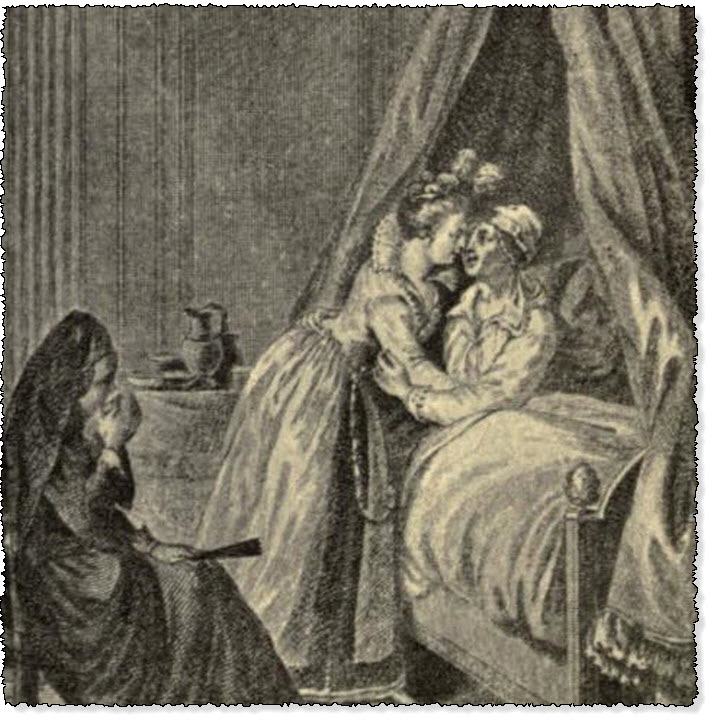
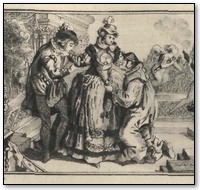
Then, as well as he could, the dying man stretched forth his arms, wherein flesh and blood alike were lacking, and with all the strength remaining in his bones embraced her who was the cause of his death. And kissing her with his pale cold lips, he held her thus as long as he was able. Then he said to her—
"The love I have borne you has been so great and honourable, that, excepting in marriage, I have never desired of you any other favour than the one you are granting me now, for lack of which and with which I shall cheerfully yield up my spirit to God. He is perfect love and charity. He knows the greatness of my love and the purity of my desire, and I beseech Him, while I hold my desire within my arms, to receive my spirit into His own."
With these words he again took her in his arms, and with such exceeding ardour that his enfeebled heart, unable to endure the effort, was deprived of all its faculties and life; for joy caused it so to swell that the soul was severed from its abode and took flight to its Creator.
And even when the poor body had lain a long time without life, and was thus unable to retain its hold, the love which the damsel had always concealed was made manifest in such a fashion that her mother and the dead man's servants had much ado to separate her from her lover. However, the girl, who, though living, was in a worse condition than if she had been dead, was by force removed at last out of the gentleman's arms. To him they gave honourable burial; and the crowning point of the ceremony was the weeping and lamentation of the unhappy damsel, who having concealed her love during his lifetime, made it all the more manifest after his death, as though she wished to atone for the wrong that she had done him. And I have heard that although she was given a husband to comfort her, she has never since had joy in her heart. (1)
"What think you of that, gentlemen, you who would not believe what I said? Is not this example sufficient to make you confess that perfect love, when concealed and disregarded, may bring folks to the grave? There is not one among you but knows the kinsfolk on the one and the other side, (2) and so you cannot doubt the story, although nobody would be disposed to believe it unless he had some experience in the matter."
When the ladies heard this they all had tears in their eyes, but Hircan said to them—
"He was the greatest fool I ever heard of. By your faith, now, I ask you, is it reasonable that we should die for women who are made only for us, or that we should be afraid to ask them for what God has commanded them to give us? I do not speak for myself nor for any who are married. I myself have all that I want or more; but I say it for such men as are in need. To my thinking, they must be fools to fear those whom they should rather make afraid. Do you not perceive how greatly this poor damsel regretted her folly? Since she embraced the gentleman's dead body—an action repugnant to human nature—she would not have refused him while he was alive had he then trusted as much to boldness as he trusted to pity when he lay upon his death-bed."
"Nevertheless," said Oisille, "the gentleman most plainly showed that he bore her an honourable love, and for this he will ever be worthy of all praise. Chastity in a lover's heart is something divine rather than human."
"Madam," said Saffredent, "in support of Hircan's opinion, which is also mine, I pray you believe that Fortune favours the bold, and that there is no man loved by a lady but may at last, in whole or in part, obtain from her what he desires, provided he seek it with wisdom and passion. But ignorance and foolish fear cause men to lose many a good chance; and then they impute their loss to their mistress's virtue, which they have never verified with so much as the tip of the finger. A fortress was never well assailed but it was taken."
"Nay," said Parlamente, "I am amazed that you two should dare to talk in this way. Those whom you have loved owe you but little thanks, or else your courting has been carried on in such evil places that you deem all women to be alike."
"For myself, madam," said Saffredent, "I have been so unfortunate that I am unable to boast; but I impute my bad luck less to the virtue of the ladies than to my own fault, in not conducting my enterprises with sufficient prudence and sagacity. In support of my opinion I will cite no other authority than the old woman in the Romance of the Rose, who says—
'Of all, fair sirs, it truly may be said, Woman for man and man for woman's made.' (3)
Accordingly I shall always believe that if love once enters a woman's heart, her lover will have fair fortune, provided he be not a simpleton."
"Well," said Parlamente, "if I were to name to you a very loving woman who was greatly sought after, beset and importuned, and who, like a virtuous lady, proved victorious over her heart, flesh, love and lover, would you believe this true thing possible?"
"Yes," said he, "I would."
"Then," said Parlamente, "you must all be hard of belief if you do not believe this story."
"Madam," said Dagoucin, "since I have given an example to show how the love of a virtuous gentleman lasted even until death, I pray you, if you know any such story to the honour of a lady, to tell it to us, and so end this day. And be not afraid to speak at length, for there is yet time to relate many a pleasant matter."
"Then, since I am to wind up the day," said Parlamente, "I will make no long preamble, for my story is so beautiful and true that I long to have you know it as well as I do myself. Although I was not an actual witness of the events, they were told to me by one of my best and dearest friends in praise of the man whom of all the world he had loved the most. But he charged me, should I ever chance to relate them, to change the names of the persons. Apart, therefore, from the names of persons and places the story is wholly true."
Footnotes:
- By an expression made use of by Dagoucin (see ante), Queen Margaret gives us to understand that the incidents here related occurred three years prior to the writing of the story. It may be pointed out, however, that there is considerable analogy between the conclusion of this tale and the death of Geffroy Rudel de Blaye, one of the earliest troubadours whose name has been handed down to us. Geffroy, who lived at the close of the twelfth century, became so madly enamoured of the charms of the Countess of Tripoli, after merely hearing an account of her moral and physical perfections, that, although in failing health, he embarked for Africa to see her. On reaching the port of Tripoli, he no longer had sufficient strength to leave the vessel, whereupon the Countess, touched by his love, visited him on board, taking his hand and giving him a kindly greeting. Geffroy could scarcely say a few words of thanks; his emotion was so acute that he died upon the spot. See J. de Nostredame's Vies des plus Célèbres et Anciens Poëtes Provençaux(Lyons, 1575, p. 25); Raynouard's Choix des Poésies des Troubadours (vol. v. p. 165); and also Raynouard's Histoire Littéraire de la France (vol. xiv. p. 559).—L.
- This certainly points to the conclusion that the tale is founded upon fact, and not, as M. Leroux de Lincy suggests, borrowed from the story of Geffroy Rudel de Blaye. It will have been observed (ante) that the Queen of Navarre curiously enough lays the scene of her narrative between Provence and Dauphiné. These two provinces bordered upon one another, excepting upon one point where they were separated by the so-called Comtat Venaissin or Papal state of Avignon. Here, therefore, the incidents of the story, if authentic, would probably have occurred. The story may be compared with Tale L. (post).—Ed.
- From John de Mehun's continuation of the poem.—M. 2
Online Edition of the Heptameron
This is the Heptameron of Marguerite de Navarre
Other Sites: CruikshankArt.com · Dante's Inferno · Book-Lover.com · Canterbury Tales ·
This site is created by the Heptameron Information Society.