
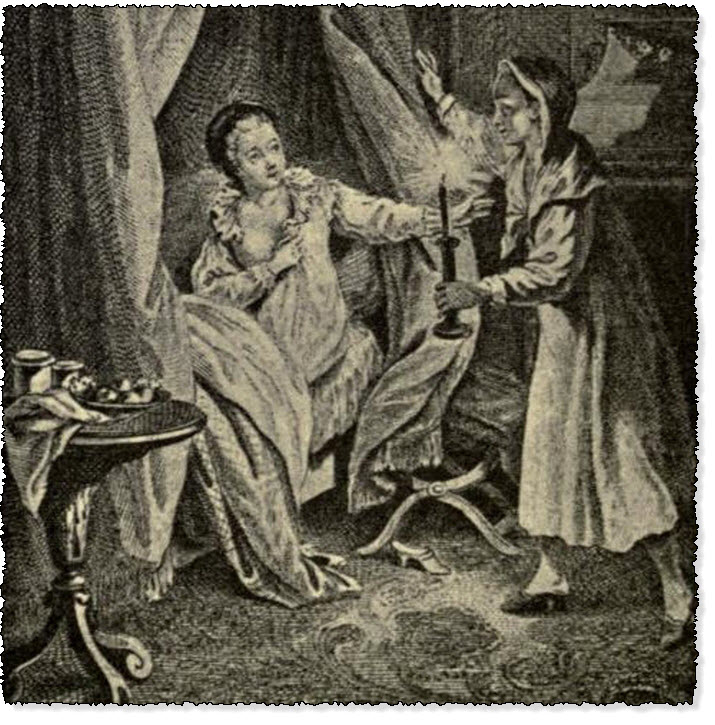
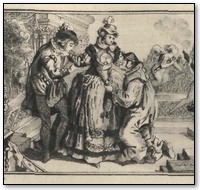
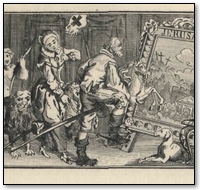
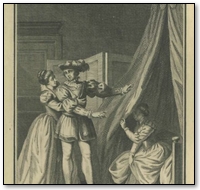
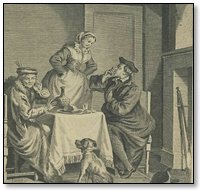
The Princess's Lady of Honour hurrying to her Mistress's Assistance
The Heptameron - Day 1 - Tale 4
Summary of the Fourth Tale Told on the First Day of the Heptameron
Tale 4 of the Heptameron
There lived in the land of Flanders a lady of such high lineage, that none more illustrious could be found. She was a widow, both her first and second husbands being dead, and she had no children living. During her widowhood she lived in retirement with her brother, by whom she was greatly loved, and who was a very great lord and married to the daughter of a King. This young Prince was a man much given to pleasure, fond of hunting, pastimes, and women, as his youth inclined him. He had a wife, however, who was of a very froward disposition, (2) and found no pleasure in her husband's pursuits; wherefore this Lord always took his sister along with his wife, for she was a most joyous and pleasant companion, and withal a discreet and honourable woman.
In this Lord's household there was a gentleman who, for stature, comeliness, and grace, surpassed all his fellows. This gentleman, (3) perceiving that his master's sister was of merry mood and always ready for a laugh, was minded to try whether the offer of an honourable love would be displeasing to her.
He made this offer, but the answer that he received from her was contrary to his desires. However, although her reply was such as beseemed a Princess and a woman of true virtue, she readily pardoned his hardihood for the sake of his comeliness and breeding, and let him know that she bore him no ill-will for what he had said. But she charged him never to speak to her after that fashion again; and this he promised, that he might not lose the pleasure and honour of her conversation. Nevertheless, as time went on, his love so increased that he forgot the promise he had made. He did not, however, risk further trial of words, for he had learned by experience, and much against his will, what virtuous replies she was able to make. But he reflected that if he could take her somewhere at a disadvantage, she, being a widow, young, lusty, and of a lively humour, would perchance take pity on him and on herself.
To compass his ends, he told his master that excellent hunting was to be had in the neighbourhood of his house, and that if it pleased him to repair thither and hunt three or four stags in the month of May, he could have no finer sport. The Lord granted the gentleman's request, as much for the affection he bore him as for the pleasure of the chase, and repaired to his house, which was as handsome and as fairly ordered as that of the richest gentleman in the land.
The Lord and his Lady were lodged on one side of the house, and she whom the gentleman loved more than himself on the other. Her apartment was so well arranged, tapestried above and matted below,(4) that it was impossible to perceive a trap-door which was by the side of her bed, and which opened into a room beneath, that was occupied by the gentleman's mother.(5)
She being an old lady, somewhat troubled by rheum, and fearful lest the cough she had should disturb the Princess, made exchange of chambers with her son. In the evening this old lady was wont to bring sweetmeats to the Princess for her collation,(6) at which the gentleman was present; and being greatly beloved by her brother and intimate with him, he was also suffered to be present when she rose in the morning and when she retired to bed, on which occasions he always found reasons for an increase of his affection.
Thus it came to pass that one evening he made the Princess stay up very late, until at last, being desirous of sleep, she bade him leave her. He then went to his own room, and there put on the handsomest and best-scented shirt he had, and a nightcap so well adorned that nothing was lacking in it. It seemed, to him, as he looked at himself in his mirror, that no lady in the world could deny herself to one of his comeliness and grace. He therefore promised himself a happy issue to his enterprise, and so lay down on his bed, where in his desire and sure hope of exchanging it for one more honourable and pleasant, he looked to make no very long stay.
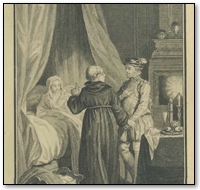
As soon as he had dismissed all his attendants he rose to fasten the door after them; and for a long time he listened to hear whether there were any sound in the room of the Princess, which was above his own. When he had made sure that all was quiet, he wished to begin his pleasant task, and little by little let down the trap-door, which was so excellently wrought, and so well covered with cloth, that it made not the least noise. Then he ascended into the room and came to the bedside of his lady, who was just falling asleep.
Forthwith, having no regard for the duty that he owed his mistress or for the house to which she belonged, he got into bed with her, without entreating her permission or making any kind of ceremony. She felt him in her arms before she knew that he had entered the room; but being strong, she freed herself from his grasp, and fell to striking, biting, and scratching him, demanding the while to know who he was, so that for fear lest she should call out he sought to stop her mouth with the bedclothes. But this he found it impossible to do, for when she saw that he was using all his strength to work her shame she did as much to baffle him. She further called as loudly as she could to her lady of honour,(7) who slept in her room; and this old and virtuous woman ran to her mistress in her nightdress.
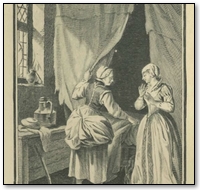
When the gentleman saw that he was discovered, he was so fearful of being recognised by the lady, that he descended in all haste through his trap-door; his despair at returning in such an evil plight being no less than his desire and assurance of a gracious reception had previously been. He found his mirror and candle on his table,(8) and looking at his face, all bleeding from the lady's scratches and bites, whence the blood was trickling over his fine shirt, which had now more blood than gold (9) about it, he said—
"Beauty! now hast thou been rewarded according to thy deserts. By reason of thy vain promises I attempted an impossible undertaking, and one that, instead of increasing my happiness, will perchance double my misfortune. I feel sure that if she knows I made this foolish attempt contrary to the promise I gave her, I shall lose the honourable and accustomed companionship which more than any other I have had with her. And my folly has well deserved this, for if I was to turn my good looks and grace to any account, I ought not to have hidden them in the darkness. I should not have sought to take that chaste body by force, but should have waited in long service and humble patience till love had conquered her. Without love, all man's merits and might are of no avail."
Thus he passed the night in tears, regrets, and sorrowings such as I cannot describe; and in the morning, finding his face greatly torn, he feigned grievous sickness and to be unable to endure the light, until the company had left his house.
The lady, who had come off victorious, knew that there was no man at her brother's Court that durst attempt such an enterprise save him who had had the boldness to declare his love to her. She therefore concluded that it was indeed her host, and made search through the room with her lady of honour to discover how he could have entered it. But in this she failed, whereupon she said to her companion in great anger—
"You may be sure that it can have been none other than the lord of this house, and I will make such report of him to my brother in the morning that his head shall bear witness to my chastity."
Seeing her in such wrath, the lady of honour said to her—
"Right glad am I, madam, to find you esteem your honour so highly that, to exalt it, you would not spare the life of a man who, for the love he bears you, has put it to this risk. But it often happens that one lessens what one thinks to increase; wherefore, I pray you, madam, tell me the truth of the whole matter."
When the lady had fully related the business, the lady of honour said to her—
"You assure me that he had nothing from you save only scratches and blows?"
"I do assure you that it was so," said the lady; "and, unless he find a rare surgeon, I am certain his face will bear the marks tomorrow."
"Well, since it is thus, madam," said the lady of honour, "it seems to me that you have more reason to thank God than to think of vengeance; for you may well believe that, since the gentleman had spirit enough to make such an attempt, his grief at having failed will be harder of endurance than any death you could award him. If you desire to be revenged on him, let love and shame do their work; they will torment him more grievously than could you. And if you would speak out for your honour's sake,(10) beware, madam, lest you fall into a mishap like to his own.
He, instead of obtaining the greatest delight he could imagine, has encountered the gravest vexation any gentleman could endure. So you, madam, thinking to exalt your honour, may perchance diminish it. If you make complaint, you will bring to light what is known to none, for you may rest assured that the gentleman on his side will never reveal aught of the matter. And even if my lord, your brother, should do justice to him at your asking, and the poor gentleman should die, yet would it everywhere be noised abroad that he had had his will of you, and most people would say it was unlikely a gentleman would make such an attempt unless the lady had given him great encouragement. You are young and fair; you live gaily with all; and there is no one at Court but has seen the kind treatment you have shown to the gentleman whom you suspect. Hence every one will believe that if he did this deed it was not without some fault on your side; and your honour, for which you have never had to blush, will be freely questioned wherever the story is related."
On hearing the excellent reasoning of her lady of honour, the Princess perceived that she spoke the truth, and that she herself would, with just cause, be blamed on account of the close friendship which she had always shown towards the gentleman. Accordingly she inquired of her lady of honour what she ought to do.
"Madam," replied the other, "since you are pleased to receive my counsels, having regard for the affection whence they spring, it seems to me you should be glad at heart to think that the most comely and gallant gentleman I have ever seen was not able, whether by love or by force, to turn you from the path of true virtue. For this, madam, you should humble yourself before God, and confess that it was not through your own merit, for many women who have led straighter lives than you have been humiliated by men less worthy of love than he. And you should henceforth be more than ever on your guard against proposals of love; for many have the second time yielded to dangers which on the first occasion they were able to avoid. Be mindful, madam, that love is blind, and that it makes people blind in such wise that the way appears safest just when it is most slippery. Further, madam, it seems to me that you should give no sign of what has befallen you, whether to him or to any one else, and that if he seeks to say anything on the matter, you should feign not to understand him. In this way you will avoid two dangers, the one of vain-glory in the victory you have won, and the other of recalling things so pleasant to the flesh that at mention of them the chastest can only with difficulty avoid feeling some sparks of the flame, though they strive their utmost to escape them. (11)
Besides this, madam, in order that he may not think he has done anything pleasing in your sight, I am of opinion you should little by little withdraw the friendship you have been in the habit of showing him. In this way he will know how much you scorn his rashness, and how great is your goodness, since, content with the victory that God has given you, you seek no further vengeance upon him. And may God give you grace, madam, to continue in the virtue He has placed in your heart; and, knowing that all good things come from Him, may you love and serve Him better than before."
The Princess determined to abide by the advice of her lady of honour, and then fell asleep with joy as great as was the sadness of her waking lover.
On the morrow, the lord, her brother, wishing to depart, inquired for his host, and was told that he was too ill to bear the light or to hear any one speak. The Prince was greatly astonished at this, and wished to go and see the gentleman; however, learning that he was asleep, he would not awake him, but left the house without bidding him farewell. He took with him his wife and sister, and the latter, hearing the excuses sent by the gentleman, who would not see the Prince or any of the company before their departure, felt convinced that it was indeed he who had so tormented her, and that he durst not let the marks which she had left upon his face be seen. And although his master frequently sent for him, he did not return to Court until he was quite healed of all his wounds, save only one—namely, that which love and vexation had dealt to his heart.
When he did return, and found himself in presence of his victorious foe, he could not but blush; and such was his confusion, that he who had formerly been the boldest of all the company, was often wholly abashed before her. Accordingly, being now quite certain that her suspicion was true, she estranged herself from him little by little, though not so adroitly that he did not perceive it; but he durst not give any sign for fear of meeting with something still worse, and so he kept his love concealed, patiently enduring the disgrace he had so well deserved.(12)
"This, ladies, is a story which should be a warning to those who would grasp at what does not belong to them, and which, further, should strengthen the hearts of ladies, since it shows the virtue of this young Princess, and the good sense of her lady of honour. If the like fortune should befall any among you, the remedy has now been pointed out."
"It seems to me," said Hircan, "that the tall gentleman of whom you have told us was so lacking in spirit as to be unworthy of being remembered. With such an opportunity as that, he ought not to have suffered any one, old or young, to baffle him in his enterprise. It must be said, also, that his heart was not entirely filled with love, seeing that fear of death and shame found place within it."
"And what," replied Nomerfide, "could the poor gentleman have done with two women against him?"
"He ought to have killed the old one," said Hircan, "and when the young one found herself without assistance she would have been already half subdued."
"To have killed her!" said Nomerfide. "Then you would turn a lover into a murderer? Since such is your opinion, it would indeed be a fearful thing to fall into your hands."
"If I had gone so far," said Hircan, "I should have held it dishonourable not to achieve my purpose."
Then said Geburon—
"You think it strange that a Princess, bred in all honour, should prove difficult of capture to one man. You should then be much more astonished at a poor woman who escaped out of the hands of two."
"Geburon," said Ennasuite, "I give my vote to you to tell the fifth tale, for I think you know something concerning this poor woman that will not be displeasing to us."
"Since you have chosen me," said Geburon, "I will tell you a story which I know to be true from having made inquiries concerning it on the spot. By this story you will see that womanly sense and virtue are not in the hearts and heads of Princesses alone, nor love and cunning in such as are most often deemed to possess them."
Footnotes:
- This story is historical, and the incidents must have occurred between 1520 and 1525.—L.
- The young prince here mentioned is Francis I., who at this period was between twenty-five and thirty years old. The froward wife is Claude of France (daughter of Louis XII. and Anne of Brittany), whom Francis married in 1514, and who died of consumption at Blois ten years later, while the King was on his way to conquer Milan. (See the Memoir of Margaret, pp. xxvi. and xxxv.)—Ed.
- According to Brantôme, the Lady of Flanders, the young Prince's sister, was Queen Margaret herself, and the gentleman who paid court to her was William Gouffier, Lord of Bonnivet, of Crevecoeur, Thois, and Querdes, and also a favourite of Francis I., with whom he was brought up, and by whom he was employed in all the great enterprises of the time. Bonnivet became Admiral of France in 1517, and two years later he was created governor of Dauphiné, and guardian of the Dauphin's person. He negotiated the peace and alliance with Henry VIII., and arranged all the preliminaries of the interview known as the Field of the Cloth of Gold (1520). In 1521, says Anselme in his Histoire Généalogique, Bonnivet became governor of Guienne, commanded the army sent to Navarre, and captured Fontarabia. In 1524 he was despatched to Italy as lieutenant-general, and besieged Milan, but was repeatedly repulsed, and finally fell back on the Ticino. He was killed at Pavia (February 24, 1525), and was largely responsible for that disastrous defeat, having urged Francis I. to give battle, contrary to the advice of the more experienced captains. Bonnivet, as mentioned by Queen Margaret in this story, had the reputation of being one of the handsomest men of his time.— L.
- In most palaces and castles at this period the walls were covered with tapestry and the floors with matting. This remark is necessary to enable one to understand Bonnivet's stratagem.—D.
- Philippa de Montmorency, second wife of William Gouffier, Lord of Boissy, who was Bonnivet's father (Anselme's Histoire Généalogique, vol. vii. p. 880).—L.
- At that period the collation, as the supper was called, was served at seven in the evening, shortly before the curfew.—B. J.
- The lady in question was Blanche de Tournon, daughter of James de Tournon, by Jane de Polignac, and sister of Cardinal de Tournon, Minister of Francis I. She first married Raymond d'Agout, Baron of Sault in Provence, who died in 1503; and secondly James de Chastillon, Chamberlain to Charles VIII. and Louis XII., killed at the siege of Ravenna in 1512. Brantôme states, moreover, that she subsequently married Cardinal John du Bellay. (See Appendix to the'present volume, C.) In this story, Margaret describes the Princess of Flanders as having lost two husbands, with the view of disguising the identity of her heroine. Her own husband (the Duke of Alençon) was still alive; but Madame de Chastillon had twice become a widow, and the Queen, who was well aware of this, designedly ascribed to the Princess the situation of the lady of honour. This story should be compared with the poem "Quatre Dames et Quatre Gentilhommes" in the Marguerites de la Marguerite.—F.
- It is not surprising that the mirror should have been lying on the table. Mirrors were for a long time no larger than our modern hand-glasses. That of Mary de' Medici, offered to her by the Republic of Venice, and now in the Galerie d'Apollon at the Louvre, is extremely small, though it has an elaborate frame enriched with precious cameos. Even the mirrors placed by Louis XIV. in the celebrated Galerie des Glaces at Versailles were no larger than ordinary window-panes.—M.
- Shirts were then adorned at the collar and in front with gold-thread embroidery, such as is shown in some of Clouet's portraits. In M. de Laborde's Comptes des Bâtiments du Roi au XVIème Siècle (vol. ii.) mention is made of "a shirt with gold work," "a shirt with white work," &c.; and also of two beautiful women's chemises in Holland linen "richly worked with gold thread and silk, at the price of six crowns apiece."—M.
- In Boaistuau's edition this passage runs: "Let love and shame do their work, they will know better than you how to torment him; and do this for your honour's sake. Beware," &c.—L.
- We here follow MS. No. 1520.—L.
- This story is referred to by Brantôme, both in his Vies des Homines illustres et grands Capitaines français, and in his Vies des Dames galantes. See Appendix to the present volume (C. ).
Online Edition of the Heptameron
This is the Heptameron of Marguerite de Navarre
Other Sites: CruikshankArt.com · Dante's Inferno · Book-Lover.com · Canterbury Tales ·
This site is created by the Heptameron Information Society.