
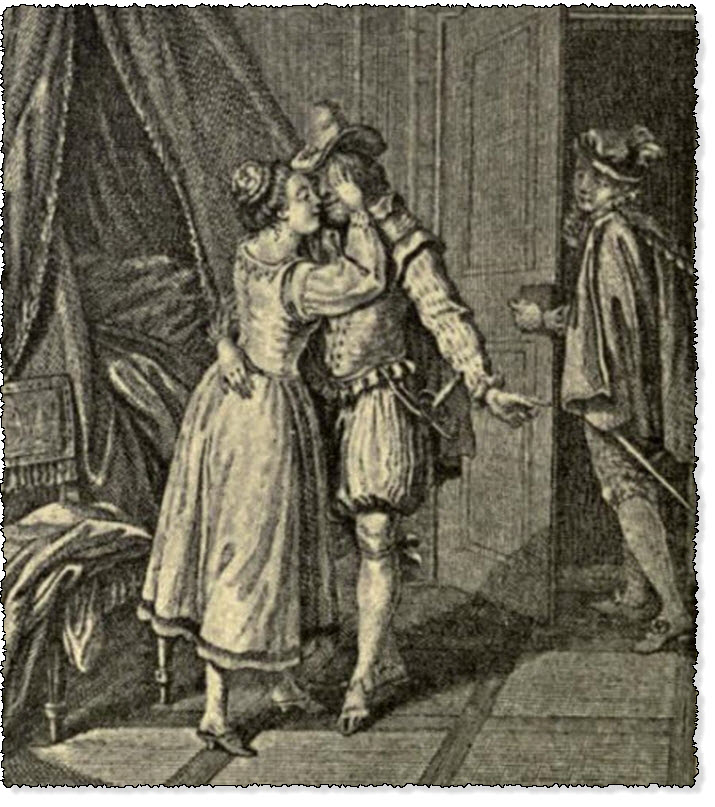
The Wife's Ruse to secure the Escape of her Lover
The Heptameron - Day 1 - Tale 6
Summary of the Sixth Tale Told on the First Day of the Heptameron
Tale 6 of the Heptameron
There was in the service of Charles, last Duke of Alençon, an old valet who had lost an eye, and who was married to a wife much younger than himself. Now, since his master and mistress liked him as well as any man of his condition that was in their service, he was not able to visit his wife as often as he could have wished. Owing to this she so far forgot her honour and conscience as to fall in love with a young man, and the affair being at last noised abroad, the husband heard of it. He could not believe it, however, on account of the many notable tokens of love that were shown him by his wife.
Nevertheless, he one day determined to put the matter to the test, and to take revenge, if he were able, on the woman who had put him to such shame. For this purpose he pretended to go away to a place a short distance off for the space of two or three days.
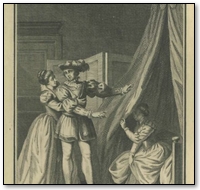
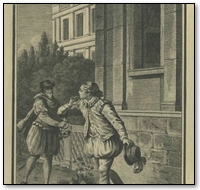
As soon as he was gone, his wife sent for her lover, but he had not been with her for half-an-hour when the husband arrived and knocked loudly at the door. The wife well knew who it was and told her lover, who was so greatly confounded that he would fain have been in his mother's womb, and cursed both his mistress and the love that had brought him into such peril. However, she bade him fear nothing, for she would devise a means to get him away without harm or shame to him, and she told him to dress himself as quickly as he could. All this time the husband was knocking at the door and calling to his wife at the top of his voice; but she feigned not to recognise him, and cried out to the people of the house—
"Why do you not get up and silence those who are making such a clamour at the door? Is this an hour to come to the houses of honest folk? If my husband were here he would soon make them desist."
On hearing his wife's voice the husband called to her as loudly as he could—
"Wife, open the door. Are you going to keep me waiting here till morning?"
Then, when she saw that her lover was ready to set forth, she opened the door.
"Oh, husband!" she began, "how glad I am that you are come. I have just had a wonderful dream, and was so pleased that I never before knew such delight, for it seemed to me that you had recovered the sight of your eye." (1)
Then, embracing and kissing him, she took him by the head and covering his good eye with one hand, she asked him—
"Do you not see better than you did before?"
At that moment, whilst he saw not a whit, she made her lover sally forth. The husband immediately suspected the trick, and said to her—
"'Fore God, wife, I will keep watch on you no more, for in thinking to deceive you, I have myself met with the cunningest deception that ever was devised. May God mend you, for it is beyond the power of man to put a stop to the maliciousness of a woman, unless by killing her outright. However, since the fair treatment I have accorded you has availed nothing for your amendment, perchance the scorn I shall henceforward hold you in will serve as a punishment."
So saying he went away, leaving his wife in great distress. Nevertheless by the intercession of his friends and her own excuses and tears, he was persuaded to return to her again.(2)
"By this tale, ladies, you may see how quick and crafty a woman is in escaping from danger. And if her wit be quick to discover the means of concealing a bad deed, it would, in my belief, be yet more subtle in avoiding evil or in doing good; for I have always heard it said that wit to do well is ever the stronger."
"You may talk of your cunning as much as you please," said Hircan, "but my opinion is that had the same fortune befallen you, you could not have concealed the truth."
"I had as lief you deemed me the most foolish woman on earth," she replied.
"I do not say that," answered Hircan, "but I think you more likely to be confounded by slander than to devise some cunning means to silence it."
"You think," said Nomerfide, "that every one is like you, who would use one slander for the patching of another; but there is danger lest the patch impair what it patches and the foundation be so overladen that all be destroyed. However, if you think that the subtlety, of which all believe you to be fully possessed, is greater than that found in women, I yield place to you to tell the seventh story; and, if you bring yourself forward as the hero, I doubt not that we shall hear wickedness enough."
"I am not here," replied Hircan, "to make myself out worse than I am; there are some who do that rather more than is to my liking."
So saying he looked at his wife, who quickly said—
"Do not fear to tell the truth on my account. I can more easily bear to hear you relate your crafty tricks than to see them played before my eyes, though none of them could lessen the love I bear you."
"For that reason," replied Hircan, "I make no complaint of all the false opinions you have had of me. And so, since we understand each other, there will be more security for the future. Yet I am not so foolish as to relate a story of myself, the truth of which might be vexatious to you. I will tell you one of a gentleman who was among my dearest friends."
Footnotes:
- This is taken from No. xvi. of the Cent Nouvelles Nouvelles, in which the wife exclaims: "Verily, at the very moment when you knocked, my lord, I was greatly occupied with a dream about you."—"And what was it, sweetheart?" asks the husband.—"By my faith, my lord," replies the wife, "it really seemed to me that you were come back, that you were speaking to me, and that you saw as clearly with one eye as with the other."—Ed.
- Although Queen Margaret ascribes the foregoing adventure to one of the officers of her husband's household, and declares that the narrative is quite true, the same subject had been dealt with by most of the old story-tellers prior to her time, and Deslongchamps points out the same incidents even in the early Hindoo fables (see the Pantcha Tantra, book I., fable vi.). A similar tale is to be found in the Gesta Romanorum (cap. cxxii.), in the fabliaux collected by Legrand d'Aussy (vol. iv., "De la mauvaise femme"), in P. Alphonse's Disciplina Clericalis (fab. vii.), in the Decameron (day vii., story vi.), and in the Cent Nouvelles Nouvelles (story xvi.). Imitations are also to be found in Bandello (part i., story xxiii.), Malespini (story xliv.), Sansovino (Cento Novelle), Sabadino (Novelle), Etienne (Apologiepour Hérodote, ch. xv. ), De la Monnoye (vol. ii.), D'Ouville (Contes, vol. ii.), &c.—L. & B. J.
Online Edition of the Heptameron
This is the Heptameron of Marguerite de Navarre
Other Sites: CruikshankArt.com · Dante's Inferno · Book-Lover.com · Canterbury Tales ·
This site is created by the Heptameron Information Society.