
The Heptameron - Day 1 - Tale 10
The Heptameron - Day 1 - Tale 10
Summary of the Tenth Tale Told on the First Day of the Heptameron
Tale 10 of the Heptameron
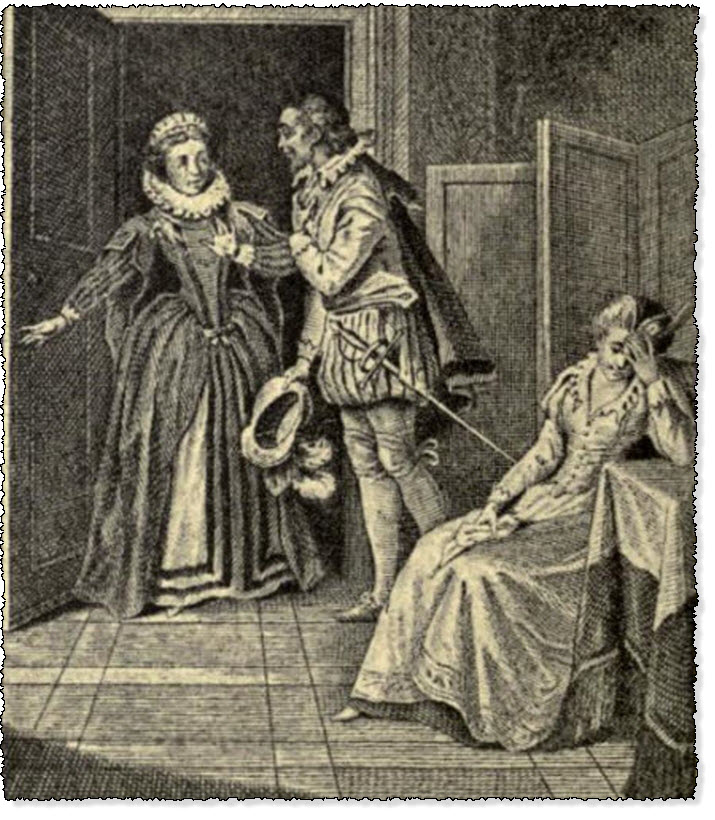
In the county of Aranda, (2) in Aragon, there lived a lady who, while still very young, was left a widow, with a son and a daughter, by the Count of Aranda, the name of the daughter being Florida. This lady strove to bring up her children in all the virtues and qualities which beseem lords and gentlemen, so that her house was reputed to be one of the most honourable in all the Spains. She often went to Toledo, where the King of Spain dwelt, and when she came to Saragossa, which was not far from her house, she would remain a long while with the Queen and the Court, by whom she was held in as high esteem as any lady could be.
Going one day, according to her custom, to visit the King, then at his castle of La Jasserye, (3) at Saragossa, this lady passed through a village belonging to the Viceroy of Catalonia, (4) who, by reason of the great wars between the kings of France and Spain, had not been wont to stir from the frontier at Perpignan. But for the time being there was peace, so that the Viceroy and all his captains had come to do homage to the King. The Viceroy, learning that the Countess of Aranda was passing through his domain, went to meet her, not only for the sake of the ancient friendship he bore her, but in order to do her honour as a kinswoman of the King's.
Now he had in his train many honourable gentlemen, who, in the long waging of war, had gained such great honour and renown that all who saw them and consorted with them deemed themselves fortunate. Among others there was one named Amadour, who, although but eighteen or nineteen years old, was possessed of such well-assured grace and of such excellent understanding that he would have been chosen from a thousand to hold a public office. It is true that this excellence of understanding was accompanied by such rare and winsome beauty that none could look at him without pleasure. And if his comeliness was of the choicest, it was so hard pressed by his speech that one knew not whether to give the greatest honour to his grace, his beauty, or the excellence of his conversation.
What caused him, however, to be still more highly esteemed was his great daring, which was no whit diminished by his youth. He had already shown in many places what he could do, so that not only the Spains, but France and Italy also made great account of his merits. For in all the wars in which he had taken part he had never spared himself, and when his country was at peace he would go in quest of wars in foreign lands, where he was loved and honoured by both friend and foe.
This gentleman, for the love he bore his commander, had come to the domain where the Countess of Aranda had arrived, and remarking the beauty and grace of her daughter Florida, who was then only twelve years old, he thought to himself that she was the fairest maiden he had ever seen, and that if he could win her favour it would give him greater satisfaction than all the wealth and pleasure he might obtain from another. After looking at her for a long time he resolved to love her, although his reason told him that what he desired was impossible by reason of her lineage as well as of her age, which was such that she could not yet understand any amorous discourse. In spite of this, he fortified himself with hope, and reflected that time and patience might bring his efforts to a happy issue. And from that moment the kindly love, which of itself alone had entered Amadour's heart, assured him of all favour and the means of attaining his end.
To overcome the greatest difficulty before him, which consisted in the remoteness of his own home and the few opportunities he would have of seeing Florida again, he resolved to get married. This was contrary to what he had determined whilst with the ladies of Barcelona and Perpignan, in which places he was in such favour that little or nothing was refused him; and, indeed, by reason of the wars, he had dwelt so long on the frontiers that, although he was born near Toledo, he seemed rather a Catalan than a Castillan. He came of a rich and honourable house, but being a younger son, he was without patrimony; and thus it was that Love and Fortune, seeing him neglected by his kin, determined to make him their masterpiece, endowing him with such qualities as might obtain what the laws of the land had refused him. He was of much experience in the art of war, and was so beloved by all lords and princes that he refused their favours more frequently than he had occasion to seek them.
Heptameron Story 10
The Countess, of whom I have spoken, arrived then at Saragossa and was well received by the King and all his Court. The Governor of Catalonia often came to visit her, and Amadour failed not to accompany him that he might have the pleasure of merely seeing Florida, for he had no opportunity of speaking with her. In order to establish himself in this goodly company he paid his addresses to the daughter of an old knight, his neighbour. This maiden was named Avanturada, and was so intimate with Florida that she knew all the secrets of her heart. Amadour, as much for the worth which he found in Avanturada as for the three thousand ducats a year which formed her dowry, determined to address her as a suitor, and she willingly gave ear to him. But as he was poor and her father was rich, she feared that the latter would never consent to the marriage except at the instance of the Countess of Aranda. She therefore had recourse to the lady Florida and said to her—
"You have seen, madam, that Castilian gentleman who often talks to me. I believe that all his aim is to have me in marriage. You know, however, what kind of father I have; he will never consent to the match unless he be earnestly entreated by the Countess and you."
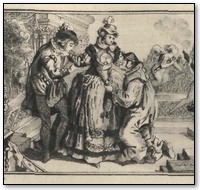
Florida, who loved the damsel as herself, assured her that she would lay the matter to heart as though it were for her own benefit; and Avanturada then ventured so far as to present Amadour to her. He was like to swoon for joy on kissing Florida's hand, and although he was accounted the readiest speaker in Spain, yet in her presence he became dumb. At this she was greatly surprised, for, although she was only twelve years old, she had already often heard it said that there was no man in Spain who could speak better or with more grace. So, finding that he said nothing to her, she herself spoke.
"Senor Amadour," she began, "the renown you enjoy throughout all the Spains has made you known to everybody here, and all are desirous of affording you pleasure. If therefore I can in any way do this, you may dispose of me."
Amadour was in such rapture at sight of the lady's beauty that he could scarcely utter his thanks. However, although Florida was astonished to find that he made no further reply, she imputed it rather to some whim than to the power of love; and so she withdrew, without saying anything more.
Amadour, who perceived the qualities which even in earliest youth were beginning to show themselves in Florida, now said to her whom he desired to marry—
"Do not be surprised if I lost the power of utterance in presence of the lady Florida. I was so astonished at finding such qualities and such sensible speech in one so very young that I knew not what to say to her. But I pray you, Avanturada, you who know her secrets, tell me if she does not of necessity possess the hearts of all the gentlemen of the Court. Any who know her and do not love her must be stones or brutes."
Avanturada, who already loved Amadour more than any other man in the world, could conceal nothing from him, but told him that Florida was loved by every one. However, by reason of the custom of the country, few spoke to her, and only two had as yet made any show of love towards her. These were two princes of Spain, and they desired to marry her, one being the son of the Infante of Fortune (5) and the other the young Duke of Cardona. (6)
"I pray you," said Amadour, "tell me which of them you think she loves the most."
"She is so discreet," said Avanturada, "that on no account would she confess to having any wish but her mother's. Nevertheless, as far as can be judged, she likes the son of the Infante of Fortune far more than she likes the young Duke of Cardona. But her mother would rather have her at Cardona, for then she would not be so far away. I hold you for a man of good understanding, and, if you are so minded, you may judge of her choice this very day, for the son of the Infante of Fortune, who is one of the handsomest and most accomplished princes in Christendom, is being brought up at this Court. If we damsels could decide the marriage by our opinions, he would be sure of having the Lady Florida, for they would make the comeliest couple in all Spain. You must know that, although they are both young, she being but twelve and he but fifteen, it is now three years since their love for each other first began; and if you would secure her favour, I advise you to become his friend and follower."
Amadour was well pleased to find that Florida loved something, hoping that in time he might gain the place not of husband but of lover. He had no fear in regard to her virtue, but was rather afraid lest she should be insensible to love. After this conversation he began to consort with the son of the Infante of Fortune, and readily gained his favour, being well skilled in all the pastimes that the young Prince was fond of, especially in the handling of horses, in the practice of all kinds of weapons, and indeed in every diversion and pastime befitting a young man.
However, war broke out again in Languedoc, and it was necessary that Amadour should return thither with the Governor. This he did, but not without great regret, since he could in no wise contrive to return to where he might see Florida. Accordingly, when he was setting forth, he spoke to a brother of his, who was majordomo to the Queen of Spain, and told him of the good match he had found in the Countess of Aranda's house, in the person of Avanturada; entreating him, in his absence, to do all that he could to bring about the marriage, by employing his credit with the King, the Queen, and all his friends. The majordomo, who was attached to his brother, not only by reason of their kinship, but on account of Amadour's excellent qualities, promised to do his best. This he did in such wise that the avaricious old father forgot his own nature to ponder over the qualities of Amadour, as pictured to him by the Countess of Aranda, and especially by the fair Florida, as well as by the young Count of Aranda, who was now beginning to grow up, and to esteem people of merit. When the marriage had been agreed upon by the kinsfolk, the Queen's majordomo sent for his brother, there being at that time a truce between the two kings. (7)
Meanwhile, the King of Spain withdrew to Madrid to avoid the bad air which prevailed in divers places, and, by the advice of his Council, as well as at the request of the Countess of Aranda, he consented to the marriage of the young Count with the heiress Duchess of Medina Celi. (8) He did this no less for their contentment and the union of the two houses than for the affection he bore the Countess of Aranda; and he caused the marriage to be celebrated at the castle of Madrid. (9)
Amadour was present at this wedding, and succeeded so well in furthering his own union, that he married Avanturada, whose affection for him was far greater than his was for her. But this marriage furnished him with a very convenient cloak, and gave him an excuse for resorting to the place where his spirit ever dwelt. After he was married he became very bold and familiar in the Countess of Aranda's household, so that he was no more distrusted than if he had been a woman. And although he was now only twenty-two years of age, he showed such good sense that the Countess of Aranda informed him of all her affairs, and bade her son consult with him and follow his counsel.
Having gained their esteem thus far, Amadour comported himself so prudently and calmly that even the lady he loved was not aware of his affection for her. By reason, however, of the love she bore his wife, to whom she was more attached than to any other woman, she concealed none of her thoughts from him, and was pleased to tell him of all her love for the son of the Infante of Fortune. Although Amadour's sole aim was to win her entirely for himself, he continually spoke to her of the Prince; indeed, he cared not what might be the subject of their converse, provided only that he could talk to her for a long time. However, he had not remained a month in this society after his marriage when he was constrained to return to the war, and he was absent for more than two years without returning to see his wife, who continued to live in the place where she had been brought up.
Meanwhile Amadour often wrote to her, but his letters were for the most part messages to Florida, who on her side never failed to return them, and would with her own hand add some pleasant words to the letters which Avanturada wrote. It was on this account that the husband of the latter wrote to her very frequently; yet of all this Florida knew nothing except that she loved Amadour as if he had been her brother. Several times during the course of five years did Amadour return and go away again; yet so short was his stay that he did not see Florida for two months altogether. Nevertheless, in spite of distance and length of absence, his love continued to increase.
At last it happened that he made a journey to see his wife, and found the Countess far removed from the Court, for the King of Spain was gone into Andalusia, (10) taking with him the young Count of Aranda, who was already beginning to bear arms.
Thus the Countess had withdrawn to a country-house belonging to her on the frontiers of Aragon and Navarre. She was well pleased on seeing Amadour, who had now been away for nearly three years. He was made welcome by all, and the Countess commanded that he should be treated like her own son. Whilst he was with her she informed him of all the affairs of her household, leaving most of them to his judgment. And so much credit did he win in her house that wherever he visited all doors were opened to him, and, indeed, people held his prudence in such high esteem that he was trusted in all things as though he had been an angel or a saint.
Florida, by reason of the love she bore his wife and himself, sought him out wherever he went. She had no suspicion of his purpose, and was unrestrained in her manners, for her heart was free from love, save that she felt great contentment whenever she was near Amadour. To more than this she gave not a thought.
Amadour, however, had a hard task to escape the observation of those who knew by experience how to distinguish a lover's looks from another man's; for when Florida, thinking no evil, came and spoke familiarly to him, the fire that was hidden in his heart so consumed him that he could not keep the colour from rising to his face or sparks of flame from darting from his eyes. Thus, in order that none might be any the wiser, he began to pay court to a very beautiful lady named Paulina, a woman so famed for beauty in her day that few men who saw her escaped from her toils.
This Paulina had heard how Amadour had made love at Barcelona and Perpignan, insomuch that he had gained the affection of the highest and most beautiful ladies in the land, especially that of a certain Countess of Palamos, who was esteemed the first for beauty among all the ladies of Spain; and she told him that she greatly pitied him, since, after so much good fortune, he had married such an ugly wife. Amadour, who well understood by these words that she had a mind to supply his need, made her the fairest speeches he could devise, seeking to conceal the truth by persuading her of a falsehood. But she, being subtle and experienced in love, was not to be put off with mere words; and feeling sure that his heart was not to be satisfied with such love as she could give him, she suspected he wished to make her serve as a cloak, and so kept close watch upon his eyes. These, however, knew so well how to dissemble, that she had nothing to guide her but the barest suspicion.
Nevertheless, her observation sorely troubled Amadour; for Florida, who was ignorant of all these wiles, often spoke to him before Paulina in such a familiar fashion that he had to make wondrous efforts to compel his eyes to belie his heart. To avoid unpleasant consequences, he one day, while leaning against a window, spoke thus to Florida—
"I pray you, sweetheart, counsel me whether it is better for a man to speak or die?"
Florida forthwith replied—
"I shall always counsel my friends to speak and not to die. There are few words that cannot be mended, but life once lost can never be regained."
"Will you promise me, then," said Amadour, "that you will not be displeased by what I wish to tell you, nor yet alarmed at it, until you have heard me to the end?"
"Say what you will," she replied; "if you alarm me, none can reassure me."
"For two reasons," he then began, "I have hitherto been unwilling to tell you of the great affection that I feel for you. First, I wished to prove it to you by long service, and secondly, I feared that you might deem it presumption in me, who am but a simple gentleman, to address myself to one upon whom it is not fitting that I should look. And even though I were of royal station like your own, your heart, in its loyalty, would suffer none save the son of the Infante of Fortune, who has won it, to speak to you of love. But just as in a great war necessity compels men to devastate their own possessions and to destroy their corn in the blade, that the enemy may derive no profit therefrom, so do I risk anticipating the fruit which I had hoped to gather in season, lest your enemies and mine profit by it to your detriment. Know, then, that from your earliest youth I have devoted myself to your service and have ever striven to win your favour. For this purpose alone I married her whom I thought you loved best, and, being acquainted with the love you bear to the son of the Infante of Fortune, I have striven to serve him and consort with him, as you yourself know. I have sought with all my power for everything that I thought could give you pleasure. You see that I have won the esteem of your mother, the Countess, and of your brother, the Count, and of all you love, so that I am regarded here, not as a dependant, but as one of the family. All my efforts for five years past have had no other end than that I might spend my whole life near you.
"Understand that I am not one of those who would by these means seek to obtain from you any favour or pleasure otherwise than virtuous. I know that I cannot marry you, and even if I could, I would not do so in face of the love you bear him whom I would fain see your husband. And as for loving you with a vicious love like those who hope that long service will bring them a reward to the dishonour of a lady, that is far from my purpose. I would rather see you dead than know that you were less worthy of being loved, or that your virtue had diminished for the sake of any pleasure to me. For the end and reward of my service I ask but one thing, namely, that you will be so faithful a mistress to me, as never to take your favour from me, and that you will suffer me to continue as I now am, trusting in me more than in any other, and accepting from me the assurance that if for your honour's sake, or for aught concerning you, you ever have need of a gentleman's life, I will gladly place mine at your disposal. You may be sure also that whatever I may do that is honourable and virtuous, will be done solely for love of you. If for the sake of ladies less worthy than you I have ever done anything that has been considered of account, be sure that, for a mistress like yourself, my enterprise will so increase, that things I heretofore found impossible will become very easy to me. If, however, you will not accept me as wholly yours, I am resolved to lay aside my arms and to renounce the valour which has failed to help me in my need. So I pray you grant me my just request, for your honour and conscience cannot refuse it."
The maiden, hearing these unwonted words, began to change colour and to cast down her eyes like a woman in alarm. However, being sensible and discreet, she replied—
"Since you already have what you ask of me, Amadour, why make me such a long harangue? I fear me lest beneath your honourable words there be some hidden guile to deceive my ignorance and youth, and I am sorely perplexed what to reply. Were I to refuse the honourable love you offer, I should do contrary to what I have hitherto done, for I have always trusted you more than any other man in the world. Neither my conscience nor my honour oppose your request, nor yet the love I bear the son of the Infante of Fortune, for that is founded on marriage, to which you do not aspire. I know of nothing that should hinder me from answering you according to your desire, if it be not a fear arising from the small need you have for talking to me in this wise; for if what you ask is already yours, why speak of it so ardently?"
Amadour, who was at no loss for an answer, then said to her—
"Madam, you speak very discreetly, and you honour me so greatly by the trust which you say you have in me, that if I were not satisfied with such good fortune I should be quite unworthy of it. But consider, madam, that he who would build an edifice to last for ever must be careful to have a sure and stable foundation. In the same way I, wishing to continue for ever in your service, must not only take care to have the means of remaining near to you, but also to prevent any one from knowing of the great affection that I bear you. Although it is honourable enough to be everywhere proclaimed, yet those who know nothing of lovers' hearts often judge contrary to the truth, and thence come reports as mischievous as though they were true. I have been prompted to say this, and led to declare my love to you, because Paulina, feeling in her heart that I cannot love her, holds me in suspicion and does nought but watch my face wherever I may be. Hence, when you come and speak to me so familiarly in her presence, I am in great fear lest I should make some sign on which she may ground her judgment, and should so fall into that which I am anxious to avoid. For this reason I am lead to entreat you not to come and speak to me so suddenly before her or before others whom you know to be equally malicious, for I would rather die than have any living creature know the truth. Were I not so regardful of your honour, I should not have sought this converse with you, for I hold myself sufficiently happy in the love and trust you bear me, and I ask nothing more save that they may continue."
Florida, who could not have been better pleased, began to be sensible of an unwonted feeling in her heart. She saw how honourable were the reasons which he laid before her; and she told him that virtue and honour replied for her, and that she granted him his request. Amadour's joy at this no true lover can doubt.
Florida, however, gave more heed to his counsel than he desired, for she became timid not only in presence of Paulina but elsewhere, and ceased to seek him out as she had been accustomed to do. While they were thus separated she took Amadour's constant converse with Paulina in bad part, for, seeing that the latter was beautiful, she could not believe that Amadour did not love her. To beguile her sorrow she conversed continually with Avanturada, who was beginning to feel very jealous of her husband and Paulina, and often complained of them to Florida, who comforted her as well as she could, being herself smitten with the same disease. Amadour soon perceived the change in Florida's demeanour, and forthwith thought that she was keeping aloof from him not merely by his own advice, but also on account of some bitter fancies of her own.
One day, when they were coming from vespers at a monastery, he spoke to her, and asked—
"What countenance is this you show me, madam?"
"That which I believe you desire," replied Florida.
Thereupon, suspecting the truth, and desiring to know whether he was right, he said to her—
"I have used my time so well, madam, that Paulina no longer has any suspicion of you."
"You could not do better," she replied, "both for yourself and for me. While giving pleasure to yourself you bring me honour."
Amadour gathered from this speech that she believed he took pleasure in conversing with Paulina, and so great was his despair that he could not refrain from saying angrily to her—
"In truth, madam, you begin betimes to torment your lover and pelt him with hard words. I do not think I ever had a more irksome task than to be obliged to hold converse with a lady I do not love. But since you take what I have done to serve you in bad part, I will never speak to her again, happen what may. And that I may hide my wrath as I have hidden my joy, I will betake me to some place in the neighbourhood, and there wait till your caprice has passed away. I hope, however, I shall there receive tidings from my captain and be called back to the war, where I will remain long enough to show you that nothing but yourself has kept me here."
So saying, he forthwith departed without waiting for her reply.
Florida felt the greatest vexation and sorrow imaginable; and love, meeting with opposition, began to put forth its mighty strength. She perceived that she had been in the wrong, and wrote continually to Amadour entreating him to return, which he did after a few days, when his anger had abated.
I cannot undertake to tell you minutely all that they said to each other in order to destroy this jealousy. But at all events he won the victory, and she promised him that not only would she never believe he loved Paulina, but that she would ever be convinced he found it an intolerable martyrdom to speak either to Paulina or to any one else except to do herself a service.
When love had conquered this first suspicion, and while the two lovers were beginning to take fresh pleasure in conversing together, news came that the King of Spain was sending all his army to Salces. (11)
Amadour, accustomed ever to be the first in battle, failed not to seize this opportunity of winning renown; but in truth he set forth with unwonted regret, both on account of the pleasure he was losing and because he feared that he might find a change on his return. He knew that Florida, who was now fifteen or sixteen years old, was sought in marriage by many great princes and lords, and he reflected that if she were married during his absence he might have no further opportunity of seeing her, unless, indeed, the Countess of Aranda gave her his wife, Avanturada, as a companion. However, by skilful management with his friends, he obtained a promise from both mother and daughter that wherever Florida might go after her marriage thither should his wife, Avanturada, accompany her. Although it was proposed to marry Florida in Portugal, it was nevertheless resolved that Avanturada should never leave her. With this assurance, yet not without unspeakable regret, Amadour went away and left his wife with the Countess.
When Florida found herself alone after his departure, she set about doing such good and virtuous works as she hoped might win her the reputation that belongs to the most perfect women, and might prove her to be worthy of such a lover as Amadour. He having arrived at Barcelona, was there welcomed by the ladies as of old; but they found a greater change in him than they believed it possible for marriage to effect in any man. He seemed to be vexed by the sight of things he had formerly desired; and even the Countess of Palamos, whom he had loved exceedingly, could not persuade him to visit her.
Amadour remained at Barcelona as short a time as possible, for he was impatient to reach Salces, where he alone was now awaited. When he arrived, there began between the two kings that great and cruel war which I do not purpose to describe. (12) Neither will I recount the noble deeds that were done by Amadour, for then my story would take up an entire day; but you must know that he won renown far above all his comrades. The Duke of Najera (13) having arrived at Perpignan in command of two thousand men, requested Amadour to be his lieutenant, and so well did Amadour fulfil his duty with this band, that in every skirmish the only cry was "Najera!" (14)
Now it came to pass that the King of Tunis, who for a long time had been at war with the Spaniards, heard that the kings of France and Spain were warring with each other on the frontiers of Perpignan and Narbonne, and bethought himself that he could have no better opportunity of vexing the King of Spain. Accordingly, he sent a great number of light galleys and other vessels to plunder and destroy all such badly-guarded places as they could find on the coasts of Spain. (15)The people of Barcelona seeing a great fleet passing in front of their town, sent word of the matter to the Viceroy, who was at Salces, and he forthwith despatched the Duke of Najera to Palamos. (16) When the Moors saw that place so well guarded, they made a feint of passing on; but returning at midnight, they landed a large number of men, and the Duke of Najera, being surprised by the enemy, was taken prisoner.
Amadour, who was on the alert and heard the din, forthwith assembled as many of his men as possible, and defended himself so stoutly that the enemy, in spite of their numbers, were for a long time unable to prevail against him. But at last, hearing that the Duke of Najera was taken, and that the Turks had resolved to set fire to Palamos and burn him in the house which he was holding against them, he thought it better to yield than to cause the destruction of the brave men who were with him. He also hoped that by paying a ransom he might yet see Florida again. Accordingly, he gave himself up to a Turk named Dorlin, a governor of the King of Tunis, who brought him to his master. By the latter he was well received and still better guarded; for the King deemed that in him he held the Achilles of all the Spains.
Thus Amadour continued for two years in the service of the King of Tunis. The news of the captures having reached Spain, the kinsfolk of the Duke of Najera were in great sorrow; but those who held the country's honour dear deemed Amadour the greater loss. The rumour came to the house of the Countess of Aranda, where the hapless Avanturada at that time lay grievously sick. The Countess, who had great misgivings as to the affection which Amadour bore to her daughter, though she suffered it and concealed it for the sake of the merits she perceived in him, took Florida apart and told her the mournful tidings. Florida, who was well able to dissemble, replied that it was a great loss to the entire household, and that above all she pitied his poor wife, who was herself so ill. Nevertheless, seeing that her mother wept exceedingly, she shed a few tears to bear her company; for she feared that if she dissembled too far the feint might be discovered. From that time the Countess often spoke to her of Amadour, but never could she surprise a look to guide her judgment.
I will pass over the pilgrimages, prayers, supplications, and fasts which Florida regularly performed to ensure the safety of Amadour. As soon as he had arrived at Tunis, he failed not to send tidings of himself to his friends, and by a trusty messenger he apprised Florida that he was in good health, and had hopes of seeing her again. This was the only consolation the poor lady had in her grief, and you may be sure that, since she was permitted to write, she did so with all diligence, so that Amadour had no lack of her letters to comfort him.
The Countess of Aranda was about this time commanded to repair to Saragossa, where the King had arrived; and here she found the young Duke of Cardona, who so pressed the King and Queen that they begged the Countess to give him their daughter in marriage. (17) The Countess consented, for she was unwilling to disobey them in anything, and moreover she considered that her daughter, being so young, could have no will of her own.
When all was settled, she told Florida that she had chosen for her the match which seemed most suitable. Florida, knowing that when a thing is once done there is small room for counsel, replied that God was to be praised for all things; and, finding her mother look coldly upon her, she sought rather to obey her than to take pity on herself. It scarcely comforted her in her sorrows to learn that the son of the Infante of Fortune was sick even to death; but never, either in presence of her mother or of any one else, did she show any sign of grief. So strongly did she constrain herself, that her tears, driven perforce back into her heart, caused so great a loss of blood from the nose that her life was endangered; and, that she might be restored to health, she was given in marriage to one whom she would willingly have exchanged for death.
After the marriage Florida departed with her husband to the duchy of Cardona, taking with her Avanturada, whom she privately acquainted with her sorrow, both as regards her mother's harshness and her own regret at having lost the son of the Infante of Fortune; but she never spoke of her regret for Amadour except to console his wife.
This young lady then resolved to keep God and honour before her eyes. So well did she conceal her grief, that none of her friends perceived that her husband was displeasing to her.
In this way she spent a long time, living a life that was worse than death, as she failed not to inform her lover Amadour, who, knowing the virtue and greatness of her heart, as well as the love that she had borne to the son of the Infante of Fortune, thought it impossible that she could live long, and mourned for her as for one that was more than dead. This sorrow was an increase to his former grief, and forgetting his own distress in that which he knew his sweetheart was enduring, he would willingly have continued all his life the slave he was if Florida could thereby have had a husband after her own heart. He learnt from a friend whom he had gained at the Court of Tunis that the King, wishing to keep him if only he could make a good Turk of him, intended to give him his choice between impalement and the renunciation of his faith. Thereupon he so addressed himself to his master, the governor who had taken him prisoner, that he persuaded him to release him on parole. His master named, however, a much higher ransom than he thought could be raised by a man of such little wealth, and then, without speaking to the King, he let him go.
When Amadour reached the Court of the King of Spain, he stayed there but a short time, and then, in order to seek his ransom among his friends, he repaired to Barcelona, whither the young Duke of Cardona, his mother, and Florida had gone on business. As soon as Avanturada heard that her husband was returned, she told the news to Florida, who rejoiced as though for love of her friend. Fearing, however, that her joy at seeing Amadour might make her change her countenance, and that those who did not know her might think wrongly of her, she remained at a window in order to see him coming from afar. As soon as she perceived him she went down by a dark staircase, so that none could see whether she changed colour, and embracing Amadour, led him to her room, and thence to her mother-in-law, who had never seen him. He had not been there for two days before he was loved as much as he had been in the household of the Countess of Aranda.
I leave you to imagine the conversation that he and Florida had together, and how she complained to him of the misfortunes that had come to her in his absence. After shedding many tears of sorrow, both for having been married against her will and also for having lost one she loved so dearly without any hope of seeing him again, she resolved to take consolation from the love and trust she had towards Amadour. Though she durst not declare the truth, he suspected it, and lost neither time nor opportunity to show her how much he loved her.
Just when Florida was all but persuaded to receive him, not as a lover, but as a true and perfect friend, a misfortune came to pass, for the King summoned Amadour to him concerning some important matter.
His wife was so grieved on hearing these tidings that she swooned, and falling down a staircase on which she was standing, was so hurt that she never rose again. Florida having by this death lost all her consolation, mourned like one who felt herself bereft of friends and kin. But Amadour grieved still more; for on the one part he lost one of the best wives that ever lived, and on the other the means of ever seeing Florida again. This caused him such sorrow that he was near coming by a sudden death. The old Duchess of Cardona visited him incessantly, reciting the arguments of philosophers why he should endure his loss with patience. But all was of no avail; for if on the one hand his wife's death afflicted him, on the other his love increased his martyrdom. Having no longer any excuse to stay when his wife was buried, and his master again summoned him, his despair was such that he was like to lose his reason.
Florida, who thinking to comfort him, was herself the cause of his greatest grief, spent a whole afternoon in the most gracious converse with him in order to lessen his sorrow, and assured him that she would find means to see him oftener than he thought. Then, as he was to depart on the following morning, and was so weak that he could scarcely stir from his bed, he prayed her to come and see him in the evening after every one else had left him. This she promised to do, not knowing that love in extremity is void of reason.
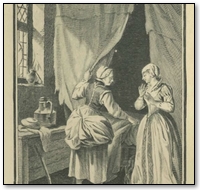
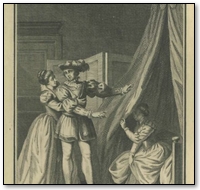
Amadour altogether despaired of ever again seeing her whom he had loved so long, and from whom he had received no other treatment than I have described. Racked by secret passion and by despair at losing all means of consorting with her, he resolved to play at double or quits, and either lose her altogether or else wholly win her, and so pay himself in an hour the reward which he thought he had deserved. Accordingly he had his bed curtained in such a manner that those who came into the room could not see him; and he complained so much more than he had done previously that all the people of the house thought he had not twenty-four hours to live.
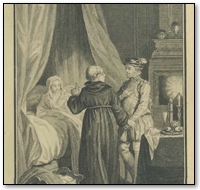
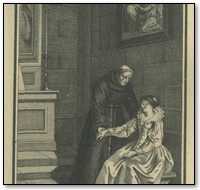
After every one else had visited him, Florida, at the request of her husband himself, came in the evening, hoping to comfort him by declaring her affection and by telling him that, so far as honour allowed, she was willing to love him. She sat down on a chair beside the head of his bed, and began her consolation by weeping with him. Amadour, seeing her filled with such sorrow, thought that in her distress he might the more readily achieve his purpose, and raised himself up in the bed. Florida, thinking that he was too weak to do this, sought to prevent him, but he threw himself on his knees before her saying, "Must I lose sight of you for ever?" Then he fell into her arms like one exhausted. The hapless Florida embraced him and supported him for a long time, doing all she could to comfort him. But what she offered him to cure his pain only increased it; and while feigning to be half dead, he, without saying a word, strove to obtain that which the honour of ladies forbids.
When Florida perceived his evil purpose, in which she could hardly believe after all his honourable conversation, she asked him what he sought to do. Amadour, fearing her reply, which he knew could not be otherwise than chaste and virtuous, said nothing, but pursued his attempt with all the strength that he could muster. Florida, greatly astonished, suspected rather that he had lost his senses than that he was really bent upon her dishonour, and called out to a gentleman whom she knew to be in the room; whereupon Amadour in extreme despair flung himself back upon his bed so suddenly that the gentleman thought him dead.
Florida, who had risen from her chair, then said to the gentleman—
"Go quickly for some strong vinegar."
This the gentleman did, whereupon Florida said—
"What madness, Amadour, has mounted to your brain? What was it you thought and wished to do?"
Amadour, who had lost all reason in the vehemence of his love, replied—
"Does so long a service merit so cruel a reward?"
"And what of the honour of which you have so often preached to me?" said Florida.
"Ah! madam," said Amadour, "it would be impossible to hold your honour more dear than I have held it. Before you were married, I was able so to subdue my heart that you knew nothing of my desires, but now that you are wedded and your honour may be shielded, do I wrong you in asking for what is mine? By the strength of my love I have won you. He who first possessed your heart had so little desire for your person that he deserved to lose both. He who now owns your person is not worthy to have your heart, and hence even your person does not properly belong to him. But for five or six years I have for your sake borne many pains and woes, which must show you that your body and heart belong to me alone. Think not to defend yourself by speaking of conscience, for when love constrains body and heart sin is never imputed. Those who are driven by frenzy so far as to slay themselves cannot sin, for passion leaves no room for reason; and if the passion of love be more intolerable than any other, and more blinding to the senses, what sin could you fasten upon one who yields to the conduct of such indomitable power? I am going away, and have no hope of ever seeing you again; but if before my departure I could have of you that assurance which the greatness of my love deserves, I should be strengthened sufficiently to endure in patience the sorrows of a long separation. If you will not grant me my request you will ere long learn that your harshness has brought me to a miserable and a cruel death." (18)
Florida was not less grieved than astonished to hear these words from one whom she had never imagined capable of such discourse, and, weeping, she thus replied—
"Alas, Amadour, is this the honourable converse that we used to have together while I was young? Is this the honour or conscience which many a time you counselled me to value more than life? Have you forgotten both the worthy examples you set before me of virtuous ladies who withstood unholy love, and also your own contempt for erring women? I cannot believe you so changed, Amadour, that regard for God, your own conscience, and my honour is wholly dead within you. But if it indeed be as you say, I praise the divine goodness which has prevented the misfortune into which I was about to fall, and has revealed to me by your own words the heart of which I was so ignorant. Having lost the son of the Infante of Fortune, not only by my marriage, but also, as is known to me, by reason of his love for another, and finding myself wedded to a man whom, strive as I may, I cannot love, I resolved to set heart and affection entirely on loving you. This love I built upon that virtue which I had so often perceived in you, and to which by your own assistance I think I have attained—I mean the virtue of loving one's honour and conscience more than life. I came hither thinking to make this rock of virtue a sure foundation of love. But you have in a moment shown me, Amadour, that instead of a pure and cleanly rock, this foundation would have been one of shifting sand or filthy mire; and although a great part of the house in which I hoped always to dwell had already been raised, you have suddenly demolished it. Lay aside, therefore, any hope you had concerning me, and make up your mind not to seek me by look or word wherever I may be, or to hope that I shall ever be able or willing to change my resolve. It is with the deepest sorrow that I tell you this, though had I gone so far as to swear eternal love with you, I know that my heart could not have lived through this meeting. Even now I am so confounded to find myself deceived, that I am sure my life will be either short or sad. With these words I bid you farewell, and for ever."
I will not try to describe to you the grief that Amadour felt on hearing this speech. It is impossible not only to describe it, but even to conceive it, except indeed to such as have experienced the like. Seeing that with this cruel conclusion she was about to leave him, he seized her by the arm, knowing full well that, if he did not remove her evil opinion of him, he would lose her for ever. Accordingly he dissembled his looks as well as he could, and said—
"During my whole life, madam, I have desired to love a woman of virtue, and having found so few of them, I was minded to put you to proof, and so discover whether you were as well worthy of esteem as of love. Now I know for certain that you are; and therefore I give praise to God, who has inclined my heart to the love of such great perfection. I entreat you to pardon my mad and foolhardy attempt, seeing that the issue of it has turned to your honour and to my great satisfaction."
Florida was beginning to learn through him the deceitfulness of men; and, just as she had formerly found it difficult to believe in evil where it existed, so did she now find it even more difficult to believe in virtue where there was none.
"Would to God you spoke the truth," she said to him; "but I am not so ignorant as not to know by my experience in marriage that the blindness of strong passion led you to act as you did. Had God given me a loose rein I am sure that you would not have drawn bridle. Those who go in quest of virtue are wont to take a different road to yours. But enough; if I have been too hasty in crediting you with some goodness, it is time I learned the truth, by which I am now delivered out of your hands."
So saying, Florida left the room. As long as the night lasted she did nought but weep; for the change that had taken place caused her intense grief, and her heart had much ado to hold out against the sorrowing of love. Although, guided by reason, she had resolved to love no more, yet the heart, which cannot be subdued, would in no wise permit this. Thus she was unable to love him less than before, and knowing that love had been the cause of his offence, she made up her mind to satisfy love by continuing to love him with her whole heart, and to obey honour by never giving any sign of her affection either to him or to any one else.
In the morning Amadour departed in the distress that I have described. Nevertheless his heart, which was so lofty that there was none like it in the world, suffered him not to despair, but prompted him to new devices for seeing Florida again and winning her favour. So as he proceeded to the King of Spain, who was then at Toledo, he took his way through the county of Aranda, where he arrived very late one evening, and found the Countess in great sadness on account of the absence of her daughter.
When she saw Amadour she kissed and embraced him as though he had been her own son, and this no less for the love she herself bore him as for that which she suspected he had for Florida. She asked minutely for news of her daughter, and he told her what he could, though not the entire truth. However, he confessed the love which existed between them, and which Florida had always concealed; and he begged the Countess to aid him in hearing often of Florida, and to take her as speedily as possible to Aranda.
At daybreak he went on his way, and when he had despatched his business with the King he left for the war. So sad was he and so changed in every way that ladies, captains, and acquaintances alike could scarcely recognise him.
He now wore nothing but black, and this of a heavier pile than was needful as mourning for his dead wife; but indeed her death served only as a cloak for the sorrow that was in his heart. Thus Amadour spent three or four years without returning to Court.
The Countess of Aranda hearing that Florida was changed and that it was pitiful to see her, sent for her, hoping that she would return home. The contrary, however, happened. When Florida learned that Amadour had told her mother of their love, and that she, although so discreet and virtuous, had approved of it, she was in extraordinary perplexity. On the one hand she perceived that if her mother, who had such great esteem for Amadour, were told the truth some mischief might befall the latter; and this even to save her life she would not have brought to pass, for she felt strong enough to punish his folly herself without calling on her kinsfolk for assistance. On the other hand she saw that, if she concealed the evil she knew of him, she would be constrained by her mother and all her friends to speak to him and show him favour, and this she feared would only strengthen his evil purpose. However, as he was a long way off, she kept her own counsel, and wrote to him whenever the Countess commanded her. Still her letters were such that he could see they were written more out of obedience than goodwill; and the grief he felt in reading them was as great as his joy had been in reading the earlier ones.
At the end of two or three years, when he had performed so many noble deeds that all the paper in Spain could not contain the records of them, (19) he conceived a very skilful device, not indeed to win Florida's heart, which he looked upon as lost, but to gain the victory over his enemy, since such she had shown herself to be. He put aside all the promptings of reason and even the fear of death, and at the risk of his life resolved to act in the following way. He persuaded the chief Governor (20) to send him on an embassy to the King concerning some secret attempt against Leucate; (21) and he procured a command to take counsel with the Countess of Aranda about the matter before communicating it to the King.
Then he came post haste to the county of Aranda, where he knew Florida to be, and secretly sent a friend to inform the Countess of his coming, praying her to keep it secret, and to grant him audience at nightfall without the knowledge of any one.
The Countess, who was very pleased at his coming, spoke of it to Florida, and sent her to undress in her husband's room, that she might be ready when sent for after every one was gone to bed. Florida had not yet recovered from her first alarm, but she said nothing of it to her mother, and withdrew to an oratory in order to commend herself to Our Lord. While she was praying that her heart might be preserved from all evil affection, she remembered that Amadour had often praised her beauty, and that in spite of long illness it had not been impaired. Being, therefore, more willing to injure her beauty than suffer it to kindle an evil flame in the heart of an honourable gentleman, she took a stone which lay in the chapel and struck herself a grievous blow on the face so that her mouth, nose, and eyes were quite disfigured. Then, in order that no one might suspect it to be of her own doing, she let herself fall upon her face on leaving the chapel when summoned by the Countess, and cried out loudly. The Countess coming thither found her in this pitiful state, and forthwith caused her face to be dressed and bandaged.
Then the Countess led her to her own apartment, and begged her to go to her room and entertain Amadour until she herself had got rid of her company. This Florida did, thinking that there were others with him.
But when she found herself alone with him, and the door closed upon her, she was as greatly troubled as he was pleased. He thought that, by love or violence, he would now have what he desired; so he spoke to her, and finding that she made the same reply as before, and that even to save her life she would not change her resolve, he was beside himself with despair.
"Before God, Florida," he said to her, "your scruples shall not rob me of the fruits of my labour. Since love, patience, and humble entreaty are of no avail, I will spare no strength of mine to gain the boon, upon which all its existence depends."
Florida saw that his eyes and countenance were altered exceedingly, so that his complexion, naturally the fairest in the world, was now as red as fire, and his look, usually so gentle and pleasant, had become as horrible and furious as though fierce flames were blazing in his heart and face. In his frenzy he seized her delicate, weak hands in his own strong, powerful ones; and she, finding herself in such bondage that she could neither defend herself nor fly, thought that her only chance was to try whether he had not retained some traces of his former love, for the sake of which he might forego his cruelty. She therefore said to him—
"If you now look upon me, Amadour, in the light of an enemy, I entreat you, by that pure love which I once thought was in your heart, to hearken to me before you put me to torture."
Seeing that he became attentive, she continued—
"Alas! Amadour, what can prompt you to seek after a thing that can afford you no satisfaction, and thus afflict me with the profoundest grief? You made trial of my inclinations in the days of my youth and earliest beauty, and they perhaps served to excuse your passion; but I am amazed that now, when I am old, and ugly, and sorrow-stricken, you should seek for what you know you can never find. I am sure you do not doubt that my mind is as it used to be, and so by force alone can you obtain what you desire. If you observe the condition of my face, and lay aside the memory of the beauty that once you saw in it, you will have no inclination to draw any nearer; and if you still retain within you any remnants of your past love, it is impossible that pity will not subdue your frenzy. To this pity, which I have often found in you, I appeal with prayers for mercy. Suffer me to live in peace, and in that honour which by your own counsel I have resolved to preserve. But if the love you once bore me is now turned to hate, and you desire, in vengeance rather than in love, to make me the unhappiest woman alive, I protest to you that it shall not be so. You will force me against my will to make your evil purpose known to her who thinks so highly of you; and you may be sure that, when she learns it, your life will not be safe."
But Amadour interrupted her.
"If I must die," he said, "I shall be the sooner rid of my torment. The disfigurement of your face, which I believe is of your own seeking, shall not restrain me from making you mine. Though I could have nothing but your bones, I would yet hold them close to me."
When Florida saw that prayers, reasoning, and tears were alike of no avail, and that while he cruelly pursued his evil purpose she lacked the strength to resist him, she summoned the aid which she dreaded as greatly as death, and in a sad and piteous voice called as loudly as she could upon her mother. The Countess, hearing her daughter's cries, had grave misgivings of the truth, and hastened into the room with all possible speed.
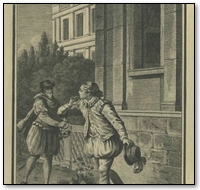
Amadour, who was not so ready to die as he affirmed, desisted promptly from his enterprise; and when the lady opened the door she found him close beside it, and Florida some distance from him. "Amadour," said the Countess, "what is the matter? Tell me the truth."
Amadour, who was never at a loss for invention, replied with a pale and daunted face—
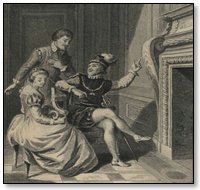
"Alas! madam, what change is this in the lady Florida? I was never so astonished before, for, as I have told you, I thought I had a share in her favour; but I now see clearly that I have lost it all. While she was being brought up by you, she was, I think, no less discreet or virtuous than she is at present; however, she had then no qualms of conscience about speaking with any one. But now, when I sought to look at her, she would not suffer me to do so. When I saw this behaviour on her part I thought I must be dreaming, and asked her for her hand to kiss it after the manner of the country. This she utterly refused me. I acknowledge, madam, that then I acted wrongfully, and I entreat your pardon for it; for I took her hand, as it were by force, and kissed it. I asked nothing more of her, but I believe that she intends my death, for she called out to you as you know. Why she did this I cannot tell, unless indeed she feared that I had some other purpose in view. Nevertheless, madam, be this as it may, I confess that I am in the wrong; for although she ought to love all who are devoted to you, fortune wills it that I, who am of all most attached to her, am banished from her good graces. Still, I shall ever continue the same both to you and to her; and I entreat you to continue me in your good favour since, by no fault of my own, I have now lost hers."
The Countess, who partly believed and partly suspected him, went up to her daughter and asked—"Why did you call me so loudly?"
Florida replied that she had felt afraid; and, although the Countess questioned her minutely on many points, she would give no other reply. Finding that she had escaped from her enemy she deemed him sufficiently punished by the failure of his attempt.
After the Countess had had a long conversation with Amadour, she suffered him to speak again in her presence with Florida, to see how he would behave. He said but little, save that he thanked her for not having confessed the truth to her mother, and begged that since she had expelled him from her heart, she would at least allow no other to take his place.
"If my voice had not been my only means of defending myself," she replied, "it would never have been heard; and from me you shall have no worse punishment, if you do not force me to it by troubling me again as you have done. Do not fear that I can ever love another; since I have not found the good I wished for in a heart that I considered to be the most virtuous in the world, I do not expect to find it in any man. This evil fortune will henceforth free me of all the passion that love can give."
With these words she bade him farewell.
Her mother, who had been watching her face, was unable to form any opinion; though from that time forth she clearly saw that her daughter had lost all affection for Amadour. She imagined her so devoid of reason as to hate everything that she herself loved; and from that hour she warred with her in a strange way, spending seven years without speaking to her except in anger, all which she did at Amadour's request.
Meanwhile, on account of her mother's harsh treatment, Florida's former dread of being with her husband was changed into a desire of never leaving him. Seeing, however, that all her efforts were useless, she resolved to deceive Amadour, and laying aside her coldness for a day or two, she advised him to pay court to a lady who, she said, had been speaking of their love.
This lady lived with the Queen of Spain, and was called Loretta. Amadour believed the story, and, thinking that he might in this way regain Florida's good graces, he made love to Loretta, who was the wife of a captain, one of the viceroys of the King of Spain. She, in her pleasure at having gained such a lover, showed so much elation that the affair was rumoured abroad. Even the Countess of Aranda, who was at Court, had knowledge of it, and thenceforward treated Florida less harshly than before.
One day Florida heard that the captain, Loretta's husband, had grown jealous, and was resolved to kill Amadour in one way or another as best he might. In spite of her altered treatment of Amadour, Florida did not desire that evil should befall him, and so she immediately informed him of what she had heard. He was quite ready to hark back again to his first love, and thereupon told her that, if she would grant him three hours of her conversation every day, he would never again speak to Loretta. But this she would not grant. "Then," said Amadour, "if you will not give me life, why prevent me from dying, unless indeed you hope to make me suffer more pain during life than any death could cause? But though death shun me, I will seek it until I find it; then only shall I have rest."
While they were on this footing, news came that the King of Granada (22) was entering upon a great war against the King of Spain. The latter, therefore, sent the Prince, his son, (23) to the war, and with him the Constable of Castille and the Duke of Alba, (24) two old and prudent lords. The Duke of Cardona and the Count of Aranda were unwilling to remain behind, and prayed the King to give them some command. This he did as befitted their rank, and gave them into the safe keeping of Amadour, who performed such extraordinary deeds during the war, that they seemed to be acts as much of despair as of bravery.
Coming now to the point of my story, I have to relate how his overboldness was proved by his death. The Moors had made a show of offering battle, and finding the Christian army very numerous had feigned a retreat. The Spaniards started in pursuit, but the old Constable and the Duke of Alba, who suspected the trickery of the Moors, restrained the Prince of Spain against his will from crossing the river. The Count of Aranda, however, and the Duke of Cardona crossed, although it was forbidden; and when the Moors saw that they were pursued by only a few men they faced about again. The Duke of Cardona was struck down and killed with a blow of a scimitar, and the Count of Aranda was so grievously wounded that he was left for dead. Thereupon Amadour came up filled with rage and fury, and bursting through the throng, caused the two bodies to be taken up and carried to the camp of the Prince, who mourned for them as for his own brothers. On examining their wounds the Count of Aranda was found to be still alive, and was sent in a litter to his home, where he lay ill for a long time. On the other hand, the Duke's body was sent back to Cardona.
Meanwhile Amadour, having made this effort to rescue the two bodies, had thought so little of his own safety that he found himself surrounded by a large number of Moors. Not desiring his person to be captured any more than he had captured that of his mistress, nor to break his faith with God as he had broken faith with her—for he knew that, if he were taken to the King of Granada, he must either die a cruel death or renounce Christianity—he resolved to withhold from his enemies the glory either of his death or capture. So kissing the cross of his sword and commending his body and soul to God, he dealt himself such a thrust as to be past all help.
Thus died the unhappy Amadour, lamented as deeply as his virtues deserved. The news spread through the whole of Spain; and the rumour of it came to Florida, who was at Barcelona, where her husband had formerly commanded that he should be buried. She gave him an honourable funeral, (25) and then, without saying anything to her mother or mother-in-law, she became a nun in the Convent of Jesus, taking for husband and lover Him who had delivered her from such a violent love as that of Amadour's, and from such great affliction as she had endured in the company of her husband. Thus were all her affections directed to the perfect loving of God; and, after living for a long time as a nun, she yielded up her soul with gladness, like that of the bride when she goes forth to meet the bridegroom.
"I am well aware, ladies, that this long tale may have been wearisome to some among you, but had I told it as it was told to me it would have been longer still. Take example, I beg you, by the virtue of Florida, but be somewhat less cruel; and think not so well of any man that, when you are undeceived, you occasion him a cruel death and yourselves a life of sorrow."
Having had a long and fair hearing Parlamente said to Hircan—
"Do you not think that this lady was pressed to extremities and that she held out virtuously?"
"No," said Hircan; "a woman can make no more feeble resistance than to cry out. If she had been in a place where none could hear her I do not know how she would have fared. And if Amadour had had more love and less fear he would not have desisted from his attempt for so little. So this story will not cause me to change my firm opinion that no man ever perfectly loved a lady, or was loved by her, that he did not prove successful if only he went the right way to work. Nevertheless, I must praise Amadour for having in part done his duty."
"What duty?" asked Oisille. "Do you call it a lover's duty to try and take his mistress by force when he owes her all reverence and submission?"
Here Saffredent took up the discourse.
"Madam," he said, "when our mistresses hold their state in chamber or hall, seated at their ease as though they were our judges, we lead them to the dance in fear; we wait upon them with all diligence and anticipate their commands; and we are so afraid of offending them and so desirous of doing them service that those who see us pity us, and often deem us more witless than brutes. They account us dull and void of understanding, and give praise to the ladies, whose faces are so imperious and their speech so fair that they make themselves feared, loved, and honoured by those who only know them outwardly. But when we are together in private, and love alone can judge our behaviour, we know full well that they are women and we are men. Then is the name 'mistress' changed to 'sweetheart,' and the 'slave' becomes a 'lover.' As the proverb says—'By service true and loyalty, do servants rise to mastery.' They have honour equally with men, who can give it to them and can take it away; and seeing us suffer in patience, they should reward us when they can do so without hurt to their honour."
"You do not speak of that true honour," said Longarine, "which is the greatest happiness this world can give. If every one calls me a virtuous woman, and I myself know the contrary, the praise I receive only increases my shame and puts me in secret to still greater confusion. In the same way, if people condemn me and I know that I am innocent, their condemnation will only make me the better pleased with myself."
"In spite of what you all have said," interposed Geburon, "it seems to me that Amadour was as noble and virtuous a knight as ever lived, and I think I can recognise him under his feigned name. Since Parlamente would not name him, neither will I. But you may rest assured that, if he be the man whom I have in mind, his heart never knew fear, nor was ever void of love and bravery."
"The day has been spent so pleasantly," said Oisille, "that if the others are like it I think our talk will make the time pass quickly by. But see where the sun is, and listen to the abbey bell, which has long been calling us to vespers. I did not mention this to you before, for I was more inclined to hear the end of the story than to go to prayers."
At these words they all rose, and when they reached the abbey they found that the monks had been waiting for them a full hour and more. After vespers they went to supper, and during the whole evening they conversed about the stories they had heard, all of them searching every corner of their memories to try and make the second day as pleasant as the first. And after playing many games in the meadow they went to bed, and so made a glad and happy ending of the first day.
Footnotes:
- This tale appears to be a combination of fact and fiction. Although Queen Margaret states that she has changed the names of the persons, and also of the places where the incidents happened, several historical events are certainly brought into the narrative, the scene of which is laid in Spain during the reign of Ferdinand and Isabella. M. Le Roux de Lincy is of opinion, however, that Margaret really refers to some affair at the Court of Charles VIII. Or Louis XII., and he remarks that there is great similarity between the position of the Countess of Aranda, left a widow at an early age with a son and a daughter, and that of Louise of Savoy with her two children. M. Lacroix and M. Dillaye believe the hero and heroine to be Admiral de Bonnivet and Margaret. It has often been suspected that the latter regarded her brother's favourite with affection until after the attempt related in Tale IV.—Ed.
- Aranda, in the valley of the Duero, between Burgos and Madrid, is one of the most ancient towns in Spain, but of miserable aspect, although a large trade is carried on there in cheap red wines. (Ferdinand and Isabella resided for some time at Aranda.—Ed.)
- This castle is called La Jafferie in Boaistuau's edition of 1558, and several learned commentators have speculated as to which is the correct spelling. Not one of them seems to have been aware that in the immediate vicinity of Saragossa there still stands an old castle called El Jaferia or Aljaferia, which, after being the residence of the Moorish sovereigns, became that of the Spanish kings of Aragon. It has of modern times been transformed into barracks.—Ed.
- Henry of Aragon, Duke of Segorbe and Count of Ribagorce, was Viceroy of Catalonia at this period. He was called the Infante of Fortune, on account of his father having died before his birth in 1445.—B. J.
- M. Lacroix asserts that the Infante of Fortune left no son by his wife, Guyomare de Castro y Norogna; whereas M. Le Roux de Lincy contends that he had a son—Alfonso of Aragon— who in 1506 was proposed as a husband for Crazy Jane. Alfonso would therefore probably be the prince referred to by Margaret.—Ed.
- Cardona, a fortified town on the river Cardoner, at a few miles from Barcelona, was a county in the time of Ferdinand and Isabella, and was raised by them to the rank of a duchy in favour of Ramon Folch I. To-day it has between two and three thousand inhabitants, and is chiefly noted for its strongly built castillo. The young Duke spoken of by Queen Margaret would be Ramon Folch's son, who was also named Ramon.—B. J. And Ed.
- There had been a truce in 1497, but Queen Margaret probably alludes to that of four months' duration towards the close of 1503.—B.J.
- Felix-Maria, widow of the Duke of Feria, and elder sister of Luis Francisco de la Cerda, ninth of the name. She became heiress to the titles and estates of the house of Medina- Celi upon her brother's death. If, however, Queen Margaret is really describing some incident in her own life, she must refer to Louis XII.'s daughter, Claude, married in 1514 to Francis I.—D.
- The castle here referred to was the Moorish Alcazar, destroyed by fire in 1734. The previous statement that King Ferdinand withdrew to Madrid on account of the bad air prevailing in other places is borne out by the fact that the town enjoyed a most delightful climate prior to the destruction of the forests which surrounded it.—Ed.
- There had been a revolt at Granada in 1499, and in the following year the Moors rose in the Alpujarras, whereupon King Ferdinand marched against them in person.—L.
- Salces, a village about fifteen miles north of Perpignan, noted for its formidable fortress, still existing and commanding a pass through the Corbière Mountains, which in the fifteenth and sixteenth centuries separated France from Roussillon, then belonging to Spain. The French burnt the village and demolished the fort of Salces in 1496, but the latter was rebuilt by the Spaniards in the most massive style. The walls of the fort are 66 feet thick at the base and 54 feet thick at the summit. When Queen Margaret returned from Spain in 152,5 she reached France by the pass of Salces. (See vol. I. P. Xlvi.).—Ed.
- In 1503 the French, under Marshals de Rieux and de Gié, again besieged Salces, which had a garrison of 1200 men. The latter opposed a vigorous defence during two months, and upon the arrival of the old Duke of Alba with an army of succour the siege had to be raised.—B. J.
- Pedro Manriquez de Lara, Count of Trevigno, created Duke of Najera by Ferdinand and Isabella in 1501.—B. J.
- The Duke's war-cry, repeated by his followers as a rallying signal in the mêlée. War-cries varied greatly. "Montjoie St. Denis" was that of the kings of France, and "Passavant le meilleur" (the best to the front) that of the Counts of Champagne. In other instances the war-cry consisted of a single word, "Bigorre" being that of the kings of Navarre, and "Flanders" that of the Princess of Beaujeu. When the war-cry was merely a name, as in the case of the Duke of Najera, it belonged to the head of the family.—D.
- The above two sentences, deficient in the MS. Followed by M. Le Roux de Lincy, have been borrowed from MS. No. 1520 (Bib. Nat.). It was in 1503 that a Moorish flotilla ravaged the coast of Catalonia.—Ed.
- The village of Palamos, on the shores of the Mediterranean, south of Cape Bagur, and within fifteen miles from Gerona.—Ed.
- The Spanish historians state that in 1513 the King, to put an end to a quarrel between the Count of Aranda and the Count of Ribagorce, charged Father John of Estuniga, Provincial of the Order of St. Francis, to negotiate a reconciliation between them, based on the marriage of the eldest daughter of the Count of Aranda with the eldest son of the Count of Ribagorce. The latter refusing his consent, was banished from the kingdom.—D.
- The passage commencing "Those who are driven" and ending "a cruel death" is deficient in the earlier editions of the Heptameron, which give the following in place of it: "Do not doubt but what those who have felt the power of love will cast the blame on you who have so robbed me of my liberty and dazzled my senses with your divine graces, that not knowing what to do henceforth, I am constrained to go away without the hope of ever seeing you again; certain, however, that wherever I may be, you will still have part of my heart, which will ever remain yours, be I on land, on the sea, or in the hands of my most cruel enemies." The above is one of various instances of the liberty taken by Boaistuau and Gruget with Margaret's text.—Ed.
- Margaret, perhaps, wrote "All the paper of Spain could not contain them," simply because Spanish paper was then of very small size. Paper-making had, however, been almost monopolised by Spain until the end of the thirteenth century, the cotton used in the manufacture being imported from the East.—M.
- The Viceroy of Catalonia.—D.
- Leucate, now a village, but said to have been a flourishing town in the fourteenth century, lies near the Mediterranean, at a few miles from Salces, and gives its name to a large salt-water lake. Formerly fortified, it was repeatedly besieged and burnt by the Spaniards; notably by the Duke of Alba in 1503, after he had relieved Salces.—Ed.
- The last King of Granada was Mahomed Boabdil, dethroned in 1493. The title may have been assumed, however, by the leader of an insurrection.—D.
- As Ferdinand and Isabella had no son, the reference must be to their daughter's husband, Philip the Fair of Austria, son of the Emperor Maximilian I. And father of Charles V.— B. J.
- Frederick of Toledo, Marquis of Coria and Duke of Alba, generally called the old Duke of Alba to distinguish him from his son.—B. J.
- The Franciscan monastery of the little village cf Bellpuig, near Lerida, contains the tomb of Ramon de Cardona, termed one of the marvels of Catalonia on account of the admirable sculptures adorning it. One of the beautiful white marble bas-reliefs shows a number of galleys drawn up in line of battle, whilst some smaller boats are conveying parties of armed men to a river-bank on which the Moors are awaiting them in hostile array. On the frieze of an arch the Spaniards and Moors are shown fighting, many of the former retreating towards the water. An inscription records that the tomb was raised to the best of husbands by Isabella, his unhappy spouse.
- Margaret gives the name of Florida to the wife of the Duke whom she mentions, but it should be borne in mind that she has systematically mingled fact with fiction throughout this story; and that she was alluding to the Duke buried at Bellpuig seems evident from an examination of the bas- reliefs mentioned above. Ramon de Cardona was, however, a more important personage than she pictures him. He became Charles V.'s viceroy in Naples, and did not die till 1520, whereas Margaret's story appears to end in or about 1513. Possibly she saw the tomb when in Spain.—Ed.
Online Edition of the Heptameron

This is the Heptameron of Marguerite de Navarre
Other Sites: CruikshankArt.com · Dante's Inferno · Book-Lover.com · Canterbury Tales ·
This site is created by the Heptameron Information Society.