
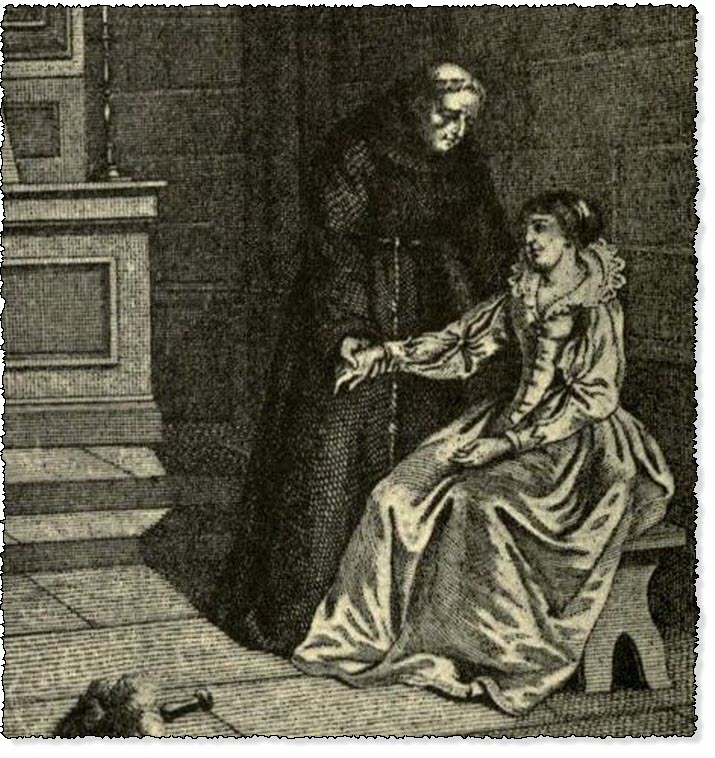
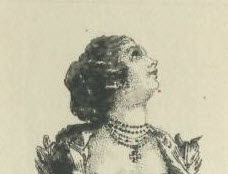
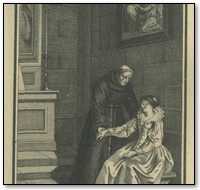
The Lady Fainting in The Arms of The Gentleman Of Valencia Who Had Become a Monk
>The Heptameron - Day 7 - Tale 64 - The Lady Fainting in The Arms of The Gentleman Of Valencia Who Had Become a Monk
Summary of the Fourth Tale Told on the Seventh of the Heptameron
Tale 64 of the Heptameron
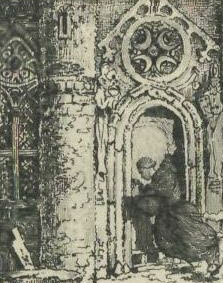
In the city of Valencia there lived a gentleman, who for the space of five or six years had loved a lady so perfectly that the honour and conscience of neither of them had taken any hurt; for his intent was to have her as his wife, and this was reasonable, seeing that he was handsome, rich and of good descent. But, before he became her lover, he first inquired concerning her own mind, whereupon she declared herself willing to marry according to the counsels of her kinsfolk. The latter, being come together for the purpose, deemed the marriage a very reasonable one provided that the maiden was herself disposed to it; but she—whether because she thought to do better or because she wished to hide her love for him—-made some difficulty, and the company separated, not without regret at having failed to conclude a match so well suited to both parties.
The most grieved of all was the poor gentleman, who would have borne his misfortune with patience had he thought that the fault lay with the kinsfolk and not with her; but he knew the truth, and the knowledge was to him worse than death. So, without speaking to his sweetheart or to any other person, he withdrew to his own house, and, after setting his affairs in order, betook himself to a solitary spot, where he strove to forget his love and change it wholly to that love of our Lord which were truly a higher duty than the other.
During this time he received no tidings of his mistress or her kindred, and he therefore resolved that, since he had failed to obtain the happiest life he could hope for, he would choose the most austere and disagreeable that he could imagine. With this sad intent, which might well have been called despair, he went and became a monk in the monastery of St. Francis. This monastery was not far from the dwellings of divers of his kinsfolk, who, on hearing of his desperate condition, did all that in them lay to hinder his purpose; but this was so firmly rooted in his heart that it was not possible to turn him from it.
Nevertheless, as the source of his distemper was known to them, they determined to seek the cure, and so repaired to her who was the cause of his sudden devoutness. She was greatly astonished and grieved by this mischance, for, in refusing for a time, she had thought only to test his affection, not to lose it for ever. Seeing now the evident risk that she ran of doing this last, she sent him a letter, which, ill-translated, was as follows:—
"Since love, if tested not full needfully, Steadfast and faithful is not shown to be, By length of time my heart would that assay Whereon itself was set to love alway— To wit, a husband with that true love filled Such as no lapsing time has ever killed. This, then, was the sole reason that I drew My kin to hinder for a year or two That closest tie which lasts till life is not, And whereby woe is oftentimes begot. Yet sought I not to have you wholly sent Away; such was in no wise my intent, For none save you could I have e'er adored Or looked to as my husband and my lord. But woe is me, what tidings reach mine ear! That you, to lead the cloistered life austere, Are gone with speech to none; whereat the pain That ever holds me, now can brook no rein, But forces me mine own estate to slight For that which yours aforetime was of right; To seek him out who once sought me alone, And win him who myself has sometimes won. Nay then, my love, life of the life in me, For loss of whom I fain would cease to be, Turn hither, graciously, those eyes of pain And trace those wandering footsteps back again. Leave the grey robe and its austerity, Come back and taste of that felicity Which often you desired, and which to-day Time has nor slain, nor swept away. For you alone I've kept myself; and I, Lacking your presence, cannot choose but die. Come back then; in your sweetheart have belief, And for past memories find cool relief In holy marriage-ties. Ah! then, my dear, To me, not to your pride give ready ear, And rest of this assured, I had no thought To give, sweetheart, to you offence in aught, But only yearned your faithfulness to prove And then to make you happy with my love. But now that through this trial, free from scathe, Are come your steadfastness and patient faith, And all that loyal love to me is known, Which at the last has made me yours alone, Come, my beloved, take what is your due And wholly yield to me, as I to you!"
This letter, brought by a friend of hers with every remonstrance that it was possible to make, was received and read by the gentleman friar with such sadness of countenance, such sighs and such tears, that it seemed as though he would drown and burn the poor epistle. But he made no reply to it, except to tell the messenger that the mortification of his exceeding passion had cost him so dear as to have taken from him both the wish to live and the fear to die. He therefore requested her who had been the cause of this, that since she had not chosen to satisfy his passionate longings, she would, now that he was rid of them, abstain from tormenting him, and rest content with the evil which was past. For that evil he could find no remedy but the choice of an austere life, which by continual penance might bring him to forget his grief, and, by fasts and disciplines, subdue his body, till the thought of death should be to him but a sovereign consolation. Above all, he begged that he might never hear of her, since he found the mere remembrance of her name a purgatory not to be endured.
The gentleman went back with this mournful reply, and reported it to the maiden who did not hear it without intolerable sorrow. But Love, which will not suffer the spirit utterly to fail, gave her the thought that, if she could see him, her words and presence might be of more effect than the writing. She therefore, with her father and the nearest of her kin, went to the monastery where he abode. She had left nothing in her box that might set off her beauty, for she felt sure that, could he but once look at her and hear her, the fire that had so long dwelt in both their hearts must of necessity be kindled again in greater strength than before.
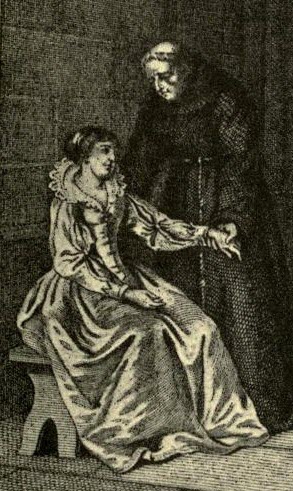
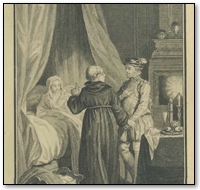
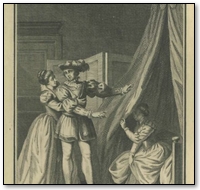
Coming thus into the monastery towards the end of vespers, she sent for him to come to her in a chapel that was in the cloister. He, knowing not who it was that sought him, went in all ignorance to the sternest battle in which he had ever been. When she saw him so pale and wan that she could hardly recognise him, yet filled with grace, in no whit less winning than of yore, Love made her stretch out her arms to embrace him, whilst her pity at seeing him in such a plight so enfeebled her heart, that she sank swooning to the floor.
The poor monk, who was not void of brotherly charity, lifted her up and set her upon a seat in the chapel. Although he had no less need of aid than she had, he feigned to be unaware of her passion, and so strengthened his heart in the love of God against the opportunities now present with him, that, judging by his countenance, he seemed not to know what was actually before him. Having recovered from her weakness, she turned upon him her beautiful, piteous eyes, which were enough to soften a rock, and began to utter all such discourse as she believed apt to draw him from the place in which he now was. He replied as virtuously as he was able; but at last, finding that his heart was being softened by his sweetheart's abundant tears, and perceiving that Love, the cruel archer whose pains he long had known, was ready with his golden dart to deal him fresh and more deadly wounds, he fled both from Love and from his sweetheart, like one whose only resource lay, indeed, in flight.
Heptameron Story 64
When he was shut up in his room, not desiring to let her go without some settlement of the matter, he wrote her a few words in Spanish, which seem to me so excellent in their matter that I would not by translating them mar their grace. These were brought to her by a little novice, who found her still in the chapel and in such despair that, had it been lawful, she too would have remained there and turned friar. But when she saw the words, which were these—
     "Volvete don venesti, anima mia,
     Que en las tristas vidas es la mia," (1)
she knew that all hope was gone, and she resolved to follow the advice of him and her friends, and so returned home, there to lead a life as melancholy as that of her lover in his monastery was austere.
"You see, ladies, what vengeance the gentleman took upon his harsh sweetheart, who, thinking to try him, reduced him to such despair that, when she would have regained him, she could not do so."
"I am sorry," said Nomerfide, "that he did not lay aside his gown and marry her. It would, I think, have been a perfect marriage."
"In good sooth," said Simontault, "I think he was very wise. Anyone who well considers what marriage is will deem it no less grievous than a monkish life. Moreover, being so greatly weakened by fasts and abstinence, he feared to take upon him a burden of that kind which lasts all through life."
"Methinks," said Hircan, "she wronged so feeble a man by tempting him to marriage, for 'tis too much for the strongest man alive; but had she spoken to him of love, free from any obligation but that of the will, there is no friar's cord that would not have been untied. However, since she sought to draw him out of purgatory by offering him hell, I think that he was quite right to refuse her, and to let her feel the pain that her own refusal had cost him."
"By my word," said Ennasuite, "there are many who, thinking to do better than their fellows, do either worse or else the very opposite of what they desire."
"Truly," said Geburon, "you remind me—though, indeed, the matter is not greatly to the point—of a woman who did the opposite of what she desired, and so caused a great uproar in the church of St. John of Lyons."
"I pray you," said Parlamente, "take my place and tell us about it."
"My story," said Geburon, "will not be so long or so piteous as the one we have heard from Parlamente."
Footnotes:
Online Edition of the Heptameron
This is the Heptameron of Marguerite de Navarre
Other Sites: CruikshankArt.com · Dante's Inferno · Book-Lover.com · Canterbury Tales ·
This site is created by the Heptameron Information Society.