
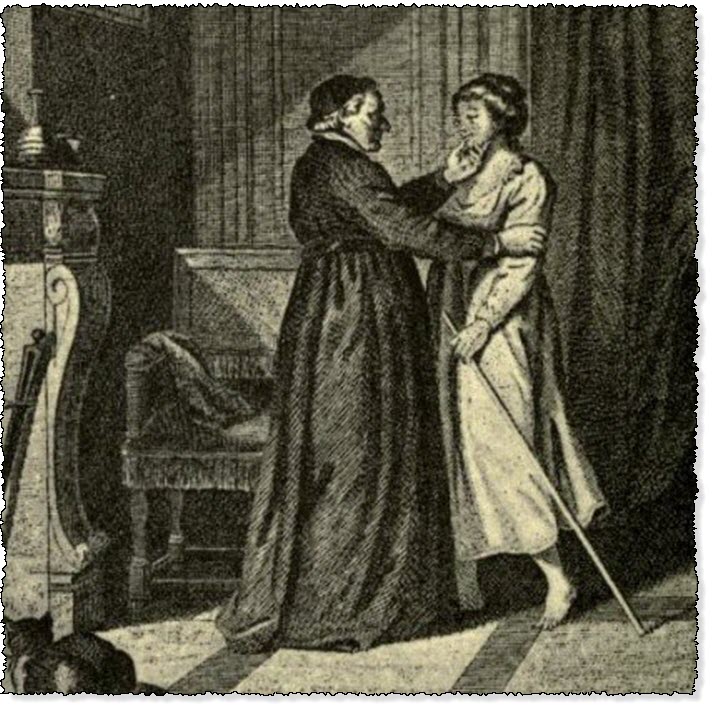
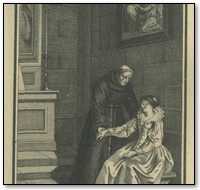
The Lady Returning to Her Lover, The Canon of Autun
The Lady Returning to Her Lover, The Canon of Autun
Summary of the First Tale Told on the Seventh Day of the Heptameron
Heptameron Tale 61
Heptameron Tale 61
Near the town of Autun there lived a very beautiful woman, who was tall, fair, and as handsome of feature as any I have ever seen. She was married to an honest man who seemed somewhat younger than herself, and who loved and treated her well enough to give her reason for content.
A little while after they were married, he took her to the town of Autun, where he had business; and while he was engaged with the law, his wife would go to the church to pray God for him.
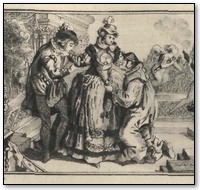
She repaired so often to this holy place that a very rich Canon fell in love with her, and wooed her so urgently that the unhappy creature gave herself up to him. Her husband had no suspicion of this, however, for he gave more thought to the guarding of his property than of his wife.
When the time for departure was come, and they must needs return to their home, which was full seven leagues from the town, great was the woman's sorrow. But the Canon promised that he would often go and see her, and this he did, pretending to be making some journey which led him past the house. The gentleman, however, was not so foolish as not to perceive the truth, and he so skilfully contrived matters, that when the Canon came thither he no longer met the wife, who was too well hidden by her husband to allow of his having any speech with her. The wife, knowing her husband's jealousy, gave no sign that this was displeasing to her; nevertheless, she resolved to set things to rights, for she felt herself as it were in hell, deprived as she was of the sight of her God.
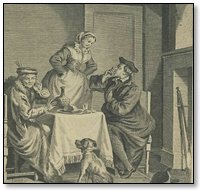
Heptameron Story 61
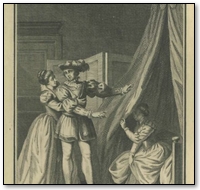
One day, when her husband was abroad, she found a means to occupy her servants, both men and women, after such a fashion that she was left alone in the house. Immediately, she took what was needful, and, with no company save that of the wanton love she carried with her, she repaired on foot to Autun. Here she arrived none too late to be recognised by her Canon, who kept her shut up in hiding for more than a year, and this in spite of the monitions and excommunications that were procured against him by her husband.
The latter, finding that he had no other remedy, at last complained to the Bishop, who had an Archdeacon, as worthy a man as any at that time in France. This Archdeacon himself searched with great diligence through all the Canon's houses, until he discovered the one in which the woman was being kept in concealment, whereupon he cast her into prison, and laid heavy penance upon the Canon.
The husband, knowing that his wife had been recovered by the counsels of the Archdeacon and divers other excellent persons, was content to take her back on her swearing to him that she would live for the future as beseemed a virtuous woman.
This the worthy man in his deep love for her readily believed, and, bringing her back to his house, he treated her as honourably as before, except that he gave her two old serving-women who never left her, one or other of them being at all times with her.
But, however kindly her husband might use her, the wicked love she bore towards the Canon caused her to regard all rest as torment. And although she was a very beautiful woman and her husband a man of excellent constitution, vigorous and strong, she never had any children by him, her heart being always seven leagues away from her body; this, however, she concealed so well that it seemed to her husband that, like himself, she had wholly forgotten the past.
But in her great wickedness she was not so minded; for, just when she saw her husband most in love with her and having least suspicion, she pretended to fall ill, and continued in this pretence until her husband was in wondrous distress, and anxious to spare nought that might relieve her.
However, she played her part so exceedingly well that he, and all in the house, thought that she was sick unto death, and was growing by degrees weaker and weaker. Finding that her husband was no less grieved than he should have been glad, she begged of him that he would authorise her to make her will, and this with tears he did.
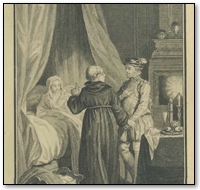
Having power of bequest, although she had no children, she gave to her husband what she could, craving at the same time his forgiveness for her wrong-doing towards him. Then she sent for the priest, confessed herself, and received the Holy Sacrament of the Altar with such devoutness, that all wept to see so glorious an end.
When the evening was come, she begged her husband to send for the extreme unction, saying that, as she was growing very weak, she was in fear lest she might not live to receive it. Her husband in all haste caused it to be brought by the priest, and she, by receiving it with very great humility, prompted every one to praise her.
After she had got through her brave mysteries, she told her husband that, having through God's grace received all that the Church commands, she felt great peace of conscience, and would fain take some rest; and she begged him to do the like, seeing that he had great need of it after all his weeping and watching with her.
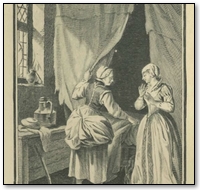
When her husband was gone, and all his servants with him, the poor old women, who had so long watched her in health and now had no fear of losing her except by death, went contentedly and comfortably to bed. As soon as she heard them asleep and loudly snoring, she rose in nothing but her shift, and went out of the room, listening to hear if any one was yet astir in the house. Taking every precaution, she then (as she well knew how) let herself out through a little garden-gate that was not shut, and, barefooted and in her shift, journeyed all night long towards Autun and the saint, who had preserved her from death.
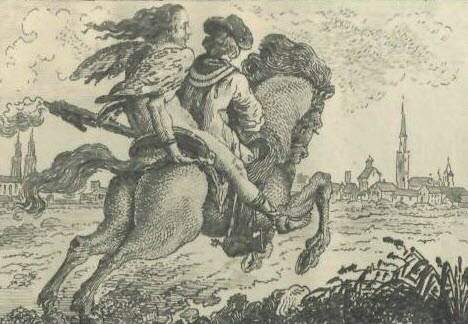
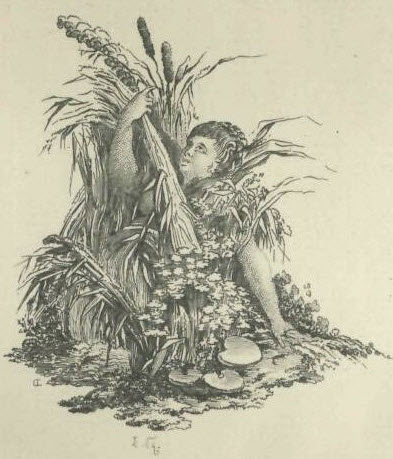
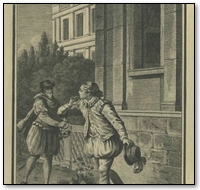
It happened, however, that as the distance was great, she could not accomplish the whole of it before daylight overtook her. Looking then all along the road, she perceived two horsemen who were galloping at full speed, and thinking that it might be her husband in search of her, she hid herself entirely in a marsh, with her head among the reeds. As her husband (for he it was) passed close beside her, he spoke to a servant who was with him, in tones of deep despair, saying—
"Ah, the wicked woman! Who could have thought that so foul and abominable a deed could be hidden under cloak of the holy sacraments of the Church."
"If Judas," replied the servant, "feared not to betray his Master when he was receiving the like, a woman's treachery is but small matter for wonder."
At this point the husband passed on, and his wife remained among the rushes, in greater gladness at having deceived and escaped him than she had ever felt at home in a good bed but in subjection.
The poor husband sought her through all the town of Autun, but learning for certain that she had not entered it, he retraced his steps, complaining unceasingly of her and of his loss, and threatening her with nothing short of death if he should find her. Of this she had as little fear in her mind as she had of cold in her body, although the place and season might well have caused her to repent of her evil journey. And any one who did not know how the fire of hell inflames those that are filled with it, must needs wonder how it was that this unhappy woman could so leave a warm bed and continue for a whole day in the piercing cold.
Yet she neither lost courage nor gave up the journey, but, as soon as night was come, went forward once more. Just as the gate at Autun was being closed, this pilgrim arrived thither and repaired straight to the shrine of her saint, who was in great wonder at her coming, and could scarcely believe that it was indeed she. But when he had carefully looked at her and examined her at all points, he found that, unlike a spirit, she was really possessed of bone and flesh, and so became convinced that she was no ghost.
And thenceforward they agreed so well together that she dwelt with the Canon for fourteen or fifteen years.
Although for a time she lived in concealment, in the end she lost all fear, and (what is worse) became so exceedingly proud of her lover that at church she would set herself before most of the honourable women of the town, wives of officials and others. Moreover, she had children by the Canon, and among others a daughter who was married to a rich merchant, and who had so magnificent a wedding that all the women of the town murmured exceedingly, yet were powerless to set the affair to rights.
Now it happened that at this time Queen Claude, wife of King Francis, passed through the town of Autun, having with her my Lady the Regent, mother of the King aforesaid, and the Duchess of Alençon, her daughter. (1) One of the Queen's waiting-women, named Perrette, came to the Duchess and said—
"Madam, I pray you listen to me, and you will do a better deed than if you went to hear the whole day's service at the church."
The Duchess gave ready heed, knowing that nought but good counsel could come from her. Then Perrette forthwith told her how she had taken a young girl to help her in washing the Queen's linen, and how, on asking the news of the town, she had heard from her the vexation which all the honourable women endured at seeing the Canon's mistress go before them, together with some of the history of the wicked woman's life.
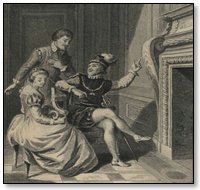
The Duchess went immediately to the Queen and my Lady the Regent, and told them the story; and they, without any form of law, sent for the unhappy woman. The latter sought no concealment, for her shame was turned to pride at being mistress in the household of so rich a man; and hence, with no feeling of confusion or disgrace, she presented herself before the ladies aforesaid, who were so abashed by her hardihood that at first they knew not what to say. After a time, however, my Lady the Regent rebuked her in a fashion which would have made a right-thinking woman weep, though this unhappy creature did not do so, but with great boldness said—
"I pray you, ladies, let my honour go unscathed, for, God be praised, I have lived so well and virtuously with the Canon that no person alive can say aught against me. And let it not be thought that I am living in opposition to the will of God, since, for three years past, the Canon has not come near me, and we live together as chastely and as lovingly as two little angels, without any speech or wish between us to the contrary. And any one separating us will commit a great sin, for the worthy man, who is nigh eighty years old, will not live long without me, who am forty-five."
You may imagine how the ladies then comported themselves, and what remonstrance they all made with her; but, in spite of the words that were spoken, and her own age, and the honourable indignation of those present, her obstinacy was not softened. That she might be the more effectually humbled, they sent for the good Archdeacon of Autun, and he condemned her to lie in prison for a year, faring on bread and water. The ladies further sent for her husband, and he, after hearing their excellent exhortations, was content to take her back again after she should have performed her penance.
But when she found that she was a prisoner, and that the Canon was resolved to have her back no more, she thanked the ladies for having taken a devil off her shoulders, and showed such deep and perfect contrition that her husband, instead of waiting until the year should have expired, came and asked her of the Archdeacon before a fortnight was over; and since then they have lived together in all peace and affection.
"You see, ladies, how the chains of St. Peter are by wicked ministers converted into those of Satan, which it is so hard to break that even the sacraments, which cast out devils from the body, are here the means of making them abide longer in the conscience; for the best things, when abused, bring about most evil."
"Truly," said Oisille, "this woman was a very wicked one, but at the same time she was well punished by her appearance before such judges as the ladies you have named. The mere glance of the Lady Regent had such power that never was there a woman, however virtuous, that did not dread being found unworthy in her sight. Those who were looked upon kindly by her deemed that they had earned a high honour, knowing as they did that none but virtuous women were favoured by her." (2)
"It were indeed a fine thing," said Hircan, "that there should be greater dread of a woman's eyes than of the Holy Sacrament, which, if it be not received in faith and charity, brings with it eternal damnation."
"Those," said Parlamente, "who are not inspired by God are, I promise you, in greater dread of the temporal than of the spiritual powers. And I believe that the poor creature was brought to mend her ways rather by her imprisonment and the thought of seeing her Canon no more, than by any remonstrance that might have been made to her."
"Nay," said Simontault, "you have forgotten the chief cause of her return to her husband, which was that the Canon was eighty years old, whilst her husband was younger than herself; so the worthy lady had the best of all her bargains. Had the Canon been young, she would not have been willing to forsake him, and the admonitions of the ladies would have been as ineffectual as the sacraments."
"Further," said Nomerfide, "I think she did well not to confess her sin so readily; such an offence ought to be humbly acknowledged to God, but stoutly denied before men. Even though it be true, still, by deception and swearing, doubt may be cast upon it."
"Not so," said Longarine. "A sin can scarcely be so secret that it will not become revealed, unless God in His pity conceal it, as in the case of those who for love of Himself have truly repented."
"And what," said Hircan, "will you say of those women who have no sooner done a deed of folly than they tell some one about it?"
"I think that a strange thing," answered Longarine, "and a sign that sin is not displeasing to them. If, as I said, a sin is not covered by the mercy of God, it cannot be denied before men; there are many who, delighting in such talk, glory to make their vices known, whilst others who contradict themselves in this way become their own accusers."
"If you know any such instance," said Saffredent, "I give you my place and beg you to tell it us."
"Listen then," said Longarine.
Footnotes:
- 1 This would have occurred in the late autumn of 1515, when the Court journeyed southward to meet Francis I. on his return from the Marignano campaign.—Ed.
- 2 We are asked to believe that Oisille is none other than the Lady Regent (Louise of Savoy), but is it likely she would thus speak of herself? We can scarcely conceive Queen Margaret perpetrating such a flagrant anachronism.—Ed.
Online Edition of the Heptameron
This is the Heptameron of Marguerite de Navarre
Other Sites: CruikshankArt.com · Dante's Inferno · Book-Lover.com · Canterbury Tales ·
This site is created by the Heptameron Information Society.