
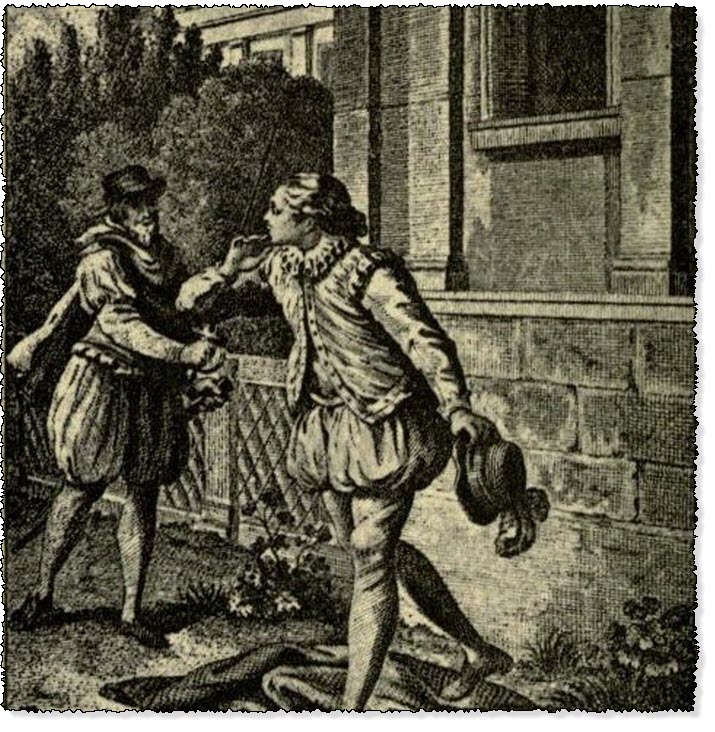
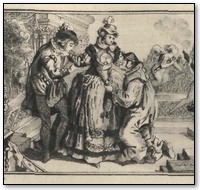
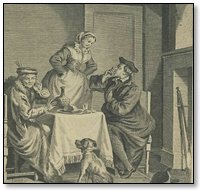
the Lord Des Cheriots Flying from The Prince's Servant
The Heptameron - Day 6 - Tale 53 - the Lord Des Cheriots Flying from The Prince's Servant
Summary of the Third Tale Told on the Sixth of the Heptameron
Tale 53 of the Heptameron
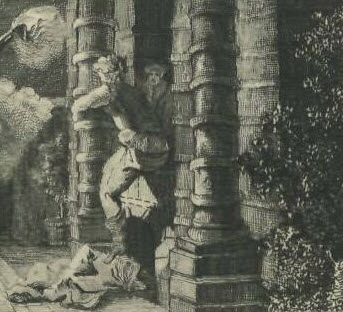
King Francis the First was once at a handsome and pleasant castle, whither he had gone with a small following, both for the purpose of hunting and in order to take some repose. With him in his train was a certain Prince of Belhoste, (1) as worshipful, virtuous, discreet and handsome a Prince as any at Court. The wife he had married did not belong to a family of high rank, yet he loved her as dearly and treated her as well as it were possible for a husband to do, and also trusted in her. And when he was in love with anybody he never concealed it from her, knowing that she had no other will than his own.
Now this Prince conceived a deep affection for a widow lady called Madame de Neufchastel, (2) who was reputed the most beautiful woman it were possible to see; and if the Prince of Bel-hoste loved her well, his wife loved her no less, and would often send and bid her to dinner, for she deemed her so discreet and honourable, that, instead of being grieved by her husband's love for her, she rejoiced to see him address his attentions to one so full of honour and virtue.
This affection lasted for a great while, the Prince of Belhoste caring for all the lady's affairs as though they were his own, and his wife doing no less. By reason, however, of her beauty many great lords and gentlemen earnestly sought the lady's favour, some only for love's sake, others for sake of the ring, for, besides being beautiful, she was also very rich.
Among the rest was a young gentleman, called the Lord des Cheriots, (3) who wooed her so ardently that he was never absent from her levee and couchée, and was also with her as much as possible during the day. This did not please the Prince of Belhoste, who thought that a man of such poor estate, and so lacking in grace, did not deserve an honourable and gracious reception, and he often made remonstrances about it to the lady. She, however, being one of Eve's daughters, (4) excused herself by saying that she spoke with every one in general, and that their own affection was the better concealed, since she never spoke more with one than with another.
Heptameron Story 53
Albeit, after some time, this Lord des Cheriots so pressed her that, more through his importunity than through love, she promised to marry him, begging him, however, not to urge her to reveal the marriage until her daughters were wedded. After this the gentleman was wont to go with untroubled conscience to her chamber at whatsoever hour he chose, and none but a waiting-woman and a serving-man had knowledge of the matter.
When the Prince perceived that the gentleman was growing more and more familiar in the house of her whom he so dearly loved, he took it in ill-part, and could not refrain from saying to the lady—
"I have always prized your honour like that of my own sister, and you are aware of the honourable manner in which I have addressed you, and the happiness that I have in loving a lady as discreet and virtuous as yourself; but did I think that another who deserves it not could win by importunity that which I am not willing to crave, contrary to your own desire, this would be unendurable to me, and in the like degree dishonouring to you. I tell you this because you are beautiful and young, and although hitherto of good repute, are now beginning to gain a very evil fame. Even though he be not your equal in birth or fortune, and have less influence, knowledge and address, yet it were better to have married him than to give all men matter for suspicion. I pray you, therefore, tell me whether you are resolved to love him, for I will not have him as fellow of mine. I would rather leave you altogether to him, and put away from me the feelings that I have hitherto borne you."
The poor lady, fearful of losing his affection, thereupon began to weep, and vowed to him that she would rather die than wed the gentleman of whom he had spoken, but (she added) he was so importunate that she could not help his entering her chamber at a time when every one else did so.
"Of such times as those," said the Prince, "I do not speak, for I can go as well as he, and see all what you are doing. But I have been told that he goes after you are in bed, and this I look upon as so extraordinary that, if you should continue in this mode of life without declaring him to be your husband, you will be disgraced more than any woman that ever lived."
She swore to him with all the oaths she could utter that the other was neither her husband nor her lover, but only as importunate a gentleman as there well could be.
"Since he is troublesome to you," said the Prince, "I promise you that I will rid you of him."
"What!" asked the lady. "Would you kill him?"
"No, no," said the Prince, "but I will give him to understood that it is not in such a place as this, not in such a house as the King's, that ladies are to be put to shame. And I swear to you by the faith of the lover that I am, that if, after I have spoken with him, he does not correct himself, I will correct him in such a manner as to make him a warning to others."
So saying he went away, and on leaving the room failed not to meet the Lord des Cheriots on his way in. To him he spoke after the fashion that you have heard, assuring him that the first time he was found there after an hour at which gentlemen might reasonably visit the ladies, he would give him such a fright as he would ever remember. And he added that the lady was of too noble a house to be trifled with after such a fashion.
The gentleman protested that he had never been in the room except in the same manner as the rest, and, if the Prince should find him there, he gave him full leave to do his worst.
One day afterwards, when the gentleman believed the Prince's words to have been forgotten, he went to see his lady in the evening, and remained sufficiently late.
The Prince [that same evening] told his wife that Madame de Neufchastel had a severe cold, upon hearing which the worthy lady begged that he would visit her on behalf of them both, and make excuse for herself, since she could not go by reason of a certain matter that she must needs attend to in her room.
The Prince waited until the King was in bed, and then went to give the lady good-evening, but as he was going up a stairway he met a serving-man coming down, who, on being asked how his mistress did, swore that she was in bed and asleep.
The Prince went down the stairway, but, suspecting that the servant had lied, looked behind and saw him going back again with all speed. He walked about the courtyard in front of the door to see whether the servant would return. A quarter of an hour later he perceived him come down again and look all about to see who was in the courtyard.
Forthwith the Prince was convinced that the Lord des Cheriots was in the lady's chamber, but through fear of himself durst not come down, and he therefore again walked about for a long-while.
At last, observing that the lady's room had a casement which was not at all high up, and which looked upon a little garden, he remembered the proverb which says, "When the door fails the window avails," and he thereupon called a servant of his own, and said to him—
"Go into the garden there behind, and, if you see a gentleman come down from the window, draw your sword as soon as he reaches the ground, clash it against the wall, and cry out, 'Slay! slay!' Be careful, however, that you do not touch him."
The servant went whither his master had sent him, and the Prince walked about until three hours after midnight.
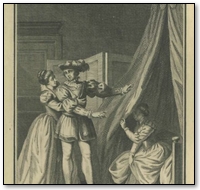
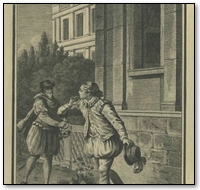
When the Lord des Cheriots heard that the Prince was still in the yard, he resolved to descend by the window, and, having first thrown clown his cloak, he then, by the help of his good friends, leapt into the garden. As soon as the servant saw him, he failed not to make a noise with his sword, at the same time crying, "Slay! slay!" Upon this the poor gentleman, believing it was his [the servant's] master, was in such great fear that, without thinking of his cloak, he fled as quickly as he was able.
He met the archers of the watch, who wondered greatly to see him running in this fashion, but he durst say nothing to them, except to beg them to open him the gate [of the castle], or else to lodge him with themselves until morning. And this, as they had not the keys, they did.
Then the Prince went to bed, and, finding his wife asleep, awoke her saying—
"Guess, my wife, what hour it is.''
"I have not heard the clock strike since I went to bed," she replied.
"It is three hours after midnight," said he.
"If that be so," said his wife, "where have you been all this time? I greatly fear that your health will be the worse for it."
"Sweetheart," said the Prince, "watching will never make me ill when I am engaged in preventing those who try to deceive me from going to sleep."
So saying, he began to laugh so heartily that his wife begged him to tell her of the matter. This he did at length, showing her the wolf's skin (4) which his servant had brought him. After making merry at the expense of the hapless lovers, they went to sleep in gentle tranquillity, while the other two passed the night in torment, fearing and dreading lest the affair should be revealed.
However, the gentleman, knowing right well that he could not use concealment with the Prince, came to him in the morning when he was dressing to beg that he would not expose him, and would give orders for the return of his cloak.
The Prince pretended that he knew nothing of the matter, and put such a face on it that the gentleman was wholly at a loss what to think. But in the end he received a rating that he had not expected, for the Prince assured him that, if ever he went to the lady's room again, he would tell the King of it, and have him banished the Court.
"I pray you, ladies, judge whether it had not been better for this poor lady to have spoken freely to him who did her the honour of loving and esteeming her, instead of leading him by her dissimulation to prove her in a way that brought her so much shame."
"She knew," said Geburon, "that if she confessed the truth she would wholly lose his favour, and this she on no account desired to do."
"It seems to me," said Longarine, "that when she had chosen a husband to her liking, she ought not to have feared the loss of any other man's affection."
"I am sure," said Parlamente, "that if she had dared to reveal her marriage, she would have been quite content with her husband; but she wished to hide it until her daughters were wed, and so she would not abandon so good a means of concealment."
"It was not for that reason," said Saffredent, "but because the ambition of women is so great that they are never satisfied with having only one lover. I have heard that the discreetest of them are glad to have three—one, namely, for honour, one for profit, and one for delight. Each of the three thinks himself loved the best, but the first two are as servants to the last."
"You speak," said Oisille, "of such women as have neither love nor honour."
"Madam," said Saffredent, "there are some of the kind that I describe, whom you reckon among the most honourable in the land."
"You may be sure," said Hircan, "that a crafty woman will be able to live where all others die of hunger."
"And," said Longarine, "when their craftiness is discerned, 'tis death."
"Nay, 'tis life," said Simontault, "for they deem it no small glory to be reputed more crafty than their fellows. And the reputation of 'crafty,' gained thus at their own expense, brings lovers more readily under subjection to them than does their beauty, for one of the greatest delights shared by those who are in love is to conduct the affair slyly."
"You speak," said Ennasuite, "of wanton love, for the honourable has no need of concealment."
"Ah!" said Dagoucin, "I pray you put that thought out of your head. The more precious the drug, the less should it be exposed to the air, because of the perverseness of those who trust only to outward signs. These are not different in the case of honourable and faithful affection than in any other case, so they must none the less be hidden when the love is virtuous than when it is the opposite, if one would avoid the evil opinion of those who cannot believe that a man may love a lady in all honour, and who, being themselves slaves to pleasure, think every one else the same. If we were all of good faith, look and speech would be without concealment, at least toward those who would rather die than take them in an evil sense."
"I protest to you, Dagoucin," said Hircan, "that your philosophy is too deep for any man here to understand or believe. You would have us think that men are angels, or stones, or devils."
"I am well aware," said Dagoucin, "that men are men and subject to every passion, but there are some, nevertheless, who would rather die than that their mistresses should, for their delight, do aught against their consciences."
"To die means a great deal," said Geburon. "I would not believe that of them were it uttered by the lips of the austerest monk alive."
"Nay, I believe," said Hircan, "that there is none but desires the very opposite. But they make pretence of disliking the grapes when these hang too high to be gathered."
"Still," said Nomcrfide, "I am sure that the Prince's wife was very glad to find that her husband was learning to know women."
"I assure you it was not so," said Ennasuite. "She was very sorry on account of the love that she bore the lady."
"I would as soon," said Saffredent, "have the lady who laughed when her husband kissed her maid."
"In sooth," said Ennasuite, "you shall tell us the story. I give place to you."
"Although the story is very short," said Saffredent, "I will still relate it, for I would rather make you laugh than speak myself at length."
Footnotes:
- The Bibliophile Jacob surmises that this personage may be one of the Italian grandees at that period in the service of France, in which case the allusion may be to John Caraccioli, Prince of Melphes, created a marshal of France in 1544. Queen Margaret, however, makes no mention of her Prince being a foreigner. "Belhoste" is of course a fictitious name invented to replace that which the Prince really bore, and admits of so many interpretations that its meaning in the present instance cannot well be determined. From the circumstance, however, that the Prince's wife was of inferior birth to himself, it is not impossible that the personage referred to may be either Charles de Bourbon, Prince of La Roche-sur-Yonne and Duke of Beaupréau, or John VIII., Lord of Créqui, Canaples and Pontdormi, and Prince of Poix. The former, who married Philippa de Montespedon, widow of René de Montéjan, and a lady of honour to Catherine de' Medici when Dauphiness, took a prominent part in the last wars of Francis I.'s reign, and survived till 1565. The latter, generally known at Court by the name of Canaples, was a gentleman of the chamber and an especial favourite of Francis I. Brantôme says of him in his Homines Illustres that he was "a valiant lord and the strongest man of arms that in those days existed in all Christendom, for he broke a lance, no matter its strength, as easily as though it were a mere switch, and few were able to withstand him." In 1525 the Prince of Poix married a Demoiselle d'Acigné or Assigny, of petite noblesse, who in 1532 became a lady of honour to Queen Eleanor. She died in 1558, surviving her husband by three years. See Rouard's rare Notice dun Recueil de Crayons à la Bibliothèque Méjanes d'Aix, Paris, 1863.—Ed.
- M. Lacroix thinks that this lady may be Jane de Hochberg, only daughter of Philip, sovereign Count of Neufchâtel. According to the custom of the time, she was commonly called Madame de Neufchâtel, despite her marriage with Louis d'Orléans, Duke of Longueville. She died in 1543, after a lengthy widowhood. We consider the accuracy of M. Lacroix's surmise to be extremely doubtful, for the names of both the men figuring in the story are obviously altered so as to conceal their identity, and it is therefore not likely that Queen Margaret would designate the lady by her real name, and thus publish her shame to the world. The Madame de Neufchâtel she speaks of may really have been a Madame de Châteauneuf, Châteauvieux or Maisonneuve; or we may again be in presence of Margaret's lady of honour, the widowed Blanche de Chastillon, née de Tournon, to whom frequent reference has been made.—Ed.
- "Des Cheriots" (occasionally Des Cheriotz in the MS.) may be a play upon the name of D'Escars, sometimes written Des Cars. According to La Curne de Ste. Palaye car as well as char signified chariot. The D'Escars dukedom is modern, dating from 1815, and in the time of Francis I. the family was of small estate. Some members of it may well have filled inferior offices about the court, as in 1536 a Demoiselle Suzanne d'Escars married Geoffrey de Pompadour, who was both a prothonotary and cupbearer to Francis I., and lived to become Governor of the Limousin under Charles IX.—M. and Ed.
- We take this expression from MS. 1520. Ours says, "a daughter of the Duke," which is evidently an error.—L.
Online Edition of the Heptameron
This is the Heptameron of Marguerite de Navarre
Other Sites: CruikshankArt.com · Dante's Inferno · Book-Lover.com · Canterbury Tales ·
This site is created by the Heptameron Information Society.