
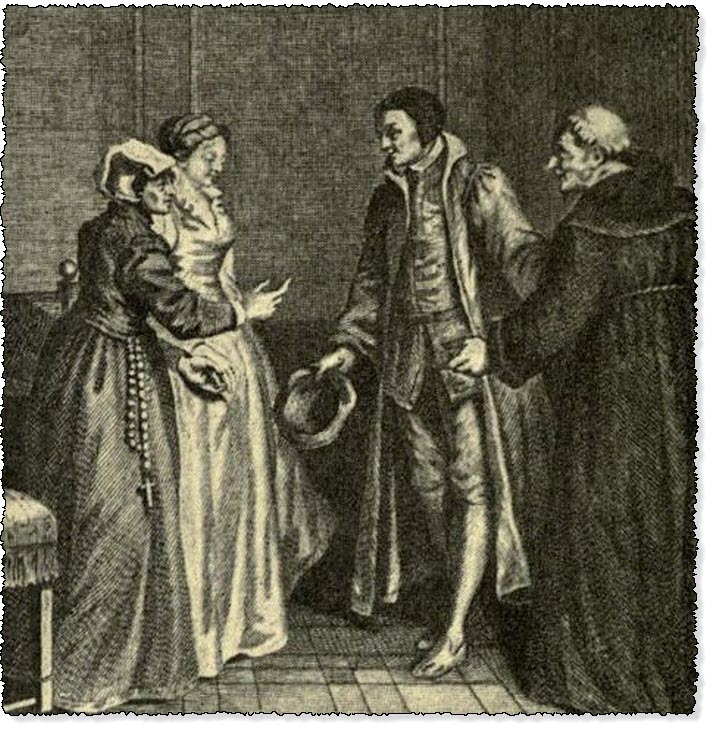
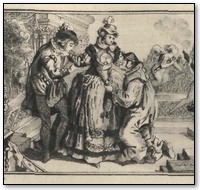
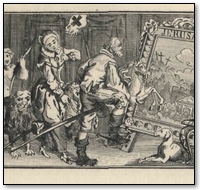
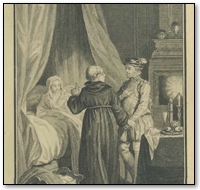
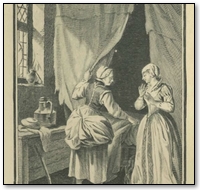
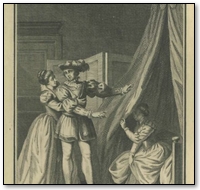
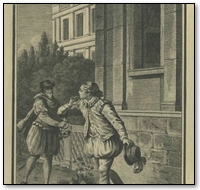
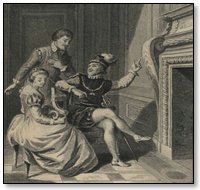
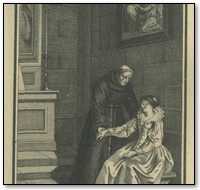
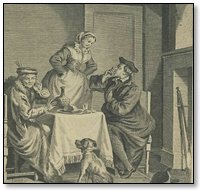
the Grey Friar Introducing his Comrade to The Lady and Her Daughter
The Heptameron - Day 6 - Tale 56 - the Grey Friar Introducing his Comrade to The Lady and Her Daughter
Summary of the Sixth Tale Told on the Sixth of the Heptameron
Tale 56 of the Heptameron
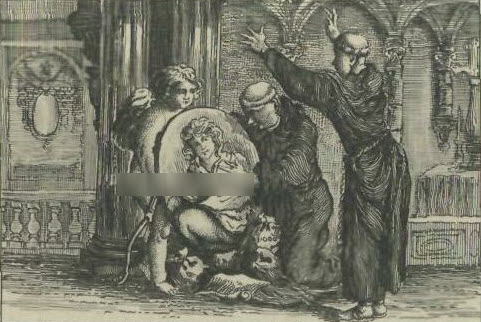
A French lady, whilst sojourning at Padua, was informed that there was a Grey Friar in the Bishop's prison there, and finding that every one spoke jestingly about him, she inquired the reason. She was told that this Grey Friar, who was an old man, had been confessor to a very honourable and pious widow lady, mother of only one daughter, whom she loved so dearly as to be at all pains to amass riches for her, and to find her a good husband. Now, seeing that her daughter was grown up, she was unceasingly anxious to find her a husband who might live with them in peace and quiet, a man, that is, of a good conscience, such as she deemed herself to possess. And since she had heard some foolish preacher say that it were better to do evil by the counsel of theologians than to do well through belief in the inspiration of the Holy Spirit, she had recourse to her father confessor, a man already old, a doctor of theology and one who was held to lead a holy life by the whole town, for she felt sure that, with his counsel and good prayers, she could not fail to find peace both for herself and for her daughter. After she had earnestly begged him to choose for her daughter such a husband as he knew a woman that loved God and her honour ought to desire, he replied that first of all it was needful to implore the grace of the Holy Spirit with prayer and fasting, and then, God guiding his judgment, he hoped to find what she required.
So the Friar retired to think over the matter; and whereas he had heard from the lady that she had got five hundred ducats together to give to her daughter's husband, and that she would take upon herself the charge of maintaining both husband and wife with lodgment, furniture and clothes, he bethought himself that he had a young comrade of handsome figure and pleasing countenance, to whom he might give the fair maiden, the house, the furniture, maintenance and food, whilst he himself kept the five hundred ducats to gratify his burning greed. And when he spoke to his comrade of the matter, he found that they were both of one mind upon it.
He therefore returned to the lady and said—"I verily believe that God has sent his angel Raphael to me as he did to Tobit, to enable me to find a perfect husband for your daughter. I have in my house the most honourable gentleman in Italy, who has sometimes seen your daughter and is deeply in love with her. And so to-day, whilst I was at prayer, God sent him to me, and he told me of his desire for the marriage, whereupon, knowing his lineage and kindred and notable descent, I promised him to speak to you on the matter. There is, indeed, one defect in him, of which I alone have knowledge, and it is this. Wishing to save one of his friends whom another man was striving to slay, he drew his sword in order to separate them; but it chanced that his friend slew the other, and thus, although he himself had not dealt a blow, yet inasmuch as he had been present at a murder and had drawn his sword, he became a fugitive from his native town. By the advice of his kinsfolk he came hither in the garb of a scholar, and he dwells here unknown until his kinsfolk shall have ended the matter; and this he hopes will shortly be done. For this reason, then, it would be needful that the marriage should be performed in secret, and that you should suffer him to go in the daytime to the public lectures and return home every evening to sup and sleep."
"Sir," replied the worthy woman, "I look upon what you tell me as of great advantage to myself, for I shall at least have by me what I most desire in the world."
Thereupon the Grey Friar brought his comrade, bravely attired with a crimson satin doublet, and the lady was well pleased with him. And as soon as he was come the betrothal took place, and, immediately after midnight, a mass was said and they were married. Then they went to bed together until daybreak, when the bridegroom told his wife that to escape discovery he must needs return to the college.
After putting on his crimson satin doublet and his long robe, without forgetting his coif of black silk, he bade his wife, who was still in bed, good-bye, promising that he would come every evening to sup with her, but that at dinner they must not wait for him. So he went away and left his wife, who esteemed herself the happiest woman alive to have found so excellent a match. And the young wedded Friar returned to the old father and brought him the five hundred ducats, as had been agreed between them when arranging the marriage.
In the evening he failed not to return and sup with her, who believed him to be her husband, and so well did he make himself liked by her and by his mother-in-law, that they would not have exchanged him for the greatest Prince alive.
This manner of life continued for some time, but God in His kindness takes pity upon those that are deceived without fault of their own, and so in His mercy and goodness it came to pass that one morning the lady and her daughter felt a great desire to go and hear mass at St. Francis, (1) and visit their good father confessor through whose means they deemed themselves so well provided, the one with a son-in-law and the other with a husband.
It chanced that they did not find the confessor aforesaid nor any other that they knew, and, while waiting to see whether the father would come, they were pleased to hear high mass, which was just beginning. And whilst the young wife was giving close heed to the divine service and its mystery, she was stricken with astonishment on seeing the Priest turn himself about to pronounce the Dominus vobiscum, for it seemed to her that it was her husband or else his very fellow. She uttered, however, not a word, but waited till he should turn round again, when, looking still more carefully at him, she had no doubt that it was indeed he. Then she twitched her mother, who was deep in contemplation, and said—
"Alas! madam, what is it that I see?"
"What is it?" said her mother.
"That is my husband," she replied, "who is singing mass, or else 'tis one as like him as can be."
"I pray you, my daughter," replied the mother, who had not carefully observed him, "do not take such a thought into your head. It is impossible that men who are so holy should have practised such deceit. You would sin grievously against God if you believed such a thing."
Nevertheless the mother did not cease looking at him, and when it came to the Ite missa est she indeed perceived that no two sons of the same mother were ever so much alike. Yet she was so simple that she would fain have said, "O God, save me from believing what I see." Since her daughter was concerned in the matter, however, she would not suffer it to remain in uncertainty, and resolved to learn the truth.
When evening was come, and the husband (who had perceived nothing of them) was about to return, the mother said to her daughter—
"We shall now, if you are willing, find out the truth concerning your husband. When he is in bed I will go to him, and then, while he is not thinking, you will pluck off his coif from behind, and we shall see whether he be tonsured like the Friar who said mass."
Heptameron Story 56
As it was proposed, so was it done. As soon as the wicked husband was in bed, the old lady came and took both his hands as though in sport—her daughter took off his coif, and there he was with his fine tonsure. At this both mother and daughter were as greatly astonished as might be, and forthwith they called their servants to seize him and bind him fast till the morning, nor did any of his excuses or fine speeches avail him aught.
When day was come, the lady sent for her confessor, making as though she had some great secret to tell him, whereupon he came with all speed, and then, reproaching him for the deceit that he had practised on her, she had him seized like the other. Afterwards she sent for the officers of justice, in whose hands she placed them both. It is to be supposed that if the judges were honest men they did not suffer the offence to go unpunished. (2)
"From this story, ladies, you will see that those who have taken vows of poverty are not free from the temptation of covetousness, which is the cause of so many ills."
"Nay, of so many blessings," said Saffredent, "for with the five hundred ducats that the old woman would have stored up there was made much good cheer, while the poor maiden, who had been longing for a husband, was thus enabled to have two, and to speak with more knowledge as to the truth of all hierarchies."
"You always hold the falsest opinions," said Oisille, "that ever I knew. You think that all women are of your own temper."
"Not so, madam, with your good leave," said Saffredent. "I would give much that they were as easily satisfied as we are."
"That is a wicked speech," said Oisille, "and there is not one present but knows the contrary, and that what you say is untrue. The story that has just been told proves the ignorance of poor women and the wickedness of those whom we regard as better than the rest of your sex; for neither mother nor daughter would do aught according to their own fancy, but subjected desire to good advice."
"Some women are so difficult," said Longarine, "that they think they ought to have angels instead of men."
"And for that reason," said Simontault, "they often meet with devils, more especially those who, instead of trusting to God's grace, think by their own good sense, or that of others, that they may in this world find some happiness, though this is granted by none save God, from whom alone it can come."
"How now, Simontault!" said Oisille. "I did not think that you knew so much good."
"Madam," said Simontault, "'tis a pity that I have not been proved, for I see that through lack of knowledge you have already judged ill of me. Yet I may well practise a Grey Friar's trade, since a Grey Friar has meddled with mine."
"So you call it your trade," said Parlamente, "to deceive women? Thus out of your mouth are you judged."
"Had I deceived a hundred thousand," said Simontault, "I should yet not have avenged the woes that I have endured for the sake of one alone."
"I know," said Parlamente, "how often you complain of women; yet, for all that, we see you so merry and hearty that it is impossible to believe that you have endured all the woes you speak of. But the 'Compassionless Fair One' (3) replies that—
"You quote a truly notable theologian," said Simontault, "one who is not only froward himself, but makes all the ladies so, who have read and followed his teaching."
"Yet his teaching," said Parlamente, "is as profitable for youthful dames as any that I know."
"If it were indeed true," said Simontault, "that the ladies were without compassion, we might as well let our horses rest and our armour grow rusty until the next war, and think of nothing but household affairs. And, I pray you, tell me whether it is an excellence in a lady to have the reputation of being without pity, or charity, or love, or mercy."
"Without charity or love," said Parlamente, "they should not be, but the word 'mercy' sounds so ill among women that they cannot use it without wounding their honour; for properly speaking 'mercy' means to grant a favour sought, and we well know what the favour is that men desire."
"May it please you, madam," said Simontault, "there are some men who are so reasonable that they crave nought but speech."
"You remind me," said Parlamente, "of one who was content with a glove."
"We must know who this easy lover was," said Hircan, "and so this time I give my vote to you."
"It will give me pleasure to tell the tale," said Parlamente, "for it is full of virtue."
Footnotes:
- The church of the Grey Friars' monastery, St Francis being their patron.—B. J.
- There is some little resemblance between this tale and the 36th of Morlini's Novello, De monacho qui duxit uxorem.—M.
- "'Tis as well to say as much To draw some comfort thence.'" La belle Dame sans mercy (The Beautiful Lady Without Mercy), by Alain Chartier.—Ed.
Online Edition of the Heptameron
This is the Heptameron of Marguerite de Navarre
Other Sites: CruikshankArt.com · Dante's Inferno · Book-Lover.com · Canterbury Tales ·
This site is created by the Heptameron Information Society.