
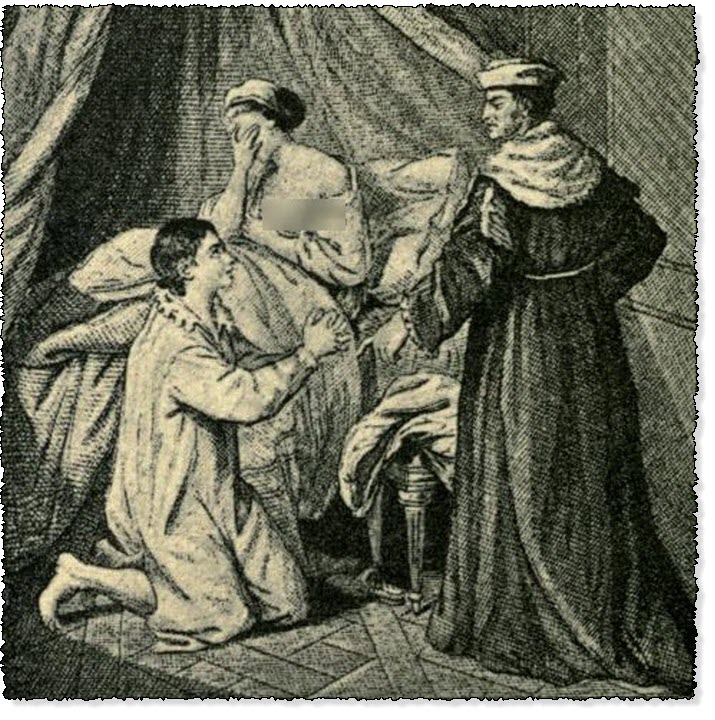
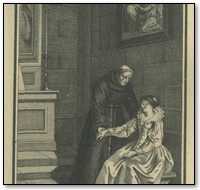
The Clerk Entreating Forgiveness of The President
The Heptameron - the Clerk Entreating Forgiveness of The President
TALE XXXVI.
By means of a salad a President of Grenoble avenged himself upon one of his clerks with whom his wife was smitten, and so saved the honour of his house.
In the town of Grenoble there dwelt a President whose name I shall not mention, but he was not a Frenchman. (1) He had a very beautiful wife, and they lived in great tranquillity together.
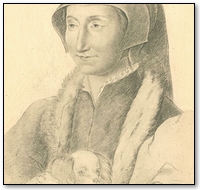
1 The personage referred to is Jeffroy Charles or Carles, Chief President of the Parliament of Grenoble, and President of the Senate of Turin; his wife's name was Margaret du Mottet; she came of a very old family of Embrun. Some interesting particulars concerning President Charles, supplied by that erudite scholar M. Jules Roman, will be found in the Appendix to the present volume (A).—Ed.
This lady, finding that her husband was now old, fell in love with a young clerk, called Nicholas. When the President went to the court in the morning, Nicholas used to enter his room and take his place. This was observed by a servant of the President's who had served his master well for thirty years, and in his faithfulness he could not refrain from speaking to him of the matter.
The President, being a prudent man, would not lightly believe the story, but said that the servant wished to create contention between himself and his wife. If the matter, said he, were really as the servant declared, he could easily prove it to him, and if proof were not given he would believe that it was a lie contrived in order to destroy the love existing between himself and his wife. The servant promised that he would show him the truth of what he had said, and one morning, as soon as the President was gone to the court and Nicholas had entered the room, he sent one of his fellow-servants to tell his master to come, while he himself remained watching at the door lest Nicholas should come out.
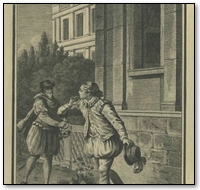
As soon as the President saw the sign that was made to him by one of his servants, he pretended to be ill, left the court and hastened home. Here he found his old servant at the door, and was assured by him that Nicholas was inside and had only just gone in.
"Do not stir from this door," said his lord to him, "for, as you are aware, there is no other means of going into or out of the room, except indeed by way of a little closet of which I myself alone carry the key."
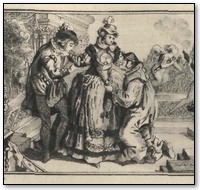
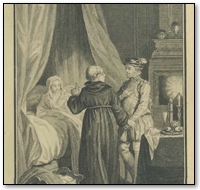
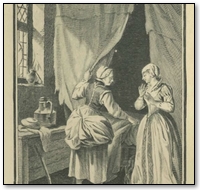
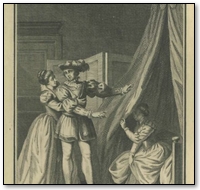
The President entered the room and found his wife and Nicholas in bed together. The clerk, clad in nothing but his shirt, threw himself at his feet to entreat forgiveness, while his wife began to weep.
Then said the President—
"Though you have done a deed the enormity of which you may yourself judge, I am yet unwilling that my house should be dishonoured on your account, and the daughters I have had by you made to suffer. Wherefore," he continued, "cease to weep, I command you, and hearken to what I am going to do; and do you, Nicholas, hide yourself in my closet and make not a single sound."
When this was done, he opened the door, and calling his old servant, said to him—
"Did you not assure me that you would show me Nicholas in company with my wife? Trusting in your word, I came hither in danger of killing my poor wife, and I have found nothing of what you told me. I have searched the whole room, as I will show you."
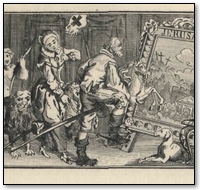
So saying, he caused his servant to look under the beds and in every quarter. The servant, finding nothing, was greatly astonished, and said to his master—
"The devil must have made away with him, for I saw him go in, and he did not come out through the door. But I can see that he is not here."
Then said his master to him—
"You are a wicked servant to try to create contention in this way between my wife and me. I dismiss you, and will pay you what I owe you for your services to me, and more besides; but be speedily gone, and take care that you are not in the town twenty-four hours from now."
The President paid him for five or six years in advance, and, knowing him to be a faithful servant, resolved to reward him still further.
When the servant was gone weeping away, the President made Nicholas come forth from the closet, and after telling them both what he thought of their wickedness, he commanded them to give no hint of the matter to anyone. He also charged his wife to dress more bravely than was her wont, and to attend all assemblies, dances and feasts; and he told Nicholas to make more merry than before, but, as soon as he whispered to him, "Begone," to see that he was out of the town before three hours were over. Having arranged matters in this way, he returned to the court, none being any the wiser. And for a fortnight, contrary to his wont, he entertained his friends and neighbours, and after the banquet had the tabourers, so that the ladies might dance.
Heptameron Story 36
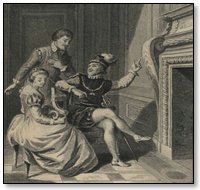
One day, seeing that his wife was not dancing, he commanded Nicholas to lead her out. The clerk, thinking that the past had been forgotten, did so gladly, but when the dance was over, the President, under pretence of charging him with some household matter, whispered to him, "Begone, and come back no more." And albeit Nicholas was grieved to leave his mistress, yet was he no less glad that his life was spared.
When the President had convinced all his kinsfolk and friends and the whole countryside of the deep love that he bore his wife, he went into his garden one fine day in the month of May to gather a salad, of such herbs that his wife did not live for twenty-four hours after eating of them; whereupon he made such a great show of mourning that none could have suspected him of causing her death; and in this way he avenged himself upon his enemy, and saved the honour of his house. (2)
2 Whilst admitting the historical basis of this story, M. Le Roux de Lincy conceives it to be the same as No. xlvii. of the Cent Nouvelles Nouvelles, printed half-a-century before the Heptameron was written. Beyond the circumstance, however, that in both cases a judge is shown privily avenging himself on his wife for her infidelity, there is no resemblance between the two tales. There is good reason for believing that Queen Margaret's narrative is based on absolute fact, and not on the story in the Cent Nouvelles. Both tales have often been imitated. See for instance Bonaventure Despéricr's Contes, Nouvelles, et joyeux Devis (tale xcii., or, in some editions, xc. ); Les Heures de Récréation de Louis Guicciardini, p. 28; G. Giraldi Cinthio's Hecatommithi, overro cento Novelle, &c. (dec. iii. nov. vi. ); Malespini's Ducento Novelle (part ii. nov. xvi.); Verboquet's Les Délices, &c, 1623, p. 23; and Shirley's Love's Cruelly. These tales also inspired some of the Spanish dramatists, notably Calderon.—Ed. and L.
"I do not mean by this, ladies, to praise the President's conscience, but rather to bring out the frailty of a woman and the great patience and prudence of a man. And I beg you, ladies, be not angered by the truth, which sometimes speaks as loudly against ourselves as against the men; for vice and virtue are common alike to men and women."
"If all those," said Parlamente, "who have fallen in love with their servants were obliged to eat salads of that kind, I know some who would be less fond of their gardens than they are at present, and who would pluck up the herbs to get rid of such as restore the honour of a family by compassing the death of a wanton mother."
Hircan, who guessed why she had said this, angrily replied—"A virtuous woman should never judge another guilty of what she would not do herself."
"Knowledge is not judgment nor yet foolishness," returned Parlamente. "However, this poor woman paid the penalty that many others have deserved, and I think that the President, when desirous of vengeance, comported himself with wondrous prudence and wisdom."
"And with great malevolence, also," said Longarine. "'Twas a slow and cruel vengeance, and showed he had neither God nor conscience before his eyes."
"Why, what would you have had him do," said Hircan, "to revenge himself for the greatest wrong that a woman can deal to a man?"
"I would have had him kill her in his wrath," she replied. "The doctors say that since the first impulses of passion are not under a man's control, such a sin may be forgiven; so it might have obtained pardon." "Yes," said Geburon, "but his daughters and descendants would have always borne the stain."
"He ought not to have killed her at all," said Longarine, "for, when his wrath was past, she might have lived with him in virtue, and nothing would ever have been said about the matter."
"Do you think," said Saffredent, "that he was appeased merely because he concealed his anger? For my part, I believe that he was as wrathful on the last day, when he made his salad, as he had been on the first, for there are persons whose first impulses have no rest until their passion has worked its will. I am well pleased you say that the theologians deem such sins easy to be pardoned, for I am of their opinion."
"It is well to look to one's words," said Longarine, "in presence of persons so dangerous as you. What I said is to be understood of passion when it is so strong that it suddenly seizes upon all the senses, and reason can find no place."
"It is so," said Saffredent, "that I understood your words, and I thence conclude that, whatever a man may do, he can commit only venial sin if he be deeply in love. I am sure that, if Love hold him fast bound, Reason can never gain a hearing, whether from his heart or from his understanding. And if the truth be told, there is not one among us but has had knowledge of such passion; and not merely do I think that sin so committed is readily pardoned, but I even believe that God is not angered by it, seeing that such love is a ladder whereby we may climb to the perfect love of Himself. And none can attain to this save by the ladder of earthly love, (3) for, as St. John says, 'He that loveth not his brother whom he hath seen, how can he love God whom he hath not seen?'" (4)
3 All this passage is borrowed, almost word for word, from Castiglione's Libro del Cortegiano. See ante, vol. i. p. 10.—B.J. 4 i John iv. 20.—M.
"There is not a passage in Scripture," said Oisille, "too good for you to turn to your own purposes. But beware of doing like the spider, which transforms sound meat into poison. Be advised that it is a perilous matter to quote Scripture out of place and without cause."
"Do you call speaking the truth out of place and without cause?" said Saffredent. "You hold, then, that when, in speaking to you unbelieving women, we call God to our assistance, we take His name in vain; but if there be any sin in this, you alone must bear the blame, for it is your unbelief that compels us to seek out all the oaths that we can think of. And in spite of it all, we cannot kindle the flame of charity in your icy hearts."
"That," said Longarine, "proves that you all speak falsely. If truth were in your words, it is strong enough to make you be believed. Yet there is danger lest the daughters of Eve should hearken too readily to the serpent."
"I see clearly," said Saffredent, "that women are not to be conquered by men. So I shall be silent, and see to whom Ennasuite will give her vote."
"I give it," she said, "to Dagoucin, for I think he would not willingly speak against the ladies."
"Would to God," said Dagoucin, "that they were as well disposed towards me as I am towards them. To show you that I have striven to honour the virtuous among them by recalling their good deeds, I will now tell you the story of such a one. I will not deny, ladies, that the patience of the gentleman at Pampeluna, and of the President at Grenoble was great, but then it was equalled in magnitude by their vengeance. Moreover, when we seek to praise a virtuous man, we ought not so to exalt a single virtue as to make of it a cloak for the concealment of grievous vice; for none are praiseworthy save such as do virtuous things from the love of virtue alone, and this I hope to prove by telling you of the patient virtue of a lady whose goodness had no other object save the honour of God and the salvation of her husband."
Online Edition of the Heptameron
This is the Heptameron of Marguerite de Navarre
Other Sites: CruikshankArt.com · Dante's Inferno · Book-Lover.com · Canterbury Tales ·
This site is created by the Heptameron Information Society.