
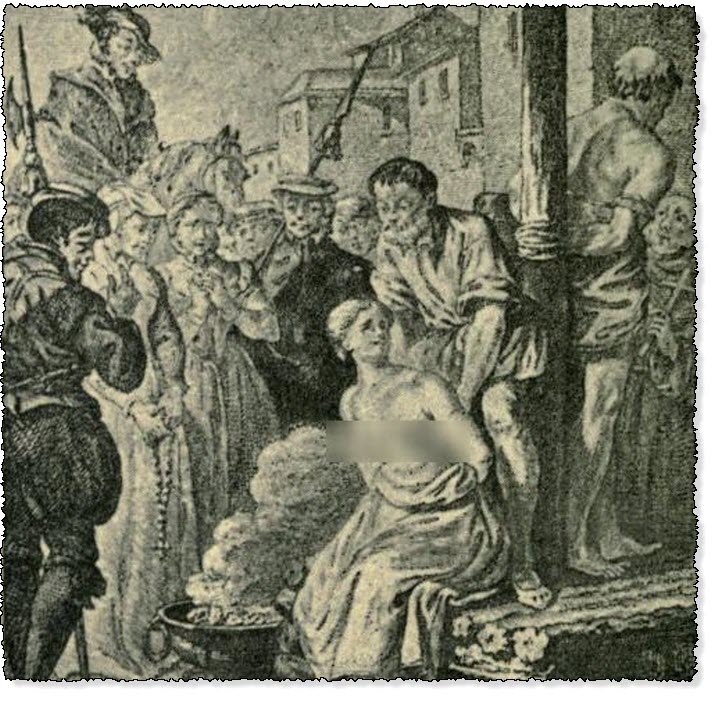
the Execution of The Wicked Priest and his Sister
The Heptameron - Day 4, Tale 33 - the Execution of The Wicked Priest and his Sister
TALE XXXIII.
The hypocrisy of a priest who, under the cloak of sanctity, had got his sister with child, was discovered by the wisdom of the Count of Angoulême, by whose command they both were visited with punishment by law. (1)
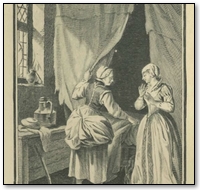
Count Charles of Angoulême, father of King Francis, a pious Prince and one that feared God, happened to be at Coignac when he was told that in a village called Cherues, (2) not far away, there dwelt a maiden who lived a marvellously austere life, and who, for all that, was now great with child. She made no secret of the matter, but assured every one that she had never known a man and that she could not tell how such a fortune should have befallen her, unless indeed it were the work of the Holy Ghost. This explanation the people readily received, and knowing as they all did how virtuous she had been from her youth up, and how she had never given a single token of worldliness, they believed and deemed her a second Virgin Mary. She used to fast not only on the days commanded by the Church, but, from natural devotion, several times a week also; and she never stirred from the church whenever there was a service going on there. For these reasons she was held in such great repute among all the vulgar that every one came to see her as though she were a miracle, and those who succeeded in touching her dress deemed themselves fortunate indeed.
1 This tale is historical, the incidents must have occurred between 1480 and 1490.—L. 2 Cherves-de-Cognac, now a large village of nearly 3000 inhabitants, within four miles of Cognac. The church, where some of the incidents recorded in the tale occurred, is still in existence. It dates from the eleventh and twelfth centuries, and is surmounted by three cupolas.—Eu.
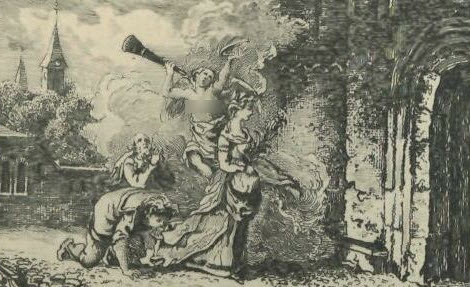
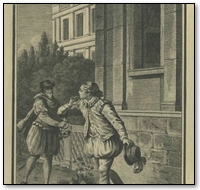
The priest of the parish was her brother; he was a man advanced in years and of very austere life, and was loved and reverenced by his parishioners, who held him for a holy man. He treated his sister with such harshness as to keep her shut up in a house, to the great discontent of all the people; and so greatly was the matter noised abroad that, as I have told you, the story reached the ear of the Count. He perceived that the people were being deceived, and, wishing to set them right, sent a Master of Requests and an Almoner, two very worthy men, to learn the truth. These repaired to the spot and inquired into the matter with all possible diligence, addressing themselves for information to the priest, who, being weary of the whole affair, begged them to be present at an examination which he hoped to hold on the morrow.
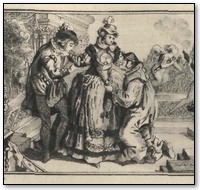
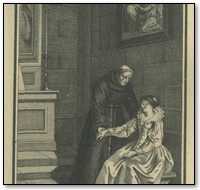
Early the next morning the said priest chanted mass, his sister, who was now far gone with child, being present on her knees; and when mass was over, the priest took the "Corpus Domini," and in presence of the whole congregation said to his sister—
"Unhappy woman that you are, here is He who suffered death and agony for you, and in His presence I ask you whether, as you have ever affirmed to me, you are indeed a virgin?"
She boldly replied that she was.
"How is it possible that you can be with child and yet be still a virgin?"
"I can give no reason," she replied, "except that the grace of the Holy Ghost has wrought within me according to His good pleasure; nevertheless, I cannot deny the grace that God has shown me in preserving me a virgin without ever a thought of marriage."
Forthwith her brother said to her—
"I offer you the precious Body of Jesus Christ, which you will take to your damnation if it be not as you say; and the gentlemen here present on behalf of my lord the Count shall be witnesses thereof."
The maiden, who was nearly thirty years of age, (3) then swore as follows:—
"I take this Body of Our Lord, here present, to my damnation in the presence of you, gentlemen, and of you, my brother, if ever man has touched me any more than yourself."
And with these words she received the Body of Our Lord.
Heptameron Story 33
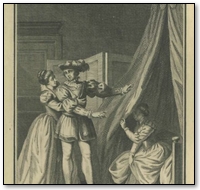
Having witnessed this, the Master of Requests and the Almoner went away quite confounded, for they thought that no lie was possible with such an oath. And they reported the matter to the Count, and tried to persuade him even as they were themselves persuaded. But he was a man of wisdom, (4) and, after pondering a long time, bade them again repeat the terms of the oath. And after weighing them well, he said—
"She has told you the truth and yet she has deceived you. She said that no man had ever touched her any more than her brother had done, and I feel sure that her brother has begotten this child and now seeks to hide his wickedness by a monstrous deception. We, however, who believe that Jesus Christ has come, can look for none other. Go, therefore, and put the priest in prison; I am sure that he will confess the truth."
3 In the MS. followed for this edition, as well as in Boaistuau's-version of the Heptameron, the age is given as "thirteen." We borrow the word "thirty" from MS. 1518 (Béthune).—L. 4 Charles of Angoulême, father of King Francis and Queen Margaret, had received for the times a most excellent education, thanks to the solicitude of his father, Count John the Good, who further took upon himself to "instruct him in morality, showing him by a good example how to live virtuously and honestly, and teaching him to pray God and obey His commandments."—Vie de très illustre et vertueux Prince Jean, Comte d'Angoulême, by Jean du Port, Angoulême, 1589, p. 66. That Count Charles profited by this teaching is shown in the above tale.—ED.
This was done according to his command, though not without serious remonstrances concerning the putting of this virtuous man to open shame.
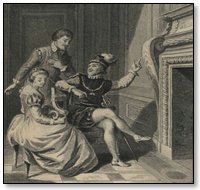
Albeit, as soon as the priest had been taken, he made confession of his wickedness, and told how he had counselled his sister to speak as she had done in order to conceal the life they had led together, not only because the excuse was one easy to be made, but also because such a false statement would enable them to continue living honoured by all. And when they set before him his great wickedness in taking the Body of Our Lord for her to swear upon, he made answer that he had not been so daring, but had used a wafer that was unconsecrated and unblessed.
Report was made of the matter to the Count of Angoulême, who commanded that the law should take its course. They waited until the sister had been delivered, and then, after she had been brought to bed of a fine male child, they burned brother and sister together. And all the people marvelled exceedingly at finding beneath the cloak of holiness so horrible a monster, and beneath a pious and praiseworthy life indulgence in so hateful a crime.
"By this you see, ladies, how the faith of the good Count was not lessened by outward signs and miracles. He well knew that we have but one Saviour, who, when He said 'Consummatum est,' (5) showed that no room was left for any successor to work our salvation."
5 "When Jesus therefore had received the vinegar, He said, It is finished."—St. John xix. 30.—M.
"It was indeed," said Oisille, "great daring and extreme hypocrisy to throw the cloak of Godliness and true Christianity over so enormous a sin."
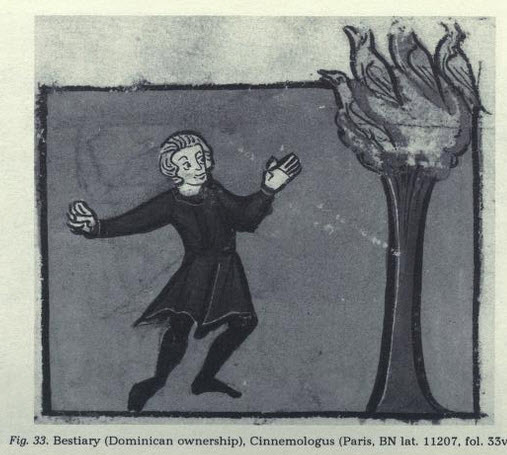
"I have heard," said Hircan, "that such as under pretext of a commission from the King do cruel and tyrannous deeds, receive a double punishment for having screened their own injustice behind the justice of the Crown. In the same way, we see that although hypocrites prosper for a time beneath the cloak of God and holiness, yet, when the Lord God lifts His cloak, they find themselves exposed and bare, and then their foul and abominable nakedness is deemed all the more hideous for having had so honourable a covering."
"Nothing can be pleasanter," said Nomerfide, "than to speak forth frankly the thoughts that are in the heart."
"Yes, for profit's sake," (6) replied Longarine. "I have no doubt that you give your opinion according to your temper."
6 This sentence is rather obscure in the MSS., and we have adopted the reading suggested by M. Frank. M. Lacroix, however, was of opinion that the sentence should run, "Yes, for mirth's sake."—M.
"I will tell you what it is," said Nomerfide. "I find that fools, when they are not put to death, live longer than wise folk, and the only reason that I know for this, is that they do not conceal their passions. If they be angry, they strike; if they be merry, they laugh: whereas those that aim at wisdom conceal their imperfections with such exceeding care that they end by thoroughly corrupting their hearts."
"I think you are right," said Geburon, "and that hypocrisy, whether towards God, man or Nature, is the cause of all our ills."
"It would be a glorious thing," said Parlamente, "if our hearts were so filled with faith in Him, who is all virtue and all joy, that we could freely show them to every one."
"That will come to pass," said Hircan, "when all the flesh has left our bones."
"Yet," said Oisille, "the Spirit of God, which is stronger than Death, is able to mortify our hearts without changing or destroying the body."
"Madam," returned Saffredent, "you speak of a gift of God that is not as yet common among mankind."
"It is common," said Oisille, "among those that have faith, but as this is a matter not to be understood by such as are fleshly minded, let us see to whom Simontault will give his vote."
"I will give it," said Simontault, "to Nomerfide, for, since her heart is merry, her words cannot be sad."
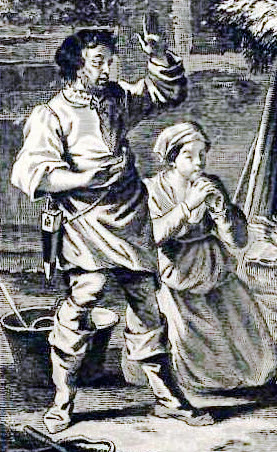
"Truly," said Nomerfide, "since you desire to laugh, I will give you reason to do so. That you may learn how hurtful are ignorance and fear, and how the lack of comprehension is often the cause of much woe, I will tell you what happened to two Grey Friars, who, through failing to understand the words of a butcher, thought that they were about to die."
Online Edition of the Heptameron
This is the Heptameron of Marguerite de Navarre
Other Sites: CruikshankArt.com · Dante's Inferno · Book-Lover.com · Canterbury Tales ·
This site is created by the Heptameron Information Society.