
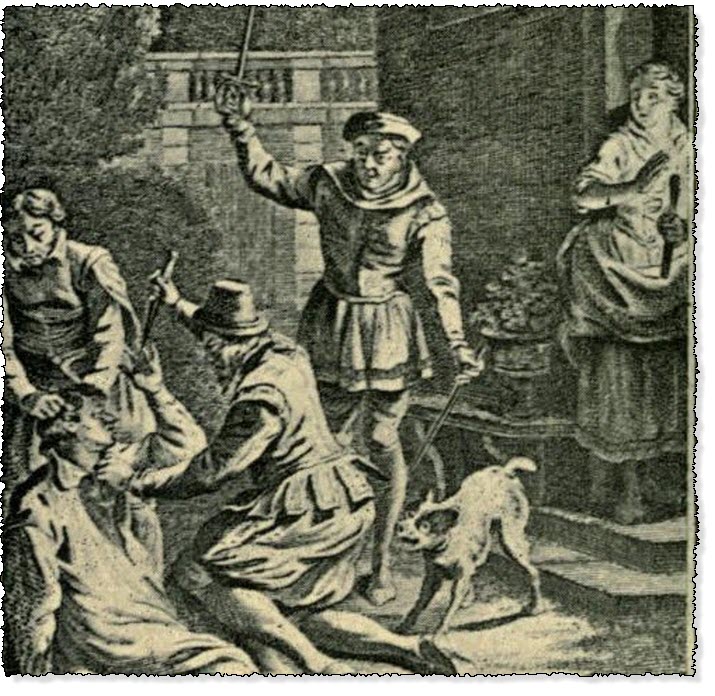
the Count of Jossebelin Murdering his Sister's Husband
The Heptameron - Day 4 - Tale 40 -the Count of Jossebelin Murdering his Sister's Husband
TALE XL.
The sister of the Count of Jossebelin, after marrying unknown to her brother a gentleman whom he caused to be put to death (albeit except for his lowlier rank he had often desired him for his brother-in-law) did, with great patience and austerity of life, spend the remainder of her days in a hermitage. (1)
This lord, who was the father of Rolandine and was called the Count of Jossebelin, had several sisters, some of whom were married to wealthy husbands, others becoming nuns, whilst one, who was beyond comparison fairer than all the rest, dwelt unwedded in his house. (2)
1 The events here narrated would have occurred in or about 1479.—L. 2 The so-called Count of Jossebelin is John II., Viscount de Rohan, previously referred to in Tale XXI. He was the son of Alan IX., Vicount of Rohan, by his second wife, Mary of Lorraine. Alan, by a first marriage with Margaret of Brittany, had three daughters, Jane, Margaret and Catherine, all three of whom were married advantageously. Contrary to Queen Margaret's assertion above, none of them became nuns; Alan may, however, have had illegitimate daughters who took the veil. By his second wife he had a son, John II., and a daughter christened Catherine, like her half-sister. She died unmarried, says Anselme's Histoire Généalogique (vol. iv. p. 57), and would appear to be the heroine of Queen Margaret's tale.—L. and B. J.
And so dearly did she love her brother that he, for his part, preferred her even to his wife and children.
She was asked in marriage by many of good estate, but her brother would never listen to them through dread of losing her, and also because he loved his money too well. She therefore spent a great part of her life un-wedded, living very virtuously in her brother's house. Now there was a young and handsome gentleman who had been reared from childhood in this same house, and who, growing in comeliness and virtue as well as in years, had come to have a complete and peaceful rule over his master, in such sort that whenever the latter desired to give any charge to his sister he always did so by means of this young gentleman, (3) and he allowed him so much influence and intimacy, sending him morning and evening to his sister, that at last a great love sprang up between the two.
3 This is possibly a Count of Keradreux, whom John II. is known to have put to death, though the Breton and French chroniclers do not relate the circumstances of the crime.— Seepost, p. 100, note 4.—Ed.
But as the gentleman feared for his life if he should offend his master, and the lady feared also for her honour, their love found gladness in speech alone, until the Lord of Jossebelin had often said to his sister that he wished the gentleman were rich and of as good a house as her own, for he had never known a man whom he would so gladly have had for his brother-in-law.

He repeated these sayings so often that, after debating them together, the lovers concluded that if they wedded one another they would readily be forgiven. Love, which easily believes what it desires, persuaded them that nothing but good could come of it; and in this hope they celebrated and consummated the marriage without the knowledge of any save a priest and certain women.
After they had lived for a few years in the delight that man and woman can have together in marriage, and as one of the handsomest and most loving couples in Christendom, Fate, vexed to find two persons so much at their ease, would no longer suffer them to continue in it, but stirred up against them an enemy, who, keeping watch upon the lady, came to a knowledge of her great happiness, and, ignorant the while of her marriage, went and told the Lord of Jossebelin that the gentleman in whom he had so much trust, went too often to his sister's room, and that moreover at hours when no man should enter it. This the Count would not at first believe for the trust that he had in his sister and in the gentleman.
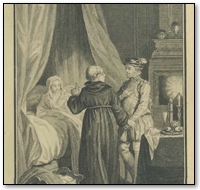
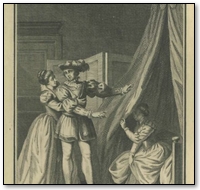
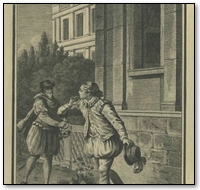
But the other, like one careful for the honour of the house, repeated the charge so often that a strict watch was set, and the poor folk, who suspected nothing, were surprised. For one evening the Lord of Jossebelin was advised that the gentleman was with his sister, and, hastening thither, found the poor love-blinded pair lying in bed together. His anger at the sight robbed him of speech, and, drawing his sword, he ran after the gentleman to kill him. But the other, being nimble of body, fled in nothing but his shirt, and, being unable to escape by the door, leaped through a window into the garden.
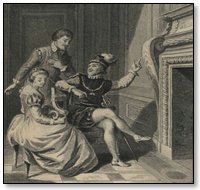
Then the poor lady, clad only in her chemise, threw herself upon her knees before her brother and said to him—
"Sir, spare the life of my husband, for I have indeed married him; and if you are offended punish only me, for what he did was done at my request."
Her brother, beside himself with wrath, could only reply—
"Even if he be your husband one hundred thousand times over, yet will I punish him as a rascally servant who has deceived me."
So saying, he went to the window and called out loudly to kill him, which was speedily done before the eyes of himself and his sister. The latter, on beholding the pitiful sight which no prayers on her part had been able to prevent, spoke to her brother like a woman bereft of reason.
"Brother," she said, "I have neither father nor mother, and I am old enough to marry according to my own pleasure. I chose one whom many a time you said you would gladly have me marry, and for doing by your own counsels that which the law permits me to do without them, you have put to death the man whom you loved best of all the world. Well, since my prayers have been of no avail to preserve his life, I implore you, by all the love you have ever borne me, to make me now a sharer in his death even as I have been a sharer in all his living fortunes. In this way, while sating your unjust and cruel anger, you will give repose to the body and soul of one who cannot and will not live without him." Although her brother was almost distracted with passion, (4) he had pity upon his sister, and so, without granting or denying her request, withdrew. After weighing well what he had done, and hearing that the gentleman had in fact married his sister, he would gladly have undone his grievous crime. Nevertheless, being afraid that his sister would seek justice or vengeance for it, he caused a castle to be built in the midst of a forest, (5) and, placing her therein, forbade that any should have speech with her.
4 John II. of Rohan was a man of the most passionate, resentful disposition, and the greater part of his life was spent in furthering ambitious schemes, stirring up feuds and factions, and desolating Brittany with civil war. In 1470 we find him leaving the service of the Duke, his master, to enter that of Louis XI., on whose side he fought till the peace of Senlis in 1475. Four years later the Duke of Brittany caused him to be arrested on the charge of murdering the Count of Keradreux, and he appears to have remained in prison till 1484, when it is recorded that he fled to France, and thence to Lorraine. In 1487 he leagued himself with several discontented nobles to drive away the Chancellor of Brittany and various foreign favourites around the Duke, and carried civil war into several parts of the duchy. Then for a brief space he made his peace with the Duke, but again took up arms for the French King, fought at St. Aubin du Cormier, captured Dinan and besieged and pillaged Guingamp. Charles VIII. appointed him Lieutenant- general of Lower Brittany in 1491, and he was first commissary of the King of France at the States of Brittany held at Vannes in 1491 and 1501. In 1507 he witnessed the marriage contract of the Princess Claude with Francis, Duke of Valois, afterwards Francis I. (Anselme's Histoire Généalogique, vol. iv. p. 57). When Anne became Duchess of Brittany, John II. vainly strove to compel her to marry his son, James, and this was one of the causes of their life- long enmity (ante vol. iii. Tale XXI.) John II. died in 1516.—L. and Ed. 5 If this be the chateau of Josselin, as some previous commentators think, Queen Margaret is in error here, for records subsist which prove that Josselin, now classed among the historical monuments of France, was built not by John II., but by his father, Alan IX. It rises on a steep rock on the bank of the Oust, at nine miles from Ploèrmel, and on the sculptured work, both inside and out, the letters A. V. (Alan, Viscount) are frequently repeated, with the arms of Rohan and Brittany quartered together, and bearing the proud device A plus. It seems to us evident that the incidents recorded in the early part of Queen Margaret's tale took place at Josselin, and that Catherine de Rohan was imprisoned in some other chateau expressly erected by her brother.—D. and Ed.
Some time afterwards he sought, for the satisfaction of his conscience, to win her back again, and spoke to her of marriage; but she sent him word that he had given her too sorry a breakfast to make her willing to sup off the same dish, and that she looked to live in such sort that he should never murder a second husband of hers; for, she added, she could scarcely believe that he would forgive another man after having so cruelly used the one whom he had loved best of all the world.
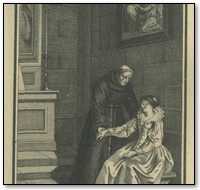
And although weak and powerless for revenge, she placed her hopes in Him who is the true Judge, and who suffers no wickedness to go unpunished; and, relying upon His love alone, was minded to spend the rest of her life in her hermitage. And this she did, for she never stirred from that place so long as she lived, but dwelt there with such patience and austerity that her tomb was visited by every one as that of a saint.
From the time that she died, her brother's house came to such a ruinous state, that of his six sons not one was left, but all died miserably; (6) and at last the inheritance, as you heard in the former story, passed into the possession of Rolandine, who succeeded to the prison that had been built for her aunt.
6 Queen Margaret is in error here. Instead of six sons, John II., according to the most reliable genealogical accounts of the Rohan family, had but two, James, Viscount of Rohan and Lord of Leon, who died childless in 1527, and Claud, Bishop of Cornouailles, who succeeded him as Viscount of Rohan (Anselme). These had two sisters, Anne, the Rolandine of Tale XXI., and Mary, who died in June 1542 (Dillaye).—Ed.
"I pray God, ladies, that this example may be profitable to you, and that none among you will seek to marry for her own pleasure without the consent of those to whom obedience is due; for marriage is a state of such long continuance that it should not be entered upon lightly and without the advice of friends and kin. And, indeed, however wisely one may act, there is always at least as much pain in it as there is pleasure."
Heptameron Story 40
"In good faith," said Oisille, "were there neither God nor law to teach maidens discretion, this example would suffice to give them more reverence for their kindred, and not to seek marriage according to their own pleasure."
"Still, madam," said Nomerfide, "whoso has but one good day in the year, is not unhappy her whole life long. She had the pleasure of seeing and speaking for a long time with him whom she loved better than herself, and she moreover enjoyed the delights of marriage with him without scruple of conscience. I consider such happiness so great, that in my opinion it surpassed the sorrow that she bore."
"You maintain, then," said Saffredent, "that a woman has more pleasure in lying with a husband, than pain in seeing him put to death before her eyes."
"That is not my meaning," said Nomerfide, "for it would be contrary to my experience of women. But I hold that an unwonted pleasure such as that of marrying the man whom one loves best of all the world, must be greater than that of losing him by death, which is common to all."
"Yes," said Geburon, "if the death be a natural one, but that in the story was too cruel. And I think it very strange, considering he was neither her father nor her husband but only her brother, and she had reached an age when the law suffers maidens to marry according to their own pleasure, that this lord should have had the daring to commit so cruel a deed."
"I do not think it at all strange," said Hircan, "for he did not kill his sister whom he dearly loved, and who was not subject to his control, but dealt with the gentleman whom he had bred as his son and loved as his brother. He had bestowed honour and wealth upon him in his service, and in return for all this the other sought his sister in marriage, a thing which was in nowise fitting for him to do."
"Moreover," said Nomerfide, "it was no ordinary or wonted pleasure for a lady of such high lineage to marry a gentleman servant for love. If the death was extraordinary, the pleasure also was novel, and it was the greater seeing that it had against it the opinions of all wise folk, for it was the happiness of a loving heart with tranquillity of soul, since God was in no wise offended by it And as for the death that you call cruel, it seems to me that, since death is unavoidable, the swifter it comes the better; for we know that it is a road by which all of us must travel. I deem those fortunate who do not long linger on the outksirts of death, but who take a speedy flight from all that can be termed happiness in this world to the happiness that is eternal."
"What do you mean by the outskirts of death?" said Simontault.
"Such as have deep tribulation of spirit," replied Nomerfide, "such, too, as have long been ill, and in their extreme bodily or spiritual pain have come to think lightly of death and find its approach too slow, such, I say, as these have passed through the outskirts of death and will tell you of the hostels where they knew more lamentation than rest. The lady of the story could not help losing her husband through death, but her brother's wrath preserved her from seeing him a long time sick or distressed in mind. And turning the gladness that she had had with him to the service of Our Lord, she might well esteem herself happy."
"Do you make no account," said Longarine, "of the shame that she endured, or of her imprisonment?"
"I consider," said Nomerfide, "that a woman who lives perfectly, with a love that is in keeping with the commands of her God, has no knowledge of shame or dishonour except when they impair or lessen the perfection of her love; for the glory of truly loving knows no shame. As for her imprisonment, I imagine that, with her heart at large and devoted to God and her husband, she thought nothing of it, but deemed her solitude the greatest freedom. When one cannot see what one loves, the greatest happiness consists in thinking constantly upon it, and there is no prison so narrow that thought cannot roam in it at will."
"Nothing can be truer than what Nomerfide says," observed Simontault, "but the man who in his passion brought this separation to pass must have deemed himself unhappy indeed, seeing that he offended God, Love and Honour."
"In good sooth," said Geburon, "I am amazed at the diversity of woman's love. I can see that those who have most love have most virtue; but those who have less love conceal it in their desire to appear virtuous."
"It is true," said Parlamente, "that a heart which is virtuous towards God and man loves more deeply than a vicious one, and fears not to have its inmost purpose known."
"I have always heard," said Simontault, "that men should not be blamed if they seek the love of women, for God has put into the heart of man desire and boldness for asking, and in that of woman fear and chastity for refusal. If, then, a man be punished for using the powers that have been given him, he suffers wrong."
"But it must be remembered," said Longarine, "that he had praised this gentleman for a long time to his sister. It seems to me that it would be madness or cruelty in the keeper of a fountain to praise its fair waters to one fainting with thirst, and then to kill him when he sought to taste them."
"The brother," thereupon said Parlamente, "did indeed so kindle the flame by gentle words of his own, that it was not meet he should beat it out with the sword."
"I am surprised," said Saffredent, "to find it taken ill that a simple gentleman should by dint of love alone, and without deceit, have come to marry a lady of high lineage, seeing that the wisdom of the philosophers accounts the least of men to be of more worth than the greatest and most virtuous of women."
"The reason is," said Dagoucin, "that in order to preserve the commonwealth in peace, account is only taken of the rank of families, the age of persons, and the provisions of the laws, without regard to the love and virtue of individuals, and all this so that the kingdom may not be disturbed. Hence it comes to pass that, in marriages made between equals and according to the judgment of kinsfolk and society, the husband and wife often journey to the very outskirts of hell."
"Indeed it has been seen," said Geburon, "that those who, being alike in heart, character and temperament, have married for love and paid no heed to diversity of birth and lineage, have ofttime sorely repented of it; for a deep unreasoning love is apt to turn to jealousy and rage."
"It seems to me," said Parlamente, "that neither course is worthy of praise, but that folks should submit themselves to the will of God, and pay no heed to glory, avarice or pleasure, and loving virtuously and with the approval of their kinsfolk, seek only to live in the married state as God and nature ordain. And although no condition be free from tribulation, I have nevertheless seen such persons live together without regret; and we of this company are not so unfortunate as to have none of these married ones among the number."

Hircan, Geburon, Simontault and Saffredent swore that they had wedded after this sort, and had never repented since. Whatever the truth of this declaration may have been, the ladies concerned were exceedingly content with it, and thinking that they could hear nothing to please them better, they rose up to go and give thanks for it to God, and found the monks at the church, ready for vespers.
When the service was over they went to supper, but not without much discourse concerning their marriages; and this lasted all the evening, each one relating the fortune that had befallen him whilst he was wooing his wife.
As it happened, however, that one was interrupted by another, it is not possible to set down these stories in full, albeit they would have been as pleasant to write as those which had been told in the meadow. Such great delight did they take in the converse, and so well did it entertain them, that, before they were aware of it, the hour for rest had come.
The Lady Oisille made the company separate, and they betook themselves to bed so joyously that, what with recounting the loves of the past, and proving those of the present, the married folk, methinks, slept no longer than the others.
And so the night was pleasantly spent until the morning.
Online Edition of the Heptameron
This is the Heptameron of Marguerite de Navarre
Other Sites: CruikshankArt.com · Dante's Inferno · Book-Lover.com · Canterbury Tales ·
This site is created by the Heptameron Information Society.