
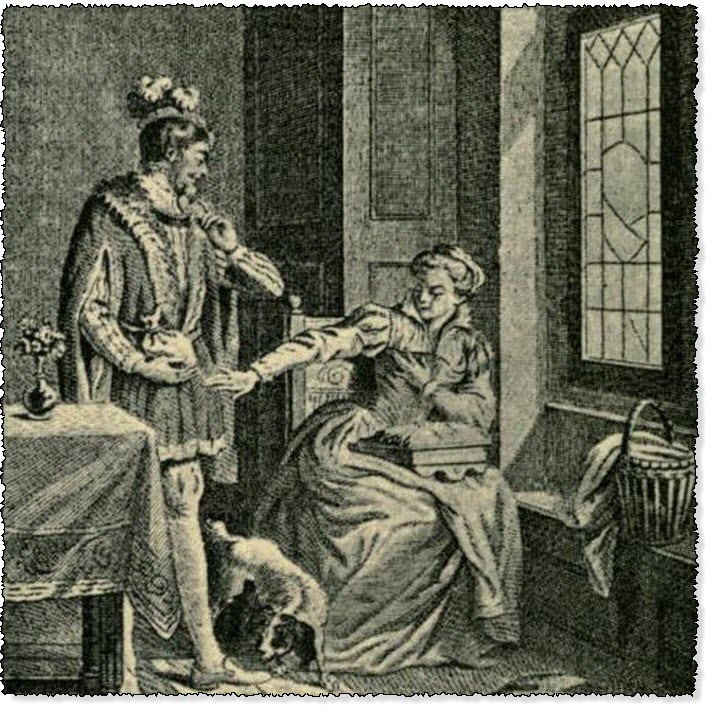
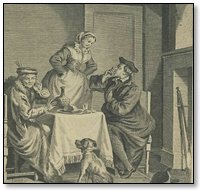
the Girl Refusing The Gift of The Young Prince
The Heptameron - Day 5 - Tale 42 - the Girl Refusing The Gift of The Young Prince
Summary of the Second Tale Told on the Fifth of the Heptameron
Tale 42 of the Heptameron
In one of the best towns in Touraine there dwelt a lord of illustrious family, who had there been brought up from early youth. Of the perfections, graces, beauty and great virtues of this young Prince (1) I will say nothing, except that in his time his equal could not be found. Being fifteen years of age, he had more pleasure in hunting and hawking than in looking at beautiful ladies.
One day in a church he beheld a young maiden who formerly, during her childhood, had been bred in the castle where he dwelt; but after her mother's death, her father having married again, she had withdrawn into Poitou with her brother. This maiden, who was called Frances, had a bastard sister whom her father dearly loved, and whom he had married to the young Prince's butler, who maintained her in as excellent a condition as that of any of her family. It came to pass that the father died and left to Frances as her portion what he possessed near the town aforementioned, and thither she returned after his death; nevertheless, being unmarried and only sixteen years of age, she would not live alone in her house, but went to lodge with her sister, the butler's wife.
On perceiving this girl, who was passably beautiful for a light brunette, and possessed a grace beyond her condition (for, indeed, she seemed rather a lady or princess than a towns-woman), the young Prince gazed at her for a long time, and he, who never yet had loved, now felt in his heart an unwonted delight. On returning to his apartment he inquired concerning the maiden he had seen in the church, and then recollected that formerly in her youth she had come to the castle to have dolls' play with his sister. He reminded the latter of her; and his sister sent for her, received her kindly, and begged her to come often to see her. This she did whenever there was a feast or entertainment; and the young Prince was so pleased to see her that he had in mind to be deeply in love with her, and, knowing her to be of low and poor parentage, hoped easily to obtain what he sought.
Having no means of speaking with her, he sent a gentleman of his chamber to her to conduct his intrigue. But she, being discreet and fearing God, told the gentleman that she did not believe so handsome and honourable a Prince as his master could have pleasure in looking upon one so ugly as herself, since he had so many beautiful ladies in the castle where he lived, that he had no need to search through the town; and she added that in her opinion the gentleman was speaking of his own authority, and without his master's command.
Heptameron Story 42
When the young Prince received this reply, love, which becomes the more eager the more it meets with resistance, caused him to pursue his enterprise more hotly than before, and to write her a letter in which he begged that she would believe all the gentleman had told her.
Being well able to read and write, she read the letter through, but, in spite of all the gentleman's entreaties, she would never send an answer to it. It was not for one of such low degree, she said, to write to so noble a Prince, and she begged the gentleman not to deem her foolish enough to believe that the Prince had so much love for her. Moreover, he was deceived if he thought that he could have her at his will by reason of her humble condition; for her heart was as virtuous as that of the greatest Princess in Christendom, and she looked upon all the treasures in the world as naught in comparison with honour and a good conscience. She therefore entreated him not to try to hinder her from keeping these treasures safe her whole life long, for she would never change her mind even were she threatened with death.
The young Prince did not find this reply to his liking, nevertheless he loved her dearly for it, and never failed to have his chair set in the church to which she went to hear mass, where, during the service, he would ever turn his eyes upon the same image. When she perceived this, she changed her place and went to another chapel—not indeed to flee the sight of him, for she would not have been a reasonable being had she not found pleasure in beholding him—but because she dreaded to be seen by him. She did not deem herself worthy to be loved by him in honour or marriage, and, on the other hand, she would not be loved wantonly and for pleasure. When she found that, in whatever part of the church she placed herself, the Prince heard mass close by, she would no longer go to the same church, but repaired every day to the remotest that she could find. And when there was feasting at the castle, although the Prince's sister often sent for her, she would no longer go thither, but excused herself on the plea of sickness.
Finding that he could not have speech with her, the Prince had recourse to his butler, and promised him great rewards if he would lend assistance in the matter. This the butler, for the sake both of pleasing his master and of the gain that he expected, readily promised to do. Every day he would relate to the Prince what she said or did, telling him that she was especially careful to shun all opportunities of seeing him. However, the great desire that the Prince had of speaking with her at his ease, prompted him to devise the following plan.
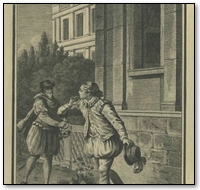
One day he took his chargers, which he was beginning to manage excellently well, to a large open space in the town opposite to his butler's house, in which Frances lived. After making many courses and leaps which she could easily see, he let himself fall from his horse into some deep mire, but so softly that he was not hurt. Nevertheless he uttered passably loud groans, and asked whether there was a house near in which he might change his dress. Every one offered his own, but on some one saying that the butler's was the nearest and worthiest, it was chosen before all the others.
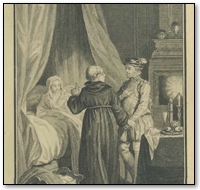
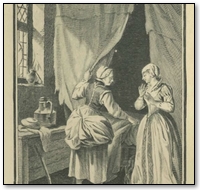
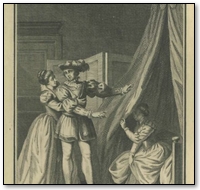
He found the room well furnished, and, as all his garments were soiled with the mud, he stripped himself to his shirt, and got into a bed. Then, when he saw that, except the gentleman aforementioned, every one was gone to bring him some clothes, he called his host and hostess and asked them where Frances was. They had much ado to find her, for, as soon as she had seen the young Prince coming in, she had gone to hide herself in the most retired nook in the house. Nevertheless her sister found her, and begged her not to be afraid to speak to so worshipful and virtuous a Prince.
"What! sister," said Frances, "do you, whom I look upon as my mother, advise me to go and speak with a young lord, of whose purpose, as you are aware, I cannot be ignorant?"
However, her sister addressed so many remonstrances to her, and promised so often not to leave her alone, that she at last went with her, showing so pale and sorry a face that she seemed more likely to beget compassion than desire.
When the young Prince saw her by his bedside, he took hold of her hand, which was cold and trembling, and said to her—
"Frances, do you deem me so wicked a man, and so strange and cruel, that I eat the women I look upon? Why have you come to be so afraid of me who seek only your honour and profit? You know that I have sought to hold converse with you in all possible places, but all in vain; and, to grieve me still more, you have even shunned the places where I had been wont to see you at mass, so that my eyes might bring me as little gladness as my tongue. But all this has availed you naught, for I have never rested until I came hither in the manner you have seen, and I have risked my neck, in allowing myself to fall, in order that I might have the joy of speaking to you without hindrance. I therefore entreat you, Frances, that the opportunity gained by so much toil may not be thrown away, and that my deep love may avail to win your own."
After waiting a long time for her reply, and seeing that her eyes were full of tears and fixed upon the ground, he drew her to him as closely as he could, and tried to embrace and kiss her. But she said to him—
"No, my lord, no; what you desire cannot be, for although I am but a worm of the earth compared with you, I hold my honour dear, and would rather die than lessen it for any pleasure that the world can give. And the dread I have lest those who have seen you come in should suspect the truth, makes me tremble and be afraid as you see. And, since it pleases you to do me the honour of speaking to me, you will also forgive me if I answer you according as my honour requires. I am not so foolish, my lord, nor so blind as not to perceive and recognise the comeliness and grace that God has given you, or not to consider that she who shall possess the person and love of such a Prince must be the happiest woman alive. But what does all this avail me, since it is not for me or any woman of my condition, and since even to long for it would, in me, be utter folly? What reason can I believe to be yours in addressing yourself to me except that the ladies in your house, whom you must love if you have any love for beauty and grace, are so virtuous that you dare not seek or expect from them what the lowliness of my condition has led you to expect from me? I am sure that if you obtained your desire from one such as I, it would afford matter for entertainment to your mistress during two good hours, to hear you tell her of your conquests over the weak. But, my lord, be pleased to bear in mind that I shall never be of their number. I have been brought up in your house, where I have learned what it is to love; my father and my mother were your faithful servants. Since, therefore, God has not made me a Princess to marry you, nor of sufficient rank to be your mistress and love, you will be pleased not to try to number me with the unfortunate, seeing that I deem and would have you to be one of the happiest Princes in Christendom. If for diversion you would have women of my condition, you will find in this town many who are beyond compare more beautiful than I, and who will spare you the pains of so many entreaties. Content yourself, then, with those to whom you will give pleasure by the purchase of their honour, and cease to trouble one who loves you more than she loves herself. For, indeed, if either your life or mine were required of God this day, I should esteem myself fortunate in offering mine to save yours. It is no lack of love that makes me shun your presence, but rather too great a love for your conscience and mine; for I hold my honour dearer than life. I will continue, my lord, if it please you, in your good grace, and will all my life pray God for your health and prosperity. And truly the honour that you have done me will lend me consideration among those of my own rank, for, after seeing you, where is the man of my own condition upon whom I could deign to look? So my heart will continue free save for the duty which shall always be mine of praying to God on your behalf. But no other service can you ever have of me."
On hearing this virtuous reply, contrary though it was to his desires, the young Prince could not but esteem her as she deserved. He did all that he could to persuade her that he would never love another woman, but she was too prudent to suffer so unreasonable a thought to enter her mind. While they were talking together, word was often brought that his clothes were come from the castle, but such was his present pleasure and comfort, that he caused answer to be given that he was asleep. And this continued until the hour for supper was come, when he durst not fail to appear before his mother, who was one of the discreetest ladies imaginable.
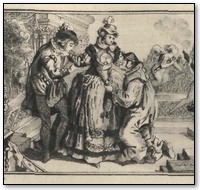
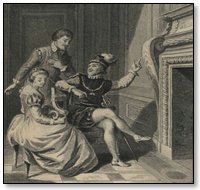
Accordingly, the young man left his butler's house thinking more highly than ever of the maiden's virtue. He often spoke of her to the gentleman that slept in his room, and the latter, who deemed money to be more powerful than love, advised his master to offer her a considerable sum if she would yield to his wishes. The young Prince, whose mother was his treasurer, had but little money for his pocket, but, borrowing as much as he was able, he made up the sum of five hundred crowns, which he sent by the gentleman to the girl, begging her to change her mind.
But, when she saw the gift, she said to the gentleman—
"I pray you tell my lord that I have a good and virtuous heart, and that if it were meet to obey his commands his comeliness and grace would ere now have vanquished me; but, since these have no power against my honour, all the money in the world can have none. Take it, therefore, back to him again, for I would rather enjoy virtuous poverty than all the wealth it were possible to desire."
On beholding so much stubbornness, the gentleman thought that violence must needs be used to win her, and threatened her with his master's authority and power. But she laughed, and said—
"Make those fear him who have no knowledge of him. For my part, I know him to be so discreet and virtuous that such discourse cannot come from him, and I feel sure that he will disown it when you repeat it to him. But even though he were what you say, there is neither torment nor death that would make me change my mind; for, as I have told you, since love has not turned my heart, no imaginable evil or good can divert me one step from the path that I have chosen."
The gentleman, who had promised his master to win her, brought him back this reply in wondrous anger, and counselled him to persevere in every possible way, telling him that it was not to his honour to be unable to win a woman of her sort.
The young Prince was unwilling to employ any means but such as honour enjoins, and was also afraid that if the affair made any noise, and so came to his mother's ears, she would be greatly angered with him. He therefore durst make no attempt, until at last the gentleman proposed to him so simple a plan that he could already fancy her to be in his power. In order to carry it into execution he spoke to the butler; and he, being anxious to serve his master in any way that might be, begged his wife and sister-in-law one day to go and visit their vintages at a house he had near the forest. And this they promised to do.
When the day was come, he informed the Prince, who resolved to go thither alone with the gentleman, and caused his mule to be secretly held in readiness, that they might set out at the proper time. But God willed it that his mother should that day be garnishing a most beautiful cabinet, (2) and needed all her children with her to help her, and thus the young Prince lingered there until the hour was past.
There was, however, no hindrance to the departure of the butler, who had brought his sister-in-law to his house, riding behind him, (3) and had made his wife feign sickness, so that when they were already on horseback she had come and said that she could not go with them. But now, seeing that the hour at which the Prince should have come was gone by, he said to his sister-in-law—
"I think we may now return to the town."
"What is there to hinder us from doing so?" asked Frances.
"Why," said the butler, "I was waiting here for my lord, who had promised me that he would come."
When his sister-in-law heard this wickedness, she replied—
"Do not wait for him, brother, for I know that he will not come to-day."
The brother-in-law believed her and brought her back again, and when she had reached home she let him know her extreme anger, telling him that he was the devil's servant, and did yet more than he was commanded, for she was sure that the plan had been devised by him and the gentleman and not by the young Prince, whose money he would rather earn by aiding him in his follies, than by doing the duty of a good servant. However, now that she knew his real nature, she would remain no longer in his house, and thereupon indeed she sent for her brother to take her to his own country, and immediately left her sister's dwelling.
Having thus failed in his attempt, the butler went to the castle to learn what had prevented the arrival of the young Prince, and he had scarcely come thither when he met the Prince himself sallying forth on his mule, and attended only by the gentleman in whom he put so much trust.
"Well," the Prince asked of him, "is she still there?"
Thereupon the butler related all that had taken place.
The young Prince was deeply vexed at having failed in his plan, which he looked upon as the very last that he could devise, but, seeing that it could not be helped, he sought out Frances so diligently that at last he met her in a gathering from which she could not escape. He then upbraided her very harshly for her cruelty towards him, and for having left her brother-in-law, but she made answer that the latter was, in regard to herself, the worst and most dangerous man she had ever known, though he, the Prince, was greatly beholden to him, seeing that he was served by him not only with body and substance, but with soul and conscience as well.
When the Prince perceived by this that the case was a hopeless one, he resolved to urge her no more, and esteemed her highly all his life.
Seeing this maiden's goodness, one of the said Prince's attendants desired to marry her, but to this she would not consent without the command and license of the young Prince, upon whom she had set all her affection; and this she caused to be made known to him, and with his approval the marriage was concluded. And so she lived all her life in good repute, and the young Prince bestowed great benefits upon her. (4)
"What shall we say to this, ladies? Have we hearts so base as to make our servants our masters—seeing that this woman was not to be subdued either by love or torment? Let us, I pray you, take example by her conduct and conquer ourselves, for this is the most meritorious conquest that we can make."
"I see but one thing to be regretted," said Oisille, "which is that these virtuous actions did not take place in the days of the old historians. Those who gave so much praise to their Lucretia would have neglected her to set down at length the virtues of this maiden."
"They are indeed so great," said Hircan, "that, were it not for the solemn vow that we have taken to speak the truth, I could not believe her to have been what you describe. We have often seen sick persons turn in disgust from good and wholesome meats to eat such as are bad and hurtful, and in the same way this girl may have had some gentleman of her own estate for whose sake she despised all nobility."
But to this Parlemente replied that the girl's whole life showed that she had never loved any living man save him whom she loved more than her very life, though not more than her honour.
"Put that notion out of your head," said Saffredent, "and learn the origin of the term 'honour' as used among women; for perhaps those that speak so much of it are ignorant of how the name was devised. Know then that in the earliest times, when there was but little wickedness among men, love was so frank and strong that it was never concealed, and he who loved the most perfectly received most praise. But when greed and sinfulness fastened upon heart and honour, they drove out God and love, and in their place set up selfishness, hypocrisy and deceit. Then, when some ladies found that they fostered in their hearts the virtue of true love but that the word 'hypocrisy' was hateful among men, they adopted instead the word 'honour.' At last, too, even those who could feel no honourable love said that 'honour' forbade them, and cruelly made this a law for all, so that now even those who love perfectly use concealment, holding virtue for a vice. But such as have an excellent understanding and a sound judgment never fall into any such error. They know the difference between darkness and light, and are aware that true honour consists in manifesting the purity of their hearts, (which should live upon love alone), and not in priding themselves on the vice of dissimulation."
"Yet," said Dagoucin, "it is said that the most secret love is the most worthy of praise."
"Ay, secret," said Simontault, "from the eyes of those who might misjudge it, but open and manifest at least to the two persons whom it concerns."
"So I take it," said Dagoucin, "but it would be better to have one of the two ignorant of it rather than have it known to a third. I believe that the love of the woman in the story was all the deeper for not being declared."
"Be that as it may," said Longarine, "virtue should be esteemed, and the highest virtue is to subdue one's own heart. Considering the opportunities that the maiden had of forgetting conscience and honour, and the virtue she displayed in all these opportunities and temptations by subduing her heart, will, and even him whom she loved better than herself, I say that she might well be called a strong woman. And, since you measure virtue by the mortification of self, I say that the lord deserved higher praise than she, if we remember the greatness of his love, his opportunities, and his power. Yet he would not offend against that rule of true love which renders prince and peasant equal, but employed only such means as honour allows."
"There are many," said Hircan, "who would not have acted in the same way."
"So much the more is he to be esteemed," said Longarine, "in having subdued the common craftiness of men. He who can do evil and yet does it not is happy indeed."
"Your words," said Geburon, "remind me of one who was more afraid of doing wrong in the eyes of men than of offending against God, her honour and love."
"Then I pray you tell us the story," said Parlamente, "for I give you my vote."
"There are some persons," said Geburon, "who have no God, or, if they believe in one, think Him so far away that He can neither see nor know the wicked acts that they commit; or, if He does, imagine that He pays no heed to things here below, and is too careless to punish them. Of this opinion was a lady, whose name I will alter for the sake of her family, and whom I will call Jambicque.( 5) She used often to say that a woman who had only God to deal with was very fortunate, if for the rest she was able to maintain her honour among men. But you will see, ladies, that her prudence and her hypocrisy did not prevent her secret from being discovered, as will appear from her story, wherein the truth shall be set forth in full, except that the names of persons and places will be changed."
Footnotes:
- This is undoubtedly Francis I., then Count of Angoulême. M. de Lincy thinks that the scene of the story must be Amboise, where Louise of Savoy went to live with her children in 1499, and remained for several years; Louis XII. having placed the château there at her disposal. Francis, however, left Amboise to join the Court at Blois in August 1508, when less than fourteen years old (see Memoir of Queen Margaret, vol. i. p. xxiii.), and in the tale, above, he is said to have been fifteen at the time of the incidents narrated. These, then, would have occurred in the autumn of 1509. It will be seen that in the tale the young Prince's sister (Margaret) is described as residing at the castle. Now Margaret married Charles of Alençon at Blois, in October 1509, and forthwith removed to Alençon. Possibly Francis, who was very precocious, especially in matters of gallantry, engaged in the love affair narrated by his sister at a yet earlier age than she asserts, in which case the town she refers to would undoubtedly be Amboise.—Ed.
- The French word here is cabinet, which some English translators have rendered as "little room." We think, however, with the Bibliophile Jacob, that the allusion is to an article of furniture, such as we ourselves still call a cabinet in England, though in France the word has virtually lost that sense.—Ed.
- The MSS. do not say whether she rode on a pillion, or simply bestrode the horse. This last fashion was still common at this period and long afterwards, even among women of high degree. See, for instance, several of the enamels in the Louvre, notably one which depicts Henry II. of France with Diana of Poitiers riding behind him. The practice is also referred to in a sixteenth century ballad. "La Superfluity des habitz des Dames" (Anciennes Poésies Françaises. Bib. Elzev. 1858, p. 308).—M.
- We take this concluding paragraph from MS. 1520; it is deficient in ours.—L.
- Some of the MSS. give the name as Camele or Camille, which is also that adopted by Boaistuau.—L.
Online Edition of the Heptameron
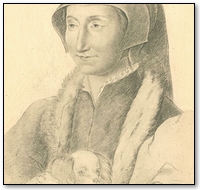
This is the Heptameron of Marguerite de Navarre
Other Sites: CruikshankArt.com · Dante's Inferno · Book-Lover.com · Canterbury Tales ·
This site is created by the Heptameron Information Society.