
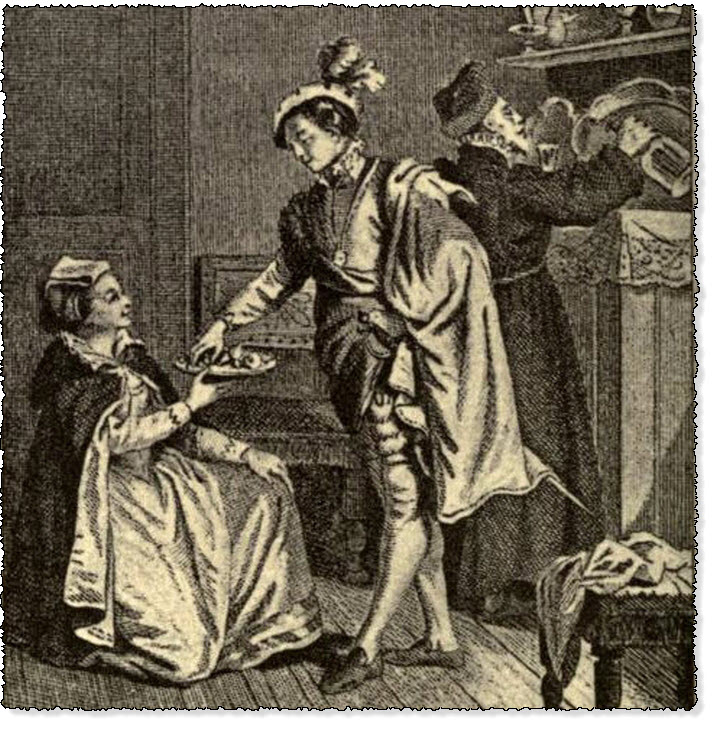
the Advocate's Wife Attending on The Prince
The Heptameron - Day 3, Tale 25 - the Advocate's Wife Attending on The Prince
TALE XXV.
A young Prince, whilst pretending to visit his lawyer and talk with him of his affairs, conversed so freely with the lawyer's wife, that he obtained from her what he desired.
In the city of Paris there dwelt an advocate who was more highly thought of than any other of his condition, (1) and who, being sought after by every one on account of his excellent parts, had become the richest of all those who wore the gown.
1 In five of the oldest MSS. of the Heptameron, and in the original editions of 1558, 1559, and 1560, the words are "than nine others of his condition." The explanation of this is, that the advocate's name, as ascertained by Baron Jerome Pichon, was Disome, which, written Dix-hommes, would literally mean "ten men." Baron Pichon has largely elucidated this story, and the essential points of his notice, contributed to the Mélanges de la Société des Bibliophiles Français, will be found summarized in the Appendix to this volume, B.—Ed.
Now, although he had had no children by his first wife, he was in hopes of having some by a second; for, although his body was no longer hearty, his heart and hopes were as much alive as ever. Accordingly, he made choice of one of the fairest maidens in the city; she was between eighteen and nineteen years of age, very handsome both in features and complexion, and still more handsome in figure. He loved her and treated her as well as could be; but he had no children by her any more than by his first wife, and this at last made her unhappy. And as youth cannot endure grief, she sought diversion away from home, and betook herself to dances and feasts; yet she did this in so seemly a fashion that her husband could not take it ill, for she was always in the company of women in whom he had trust.
One day, when she was at a wedding, there was also present a Prince of very high degree, who, when telling me the story, forbade me to discover his name. I may, however, tell you that he was the handsomest and most graceful Prince that has ever been or, in my opinion, ever will be in this realm. (2)
2 Francis L, prior to his accession.—Ed.
The Prince, seeing this fair and youthful lady whose eyes and countenance invited him to love her, came and spoke to her with such eloquence and grace that she was well pleased with his discourse.
Nor did she seek to hide from him that she had long had in her heart the love for which he prayed, but entreated that he would spare all pains to persuade her to a thing to which love, at first sight, had brought her to consent. Having, by the artlessness of love, so promptly gained what was well worth the pains of being won by time, the young Prince thanked God for His favour, and forthwith contrived matters so well that they agreed together in devising a means for seeing each other in private.
The young Prince failed not to appear at the time and place that had been agreed upon, and, that he might not injure his lady's honour, he went in disguise. On account, however, of the evil fellows (3) who were wont to prowl at night through the city, and to whom he cared not to make himself known, he took with him certain gentlemen in whom he trusted.
3 The French expression here is mauvais garsons, a name generally given to foot-pads at that time, but applied more particularly to a large band of brigands who, in the confusion prevailing during Francis I.'s captivity in Spain, began to infest the woods and forests around Paris, whence at night-time they descended upon the city. Several engagements were fought between them and the troops of the Queen-Regent, and although their leader, called King Guillot, was captured and hanged, the remnants of the band continued their depredations for several years.—B. J.
And on entering the street in which the lady lived, he parted from them, saying—
"If you hear no noise within a quarter of an hour, go home again, and come back here for me at about three or four o'clock."
They did as they were commanded, and, hearing no noise, withdrew.
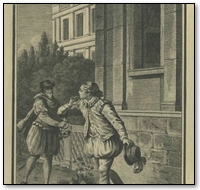
The young Prince went straight to his advocate's house, where he found the door open as had been promised him. But as he was ascending the staircase he met the husband, carrying a candle in his hand, and was perceived by him before he was aware. However Love, who provides wit and boldness to contend with the difficulties that he creates, prompted the young Prince to go straight up to him and say—
"Master advocate, you know the trust which I and all belonging to my house have ever put in you, and how I reckon you among my best and truest servants. I have now thought it well to visit you here in private, both to commend my affairs to you, and also to beg you to give me something to drink, for I am in great thirst. And, I pray you, tell none that I have come here, for from this place I must go to another where I would not be known."
The worthy advocate was well pleased at the honour which the Prince paid him in coming thus privately to his house, and, leading him to his own room, he bade his wife prepare a collation of the best fruits and confections that she had.
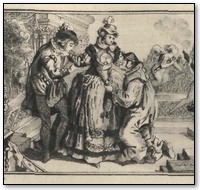
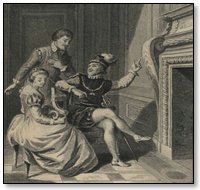
Although the garments she wore, a kerchief and mantle, made her appear more beautiful than ever, the young Prince affected not to look at her or notice her, but spoke unceasingly to her husband about his affairs, as to one who had long had them in his hands. And, whilst the lady was kneeling with the confections before the Prince, and her husband was gone to the sideboard in order to serve him with drink, she told him that on leaving the room he must not fail to enter a closet which he would find on the right hand, and whither she would very soon come to see him.
As soon as he had drunk, he thanked the advocate, who was all eagerness to attend him; but the Prince assured him that in the place whither he was going he had no need of attendance, and thereupon turning to the wife, he said—
"Moreover, I will not do so ill as to deprive you of your excellent husband, who is also an old servant of mine. Well may you render thanks to God since you are so fortunate as to have such a husband, well may you render him service and obedience. If you did otherwise, you would be blameworthy indeed."
With these virtuous words the young Prince went away, and, closing the door behind him so that he might not be followed to the staircase, he entered the closet, whither also came the fair lady as soon as her husband had fallen asleep.
Thence she led the Prince into a cabinet as choicely furnished as might be, though in truth there were no fairer figures in it than he and she, no matter what garments they may have been pleased to wear. And here, I doubt not, she kept word with him as to all that she had promised.
He departed thence at the hour which he had appointed with his gentlemen, and found them at the spot where he had aforetime bidden them wait.
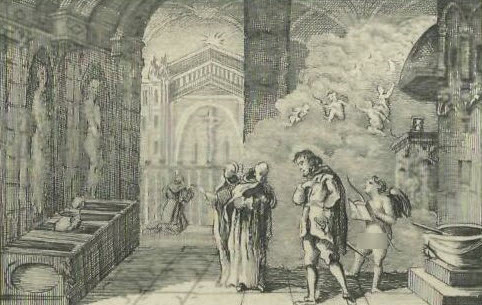
As this intercourse lasted a fairly long time, the young Prince chose a shorter way to the advocate's house, and this led him through a monastery of monks. (4) And so well did he contrive matters with the Prior, that the porter used always to open the gate for him about midnight, and do the like also when he returned. And, as the house which he visited was hard by, he used to take nobody with him.
4 If at this period Jane Disome, the heroine of the story, lived in the Rue de la Pauheminerie, where she is known to have died some years afterwards, this monastery, in Baron Jerome Pichon's opinion, would be the Blancs-Manteaux, in the Marais district of Paris. We may further point out that in the Rue Barbette, near by, there was till modern times a house traditionally known as the "hôtel de la belle Féronnière." That many writers have confused the heroine of this tale with La Belle Féronnière (so called because her husband was a certain Le Féron, an advocate) seems manifest; the intrigue in which the former took part was doubtless ascribed in error to the latter, and the proximity of their abodes may have led to the mistake. It should be pointed out, however, that the amour here recorded by Queen Margaret took place in or about the year 1515, before Francis I. ascended the throne, whereas La Féronnière was in all her beauty between 1530 and 1540. The tradition that the King had an intrigue with La Féronnière reposes on the flimsiest evidence (see Appendix B), and the supposition, re-echoed by the Bibliophile Jacob, that it was carried on in the Rue de l'Hirondelle, is entirely erroneous. The house, adorned with the salamander device and corneted initials of Francis I., which formerly extended from that street to the Rue Git-le- Coeur, never had any connection with La Féronnière. It was the famous so-called Palace of Love which the King built for his acknowledged mistress, Anne de Pisseleu, Duchess of Étampes.—Ed.
Although he led the life that I have described, he was nevertheless a Prince that feared and loved God, and although he made no pause when going, he never failed on his return to continue for a long time praying in the church. And the monks, who when going to and fro at the hour of matins used to see him there on his knees, were thereby led to consider him the holiest man alive.
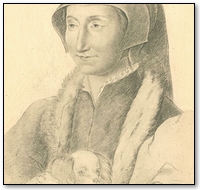
This Prince had a sister (5) who often visited this monastery, and as she loved her brother more than any other living being, she used to commend him to the prayers of all whom she knew to be good.
5 This of course is Queen Margaret, then Duchess of Alençon. On account of her apparent intimacy with the prior, M. de Montaiglon conjectures that the monastery may have been that of St. Martin-in-the-Fields.—See ante, Tale XXII.—Ed.

Heptameron Story 25
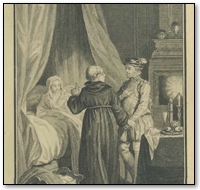
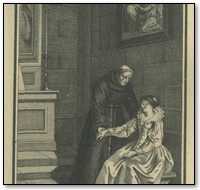
One day, when she was in this manner commending him lovingly to the Prior of the monastery, the Prior said to her—
"Ah, madam, whom are you thus commending to me? You are speaking to me of a man in whose prayers, above those of all others, I would myself fain be remembered. For if he be not a holy man and a just"—here he quoted the passage which says, "Blessed is he that can do evil and doeth it not"—"I cannot hope to be held for such."
The sister, wishing to learn what knowledge this worthy father could have of her brother's goodness, questioned him so pressingly that he at last told her the secret under the seal of the confessional, saying—
"Is it not an admirable thing to see a young and handsome Prince forsake pleasure and repose in order to come so often to hear our matins? Nor comes he like a Prince seeking honour of men, but quite alone, like a simple monk, and hides himself in one of our chapels. Truly such piety so shames both the monks and me, that we do not deem ourselves worthy of being called men of religion in comparison with him."
When the sister heard these words she was at a loss what to think. She knew that, although her brother was worldly enough, he had a tender conscience, as well as great faith and love towards God; but she had never suspected him of a leaning towards any superstitions or rites save such as a good Christian should observe. (6) She therefore went to him and told him the good opinion that the monks had of him, whereat he could not hold from laughing, and in such a manner that she, knowing him as she did her own heart, perceived that there was something hidden beneath his devotion; whereupon she rested not until she had made him tell her the truth.
6 In Boaistuau's edition this sentence ends, "But she had never suspected him of going to church at such an hour as this."—L.
And she has made me here set it down in writing, for the purpose, ladies, of showing you that there is no lawyer so crafty and no monk so shrewd, but love, in case of need, gives the power of tricking them both, to those whose sole experience is in truly loving. And since love can thus deceive the deceivers, well may we, who are simple and ignorant folk, stand in awe of him.
"Although," said Geburon, "I can pretty well guess who the young Prince is, I must say that in this matter he was worthy of praise. We meet with few great lords who reck aught of a woman's honour or a public scandal, if only they have their pleasure; nay, they are often well pleased to have men believe something that is even worse than the truth."
"Truly," said Oisille, "I could wish that all young lords would follow his example, for the scandal is often worse than the sin."
"Of course," said Nomerfide, "the prayers he offered up at the monastery through which he passed were sincere."
"That is not a matter for you to judge," said Parlamente, "for perhaps his repentance on his return was great enough to procure him the pardon of his sin."
"'Tis a hard matter," said Hircan, "to repent of an offence so pleasing. For my own part I have many a time confessed such a one, but seldom have I repented of it."
"It would be better," said Oisille, "not to confess at all, if one do not sincerely repent."
"Well, madam," said Hircan, "sin sorely displeases me, and I am grieved to offend God, but, for all that, such sin is ever a pleasure to me."
"You and those like you," said Parlamente, "would fain have neither God nor law other than your own desires might set up."
"I will own to you," said Hircan, "that I would gladly have God take as deep a pleasure in my pleasures as I do myself, for I should then often give Him occasion to rejoice."
"However, you cannot set up a new God," said Geburon, "and so we must e'en obey the one we have. Let us therefore leave such disputes to theologians, and allow Longarine to give some one her vote."
"I give it," she said, "to Saffredent, but I will beg him to tell us the finest tale he can think of, and not to be so intent on speaking evil of women as to hide the truth when there is something good of them to relate."
"In sooth," said Saffredent, "I consent, for I have here in hand the story of a wanton woman and a discreet one, and you shall take example by her who pleases you best. You will see that just as love leads wicked people to do wicked things, so does it lead a virtuous heart to do things that are worthy of praise; for love in itself is good, although the evil that is in those that are subject to it often makes it take a new title, such as wanton, light, cruel or vile. However, you will see from the tale that I am now about to relate that love does not change the heart, but discovers it to be what it really is, wanton in the wanton and discreet in the discreet."
Online Edition of the Heptameron

This is the Heptameron of Marguerite de Navarre
Other Sites: CruikshankArt.com · Dante's Inferno · Book-Lover.com · Canterbury Tales ·
This site is created by the Heptameron Information Society.