
Tale 72 told on Day Eighth of the Heptameron
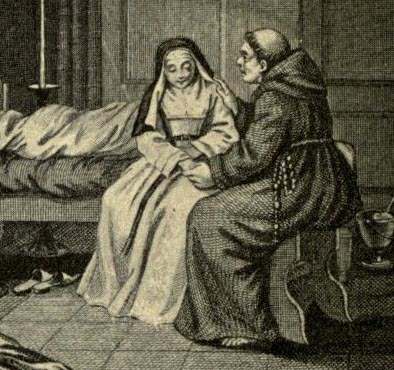
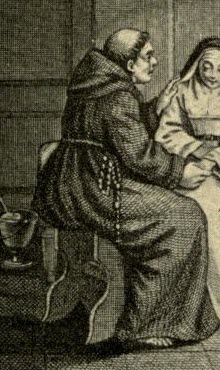
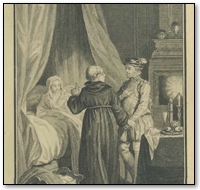
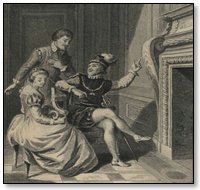
The Monk Conversing With The Nun
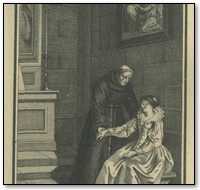
The Monk Conversing With The Nun While Shrouding A Dead Body
Summary of the Second Tale Told on the Eighth of the Heptameron
Tale 72 told on Day Eighth of the Heptameron
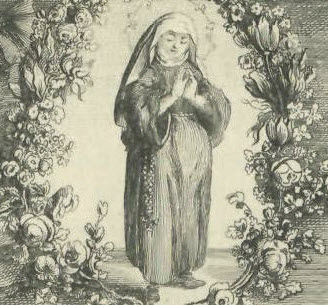
In one of the finest towns of France after Paris there stood an hospital (2) richly endowed—namely, with a Prioress and fifteen or sixteen nuns, while in another building there was a Prior and seven or eight monks. Every day the monks said mass, but the nuns only their paternosters and the Hours of Our Lady, for they were occupied in tending the sick.
One day it chanced that a poor man died, and the nuns, being all assembled with him, after giving him every remedy for his health, sent for one of their monks to confess him. Then, finding that he was growing weaker, they gave him the extreme unction, after which he little by little lost the power of speech.
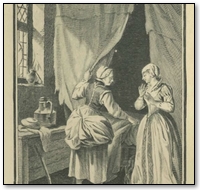
But as he was a long time in passing away, and it seemed that he could still hear, the nuns continued speaking to him with the most comforting words they knew, until at last they grew weary, and, finding that night was come and that it was late, retired one after another to rest. Thus, to shroud the body, there remained only one of the youngest of the nuns, with a monk whom she feared more than the Prior or any other, by reason of the severity that he displayed in both speech and life.
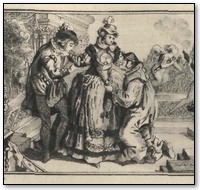
When they had duly uttered their Hours in the poor man's ear, they perceived that he was dead, and thereupon laid him out. Whilst engaged on this last deed of charity, the monk began to speak of the wretchedness of life, and the blessedness of death; and in such discourse they continued until after midnight.
The poor girl listened attentively to the monk's pious utterances, looking at him the while with tears in her eyes; and so pleasing were these to him that, whilst speaking of the life to come, he began to embrace her as though he longed to bear her away in his arms to Paradise.
The poor girl, listening to his discourse and deeming him the most pious of the community, ventured not to say him nay.
Perceiving this, the wicked monk, whilst still speaking of God, accomplished with her the work which the devil suddenly put into their hearts—for before there had been no question of such a thing. He assured her, however, that secret sin was not imputed to men by God, and that two persons who had no ties, could do no wrong in this manner, when no scandal came of it; and, to avoid all scandal, he told her to be careful to confess to none but himself.
So they parted each from the other, she going first. And as she passed through a chapel dedicated to Our Lady, she was minded to make her prayer as was her wont. But when she began with the words, "Mary, Virgin," she remembered that she had lost the title of virginity not through force or love, but through foolish fear; and she began to weep so bitterly that it seemed as if her heart must break.
The monk, hearing the sighing from a distance, suspected her repentance, which might make him lose his delight, and to prevent this, he came and, finding her prostrate before the image, began to rebuke her harshly, telling her that if she had any scruples of conscience she should confess herself to him, and that she need not so act again unless she desired; for she might behave in either way without sin. The foolish nun, thinking to make atonement to God, confessed herself to the monk; but in respect of penance he swore to her that she did no sin in loving him, and that holy water would suffice to wash away such a peccadillo.
Believing in him more than in God, she again some time afterwards yielded to him, and so became big with child. At this she was in deep grief, and entreated the Prioress to have the monk turned away from his monastery, saying that she knew him to be so crafty that he would not fail to seduce her. The Abbess and the Prior, who understood each other, laughed at her, saying that she was big enough to defend herself against a man, and that the monk she spoke of was too virtuous to do such a deed.
At last, urged by the prickings of her conscience, she craved license to go to Rome, for she thought that, by confessing her sin at the Pope's feet, she might recover her virginity. This the Prior and Prioress very readily granted her, for they were more willing that she should become a pilgrim contrary to the rules of her order, than be shut up in the convent with her present scruples. They feared also that in her despair she might denounce the life that was led among them, and so gave her money for her journey.
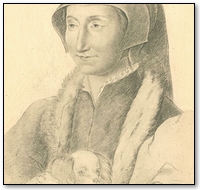
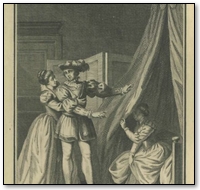
But God brought it to pass that when she came to Lyons, my lady the Duchess of Alençon, afterwards Queen of Navarre, being one evening after vespers in the roodloft of the church of St. John, whither she came secretly to perform a novena with three or four of her women, (2) heard someone mounting the stairway whilst she was kneeling before the crucifix. By the light of the lamp she saw it was a nun, and in order that she might hear her devotions, the Duchess thereupon withdrew to the corner of the altar. The nun, who believed herself to be alone, knelt down and, beating her breast, began weeping so sorrowfully that it was piteous to hear her; and all the while she cried naught but this—"Alas! my God, take pity on this poor sinner."
The Duchess, wishing to learn what it meant, went up to her and said, "Dear heart, what ails you, and whence do you come, and what brings you to this place?"
The poor nun, who did not know her, replied, "Ah, sweet, my woe is such that I have no help but in God; and I pray that He may bring me to speak with the Duchess of Alençon. To her alone will I tell the matter, for I am sure that, if it be possible, she will set it right."
"Dear heart," then said the Duchess, "you may speak to me as you would to her, for I am one of her nearest friends."
"Forgive me," said the nun; "she alone must know my secret."
Then the Duchess told her that she might speak freely, since she had indeed found her whom she sought. Forthwith the poor woman threw herself at her feet, and, after she had wept, related what you have heard concerning her hapless fortune. The Duchess consoled her so well, that whilst she took not from her everlasting repentance for her sin, she put from her mind the journeying to Rome, and then sent her back to her priory with letters to the Bishop of the place to have that shameful monk turned away.
"I have this story from the Duchess herself, and from it you may see, ladies, that Nomerfide's prescription is not good for all, since these persons fell into lewdness even while touching and laying out the dead."
"'Twas a device," said Hircan, "that methinks no man ever used before, to talk of death and engage in the deeds of life."
"'Tis no deed of life," said Oisille, "to sin, for it is well known that sin begets death."
"You may be sure," said Saffredent, "that these poor folk gave no thought to any such theology; but just as the daughters of Lot made their father drunk so that the human race might be preserved, so these persons wished to repair what death had spoiled, and to replace the dead body by a new one. I therefore can see no harm in the matter except the tears of the poor nun, who was always weeping and always returning to the cause of her tears."
"I have known many of the same kind," said Hircan, "who wept for their sins and laughed at their pleasures both together."
"I think I know whom you mean," said Parlamente, "and their laughter has lasted so great a while that 'twere time the tears should begin."
"Hush!" said Hircan. "The tragedy that has begun with laughter is not ended yet."
"To change the subject," said Parlamente, "it seems to me that Dagoucin departed from our purpose. We were to tell only merry tales, and his was very piteous."
"You said," replied Dagoucin, "that you would only tell of follies, and I think that herein I have not been lacking. But, that we may hear a more pleasant story, I give my vote to Nomerfide, in the hope that she will make amends for my error."
"I have indeed," she answered, "a story ready which is worthy to follow yours; for it speaks of monks and death. So I pray you give good heed."
Footnotes:
- Gruget first printed this tale, which was not given by Boaistuau.—L.
- It is impossible to say what town and hospital Margaret here refers to. Lyons is the scene of the latter part of the story; and we are inclined to think that the earlier incidents may have occurred at Dijon, where there was a famous hospital under ecclesiastical management, founded by Eudes III., seventh Duke of Burgundy.—L. and Ed.
- See ante, Tale LXV., note i.
Here end the Tales and Novels of the late Queen of Navarre, that is, all that can be recovered of them.
Online Edition of the Heptameron
This is the Heptameron of Marguerite de Navarre
Other Sites: CruikshankArt.com · Dante's Inferno · Book-Lover.com · Canterbury Tales ·
This site is created by the Heptameron Information Society.