
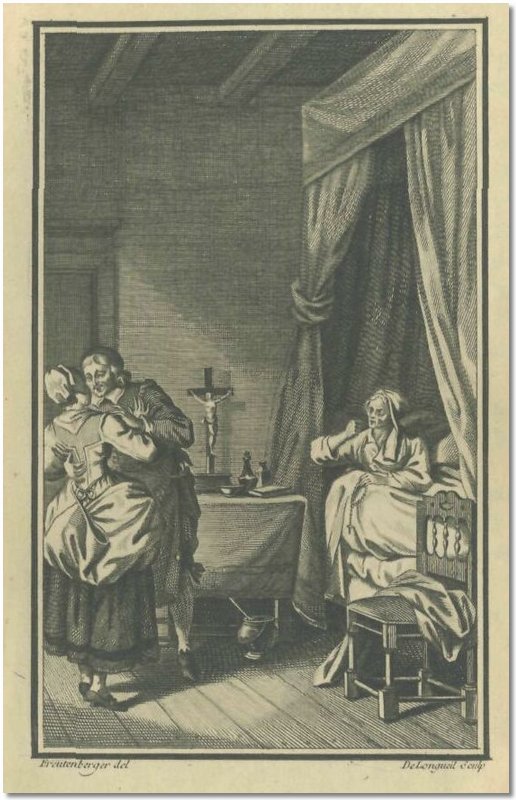
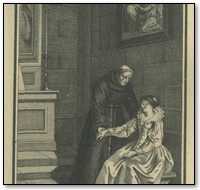
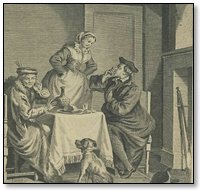
The Saddler's Wife Cured by The Sight of Her Husband Caressing the Serving-maid
The Saddler's Wife Cured by The Sight of Her Husband Caressing the Serving-maid
Summary of the 1st Tale Told on the Eighth of the Heptameron
DAY 8 - TALE LXXI
Tale 72 of the Heptameron
In the town of Amboise there lived one Brimbaudier, ([1]) saddler to the Queen of Navarre, and a man whose colour of feature showed him to be by nature rather a servant of Bacchus than a priest of Diana. He had married a virtuous woman who controlled his household very discreetly, and with whom he was well content.
One day it was told him that his good wife was sick and in great danger, at which tidings he was in the greatest trouble imaginable. He went with all speed to her aid, and found her so low, poor woman, that she had more need of a confessor than a doctor. Thereupon he made the most pitiful lamentation that could be, but to represent it well 'twere needful to speak thickly as he did, (2) and better still to paint one's face like his.
When he had done all that he could for her, she asked for the cross, and it was brought. On seeing this, the good man flung himself upon a bed in despair, crying and saying in his thick speech—
"Ah God! I am losing my poor wife! What shall I do, unhappy man that I am?"
After uttering many such complaints, he perceived that there was no one in the room but a young servant-maid, passably fair and buxom, and he called to her in a whisper.
"Sweetheart," he said, "I am dying. I am more than dead to see your mistress dying in this manner. I know not what to do or say, except that I commend myself to you, and beg you to care for my house and my children. Take therefore the keys from my side, and order the household, for I myself can attend to nothing more."
The poor girl had pity on him and comforted him, begging him not to despair, so that, if she must lose her mistress, she might not also lose her good master.
"Sweetheart," he replied, "'tis all of no avail, for I am indeed dying. See yourself how cold my face is; bring your cheeks close to mine and warm them."
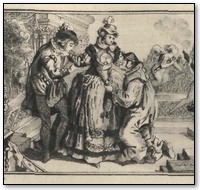
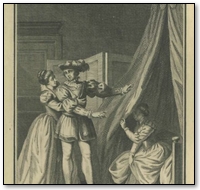
With this he laid his hand upon her breast. She tried to make some difficulty, but he begged her to have no fear, since they must indeed see each other more closely. And speaking in this wise, he took her in his arms and threw her upon the bed.
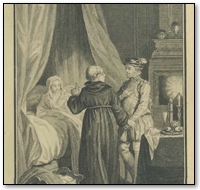
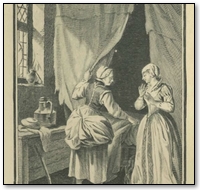
Then his wife, whose only company was the cross and the holy water, and who had not spoken for two days, began to cry out as loudly as her feeble voice enabled her—
"Ah! ah! ah! I am not dead yet!" And threatening them with her hand, she repeated—"Villain! monster! I am not dead yet!"
On hearing her voice, the husband and maid rose up, but she was in such a rage against them that her anger consumed the catarrhal humour that had prevented her from speaking, and she poured upon them all the abuse that she could think of. And from that hour she began to mend, though not without often reproaching her husband for the little love he bore her. (3)
"By this you see, ladies, the hypocrisy of men, and how a little consolation will make them forget their sorrow for their wives."
"How do you know," said Hircan, "that he had not heard that such was the best remedy his wife could have? Since his kindly treatment availed not to cure her, he wished to try whether the opposite would prove any better, and the trial was a very fortunate one. But I marvel that you who are a woman should have shown how the constitution of your sex is brought to amendment rather by foul means than by fair."
"Without doubt," said Longarine, "behaviour of that kind would make me rise not merely from my bed, but from a grave such as that yonder."
"And what wrong did he do her," asked Saffre-dent, "by comforting himself when he thought that she was dead? It is known that the marriage-tie lasts only through life, and that when this is ended it is loosed."
"Ay," said Oisille, "loosed from oath and bond, but a good heart is never loosed from love. The husband you have told us of was indeed quick to forget his grief, since he could not wait until his wife had breathed her last."
"What I think strangest of all," said Nomerfide, "is that, when death and the cross were before his eyes, he should not have lost all desire to offend against God."
"A brave argument!" said Simontault. "You would therefore not be surprised to see a man act wantonly provided he were a good distance from the church and cemetery?"
"You may laugh at me as much as you please," said Nomerfide; "nevertheless the contemplation of death must greatly chill a heart, however young it may be."
"I should indeed be of the same opinion as yourself," said Dagoucin, "if I had not heard a Princess say the opposite."
"In other words." said Parlamente, "she told some story about it. If it be so, I will give you my place that you may relate it to us."
Then Dagoucin began as follows:—More ...
Footnotes:
- Boaistuau gives the name as Bruribandier, and Gruget transforms it into Borribaudier. M, Pifteau, after examining the MSS., is doubtful whether Brimbaudier is the correct reading. Bromardier, which in old French meant a tippler (Ducange, Briemardum), would have been an appropriate name for the individual referred to.—Ed.
- Curiously enough, the transcriber of MS. No. 1520 attempts to give some idea of the husband's pronunciation by transforming all his r's into l's. Here is an example: "Je pelz ma povle femme, que fesai-ze, moi malhureux?... M'amie je me meuls, je suis pis que tlepassé... je ne sçai que faize," &c.—L.
- This story was imitated by Noël du Fail de La Hérissaye in his Contes d'Eutrapel (ch. v. De la Goutte), where the hero of the incident is called Glaume Esnaut de Tremeril. "It is said," writes Du Fail, "that the wife of that rascal Glaume of Tremeril when at the point of death, on seeing Glaume too familiar with her serving-woman, recovered her senses, saying, 'Ah! wicked man, I am not yet so low as you thought. By God's grace, mistress baggage, you shall go forth at once.'" Curiously enough, the 1585 edition of the Contes d'Eutrapel was printed at Rennes for Noël Glame, virtually the same name as Glaume.—M.
Online Edition of the Heptameron
This is the Heptameron of Marguerite de Navarre
Other Sites: CruikshankArt.com · Dante's Inferno · Book-Lover.com · Canterbury Tales ·
This site is created by the Heptameron Information Society.